February 20, 2011 | Read Time: 7 minutes
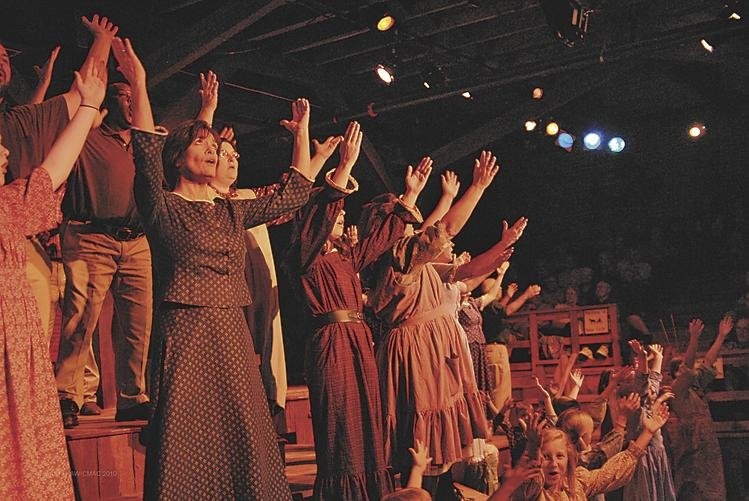
When the lights go down, actors of all ages stream into the theater. Their costumes are old-fashioned, but the time period is indistinct. Women and girls wear cotton dresses, while overalls and suspenders are popular among the men. Cast members spread out on small, rough-hewn stages to sing the song that opens every performance.
Oh you’ve got a story
And I’ve got a story
We’ve all got a story to tell
And for the next two hours, the cast of 65 volunteers does just that, performing “Swamp Gravy,” a collection of vignettes drawn from the reminiscences of local residents.
In a very real way, these stories saved Colquitt from economic ruin.
Since “Swamp Gravy” started nearly two decades ago, the production—scheduled to be staged again next month—has grown into a financial engine that draws more than 40,000 visitors annually to this small town in rural southwestern Georgia, which has a population of 2,000. At least $2-million flows to the county in economic benefits each year, according to a
study by the Center for Creative Community Development, at Williams College.
The arts council that sparked the town’s revival has also dedicated itself to helping other communities learn from its experience. The group has worked with leaders from small towns throughout the United States and as far away as Brazil and Kenya, and its annual Building Creative Communities conference brings local leaders and students to Colquitt to see the work firsthand.
Town Spirit Revival
Twenty years ago, Colquitt was struggling to survive. Like many rural hamlets in the South, the town had long been losing residents and businesses as small family farms gave way to mechanized agriculture, which required fewer workers.
And the people who remained were demoralized.
“Our town had a poverty of spirit, and I think that’s the worst poverty of all,” says Karen S. Kimbrel, who served as executive director of the Colquitt Miller Arts Council for 12 years. The small group of residents that joined together to start the arts council thought a history play might be one way to revive the town’s spirit, but they weren’t sure how to proceed.
Then, at a conference in New York, one of the residents, Joy Jinks, happened to meet Richard Geer, a young director who dreamed of creating theater that grew out of the everyday experiences of community members. The fledgling arts council won a grant from the Georgia Humanities Council to learn how to collect oral histories, and “Swamp Gravy” was born.
For the last 19 years, the council has worked with professional playwrights and directors to create a new production every year. But volunteers gather the oral histories, write the songs, create the costumes, sell concessions, and perform.
The production shares its name with a traditional Southern dish made from the drippings left over after frying fish, potatoes, onions, and whatever else the cook has on hand. “Swamp Gravy,” the play, is a gumbo of emotions.
Some of the stories are funny, like the cunning service-station owner who happily pumps gas for the customer who never pays his tab but “repossesses” the man’s carburetor for nonpayment. Others are painful. An African-American character recounts the time his father was chased off the town square, which was then considered the white part of town, after buying presents for his children.
“We talk about a way of life that makes people reflect on their own lives,” says Don Chandler, a longtime performer who is now president of the arts council’s board of directors.
He thinks about the play as a calling. “If you can’t be here and be moved by a power stronger than ‘Swamp Gravy,’ then you weren’t paying attention.”
As the performances’ popularity grew, the arts council—and later other groups—took on additional community-improvement projects. The council converted an old cotton warehouse into a theater and renovated a dilapidated inn on the town square. Vivid murals throughout the town illustrate stories collected for “Swamp Gravy.”
Some of the same people who formed the arts council created a nonprofit community-development corporation, which has built 32 units of low-cost housing and runs a business incubator and revolving loan fund. And the Downtown Development Authority created by the town of Colquitt is now working to turn a movie theater that has sat vacant since the early 1960s into a conference center and performance space.
“You don’t usually find that breadth of activity unless you’re in a town of 100,000 people,” says Tim Chapin, chairman of the Department of Urban and Regional Planning at Florida State University, in Tallahassee. “The density of community development that they’re doing is remarkable, just off-the-charts remarkable.”
Bustling Town Square
The economic impact isn’t lost on local residents.
“‘Swamp Gravy’ dug us out of a hole,” says Jewella Lovering, a Colquitt native, as she minds the register at Dee’s, a housewares store. “We were dying.”
Tammy Pickle Phillips, who stopped by the store one recent day, says that almost every storefront on Colquitt’s town square—the four blocks that surround the courthouse—is occupied. In nearby towns the size of Colquitt, she notes, downtown buildings sit empty.
Ms. Phillips was raised in Colquitt, and her family has deep roots in the area. She lived away for more than 20 years, but last January she returned and opened an accounting and tax-preparation business on the square.
“Everybody is proud of ‘Swamp Gravy,’” says Eric Lovering, Jewella’s 19-year-old grandson. He says that he usually sees the show several times a year. Sometimes, when he attends with his family, one of his grandparents will lean over and whisper whose story is being portrayed or what he or she remembers about the event.
Creating a sense of place and shared purpose has been a key part of the show’s success, says Susan S. Weiner, executive director of the Georgia Council for the Arts, which has provided financial support to the arts council since it got started.
Ms. Weiner remembers giving a speech at a conference for high-school theater groups. After the talk, a young man with “vibrant red hair and freckles that just went from ear to ear” introduced himself.
“He didn’t say he was from Colquitt,” she says. “He didn’t say he was from Miller County. He said, ‘I’m from the home of “Swamp Gravy.”’ That’s what you call building a sense of community.”
The bonds that cast members have formed have made a real difference in race relations in Colquitt, says Mr. Chandler. “In the early ’90s, when this project started, to see me, a white man, hugging a black woman was strange,” he says. “People turned their nose up and looked funny at me. We had to work through those racial barriers.”
‘The Divide Is Still Great’
But even with that progress, “Swamp Gravy” hasn’t been a panacea. African-American participation has been dropping, and this year’s cast of 65 people includes only six black members.
Gayle Grimsley, who is black, has been a participant since the beginning and is enthusiastic in her support of the production. She clearly loves her fellow cast members, but she is troubled that so few African-Americans are taking part. A big reason, she says, is that too few stories from black residents were included in the current play. The other hurdle, especially during the economic downturn, is the time commitment—two months of performances and at least two more months of rehearsals.
“You can come in here at 6 p.m. and not leave out until 10 p.m.,” she says. People who are struggling, working two and three minimum-wage jobs, can’t afford to volunteer that much time, says Ms. Grimsley.
Everyone would like to have more black participants, says Mrs. Jinks, who is white. She says that she and her fellow organizers are tapping their personal networks to try to increase recruitment. Bridging the barriers that divide residents—especially race—is a continuing process, she says. “But the divide is still great.”
Signs of Pride
The mark that the arts council has made on Colquitt is perhaps most visible in the 15 murals that dot the town. The most recent one is an arresting sight, with its brilliant blue sky and heroic depiction of a peanut farmer painted around a towering 95-foot-tall silo. The man’s face is furrowed from years of hard work, but his pride is unmistakable.
Mrs. Jinks says that when she looks back at what “Swamp Gravy” has achieved, it is the change in how residents feel about themselves and their heritage that matters most to her.
She says, with laughter in her voice, “There’s nothing like having tour buses come from all over to see our town to really build community pride.”