
After Deficit Fight, Charities Face Even Deeper Cuts

By SUZANNE PERRY
Contributor
August 21, 2011 | Read Time: 6 minutes
Washington
United Way Worldwide this month started reaching out to its local affiliates with an urgent message: The news from Capitol Hill is grim, and they should help nonprofits in their regions brace for a possibly unprecedented budgetary fallout.
Like many charities, United Way is trying to prepare for what will happen when Congress returns from its summer recess and starts leveling the spending cuts that are required under a debt-reduction deal that was finalized this month to prevent the government from defaulting.
“Our sense is that a lot of small nonprofit agencies in communities across the country don’t understand how dire the situation is,” says Steve Taylor, United Way’s counsel for public policy.
On average, the charities that United Way works with nationwide get 40 percent of their revenue from federal, state, and local governments—and he wants them to know that next year’s federal budget could include “pretty dramatic cuts” to social services. He also wants them to tell lawmakers how that will affect educational, emergency food and shelter, and other programs in their communities.
Bitter Divisions
The debt agreement, signed into law by President Obama, calls for federal-deficit cuts of more than $2-trillion over 10 years. However, it does not spell out exactly where those savings should come from. So nonprofits will have to watch for months, if not years, to figure out if they or the people they serve will be victims of the budget scalpel.
Bitterly divided lawmakers must now decide how much of the savings will come from social programs, how much from tax increases, and how much from Medicaid and other entitlement programs.
“We’re going to see an environment I don’t think we’ve seen before,” says Perry Wasserman, a lobbyist for nonprofits. “Everything’s on the table.”
Nonprofit advocates who worked overtime during the combative 2011 budget negotiations, which almost shut the government down, are now gearing up for further battle.
Many have been making their cases to members of Congress while lawmakers are in their home districts this month. For example, national-service advocates made more than 2,000 visits to Congressional offices across the country on August 10 to tell lawmakers they should spare programs like AmeriCorps from deep cuts because they create jobs and help vulnerable people at a time when local governments are hurting for cash.
But even grizzled veterans of previous budget battles have seen nothing like the scenario that is about to unfold after Labor Day. The debt agreement places annual limits on spending that will provide $917-billion in savings through the 2021 fiscal year. The first deadline is October 1, when Congress is supposed to have a 2012 spending plan in place.
Some analysts fear that partisan hostilities are so high that the negotiations could lead to threats of another government shutdown, or at least a shutdown of individual agencies that get trapped by Congressional disagreement.
The debt deal also sets up an entirely new player: a 12-member bipartisan “super committee” that must suggest at least $1.2-trillion in additional deficit-cutting measures over the next decade.
The committee, with six members each from the House of Representatives and the Senate, must produce a plan before Thanksgiving, and Congress must approve it by December 23. Otherwise, automatic across-the-board spending cuts will take effect starting in January 2013.
Tax-Deduction Worries
In addition to worrying about spending cuts, some nonprofit leaders fear that future budget negotiations will revive proposals to limit the value of the charitable deduction. Because of Republican opposition, the debt agreement included no tax measures in the $917-billion in initial cuts. However, President Obama and many Democrats want the deficit-reduction committee to include them in its plan—and that could put the deduction into play.
“We’re working under the premise that we still have our work cut out for us,” says Jason Lee, a lawyer for the Association of Fundraising Professionals, a trade group that argues that reducing the tax break would dampen giving.
President Obama several times has proposed limiting the value of the deduction for wealthy donors. In July, an influential bipartisan group of senators called for a “reform” of the deduction along with other changes in the tax code.
While it gave no details, it said its overall plan was consistent with recommendations made last year by President Obama’s deficit-reduction panel, which suggested replacing the charitable deduction with a 12-percent tax credit and making it available only for amounts spent beyond 2 percent of a taxpayer’s adjusted gross income.
A discussion of taxes could also unearth other proposals that would affect nonprofits, says Mr. Wasserman, noting that Sen. Charles E. Grassley, a Republican lawmaker from Iowa, has raised questions about whether nonprofit hospitals and universities should earn their tax-exempt status by doing more for low-income people.
Burden on the Poor
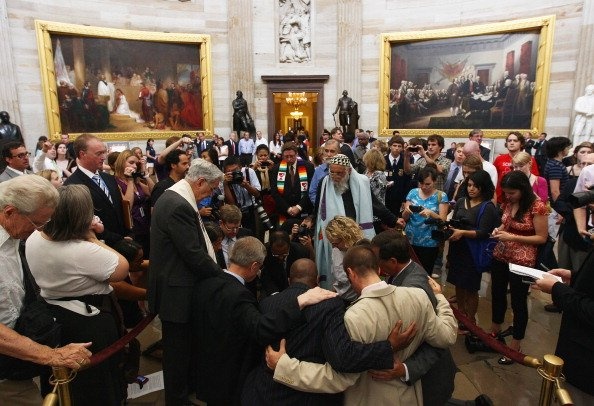
While plotting their strategies for what promises to be an eventful fall, some nonprofit leaders are also fleshing out longer-range plans for influencing the budget debate. Martin Shupack, director of advocacy at Church World Service, a global antipoverty group, was among almost a dozen religious leaders who were arrested last month while praying in the Capitol Rotunda.
He planned that move as part of an 18-month interfaith campaign the group started this summer to persuade Congress to exempt programs that help needy people from budget cuts.
“We don’t know in detail how the cuts are going to be implemented,” he says. But the magnitude of the planned cuts and the vow by Republicans not to raise taxes “causes us great concern that the burden is going to disproportionately fall on impoverished people in the U.S. and abroad.”
Programs for low-income people like Medicaid and food stamps, along with other entitlement programs—that is, those that must serve everyone who qualifies for help—were spared in the first round of budget cuts outlined by the debt agreement, but they are likely to be part of the mix in future proposals.
Conservatives who believe the government must make drastic spending cuts to restore its fiscal health say that is only right. “The Good Samaritan didn’t use a government credit card,” says a recent advertisement in the newspaper Politico placed by the American Enterprise Institute’s Values and Capitalism project in response to the “Circle of Protection” campaign by liberal Christian leaders to protect antipoverty programs from spending cuts. “As our runaway debt hinders economic growth, those most harmed will inevitably be the poor.”
Some charity leaders say nonprofit advocates must get better at explaining why their programs are effective if they hope to fend off drastic cuts.
The National Human Services Assembly, an association of nonprofits, for example, just issued a report instructing human-service groups to change the language they use when approaching policy makers—for example emphasizing that their programs offer a “return on investment,” contribute to “national prosperity and competitiveness,” and provide help now that prevents costly government spending in the future.
Whatever the outcome of the budget deliberations, charities need to start planning for a world with less government money, says Bill Shore, executive director of Share Our Strength, an antihunger charity, who also heads a management-consulting firm.
“It’s bad enough that the nonprofit sector has been AWOL in the national debate about spending priorities,” he wrote in his blog. “But what’s even worse is the failure of most nonprofits to aggressively invest in building their own capacity so that they might have even a chance of meeting the challenges of the future.”
Lisa Chiu and Holly Hall contributed to this article.




