
After Supreme Court Rules, Nonprofits Focus on Making Health-Care Law Work

By SUZANNE PERRY
Contributor
June 28, 2012 | Read Time: 5 minutes
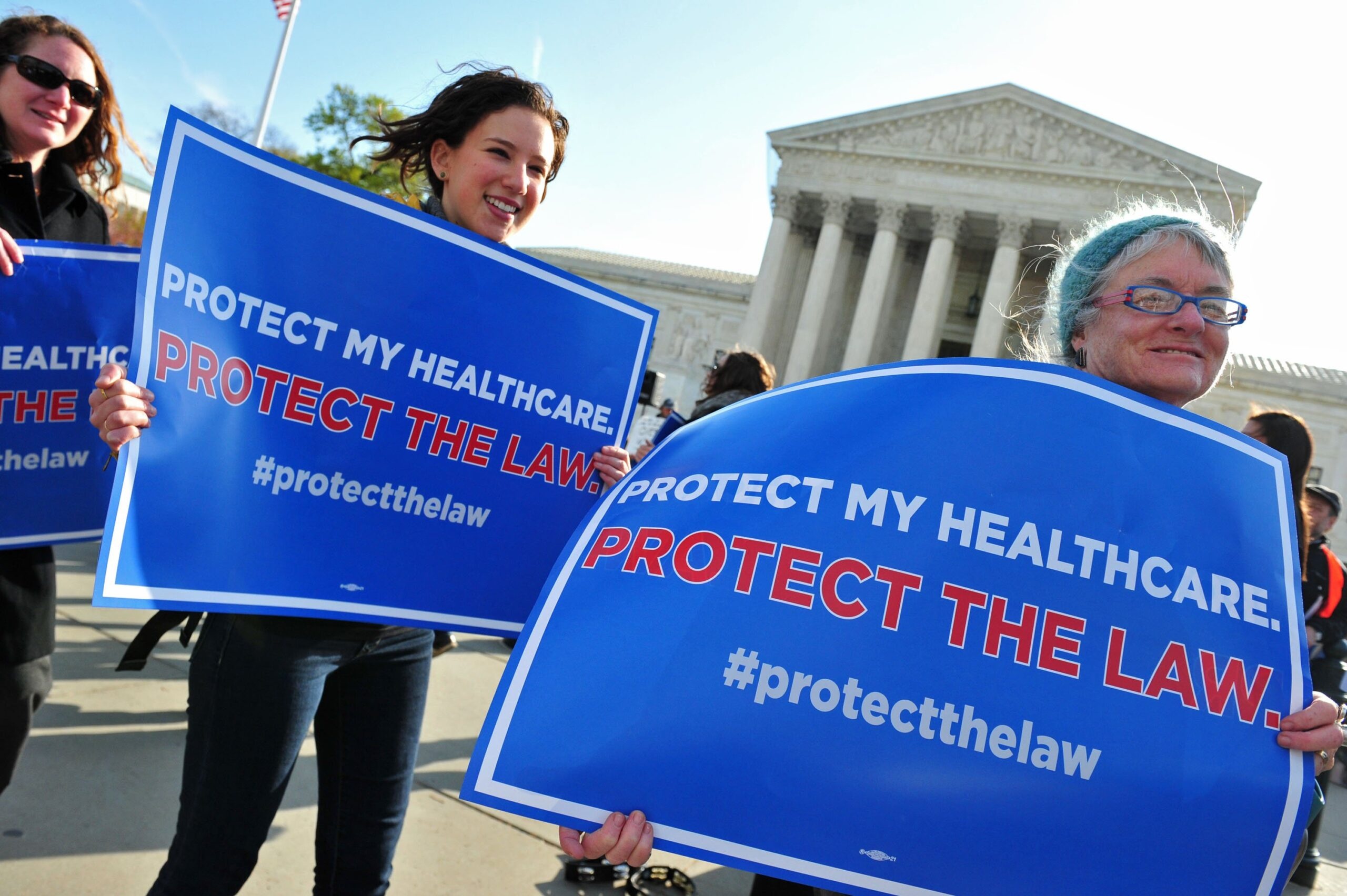
For nonprofit and foundation leaders who have been fighting to protect the new federal health-care law, today’s U.S. Supreme Court decision upholding the measure offered sweet relief.
With the exception of a provision on Medicaid, the 5-to-4 ruling preserves the status quo, removing a cloud of uncertainty that hindered efforts to develop long-term health-care strategies.
“As advocates, we never rest,” said Lara Schwartz, vice president of external affairs at the American Association of People with Disabilities. “But we’re all going to take a deep breath.”
Last winter, Ms. Schwartz’s group joined coalitions that filed two briefs urging the Supreme Court to uphold the health-care law, saying that provisions such as expanding Medicaid and requiring insurance companies to accept patients with preexisting conditions would help people with disabilities.
Today she and her colleagues, like thousands of other people across the country, were glued to their laptops, waiting for news of a decision that she pronounced “a victory for all Americans.”
Many patient-advocacy and social-services groups agreed, issuing a stream of press releases saying the health-care law would help ensure that many more millions of Americans are covered by health insurance.
But they agree as well that much work remains to be done. States still have to implement the law—which will be especially challenging in those like Florida that have been dragging their feet while waiting for the Supreme Court decision. And they will have to fight off efforts by opponents, including the Republican presidential candidate Mitt Romney, to get Congress to repeal or weaken the law.
‘Many Hurdles Remain’
Groups opposed to the law also issued a flurry of press releases today, vowing to continue fighting it. “President Obama’s health-care law stands as one of the largest tax increases in American history,” said Paul T. Conway, president of Generation Opportunity, a group that focuses on economic issues affecting young people. “It will be paid for by young Americans” who are already suffering from a lack of full-time, meaningful jobs, he added.
For other groups, the ruling signaled the start of new challenges.
“Many hurdles remain, both political and operational,” said Chris Perrone, deputy director of health reform and public programs at the California HealthCare Foundation. Like many grant makers, his organization has been operating on the assumption that the law would be upheld and has provided money for projects to make it work.
For example, it joined with other foundations to help pay for a project to design Enroll Ux2014, a Web tool that states can use when they set up their health-insurance exchanges, or online marketplaces that allow people to compare and purchase insurance plans. Such exchanges are supposed to be in place by 2014.
Mr. Perrone and others say philanthropy must play a key role in moving the health-care debate forward.
Foundations must stress the bigger picture, said John Lumpkin, a senior vice president at the Robert Wood Johnson Foundation, which is putting millions of dollars into projects to help carry out the health-care law. That is, they should “put this in the context that health-care insurance is just one part of the overall context of improving health.” Issues like poverty, childhood obesity, and the aging population are putting tremendous strain on the health-care system, he said.
Susan Dreyfus, chief executive of Alliance for Children and Families, a network of social-services groups, agreed that expanding access to health care is just “phase one.”
“Now we have to move forward as a nonprofit sector [to improve] the health-care delivery system” and bring down costs, she said.
Expansion of Treatment
Today’s ruling preserves $11-billion in new money over five years to help community health centers expand the number of low-income people they can treat.
Dr. Gary Wiltz, who heads a community health center in Franklin, La., and is chair-elect of the National Association of Community Health Centers, said his center has already received about $2-million through the law, allowing it to treat more patients and expand into a new high-poverty region. “This has been a tremendous breakthrough to us as far as being able to provide services for those in need,” he said.
His association, however, has concerns about the part of the ruling that limits a plan to expand Medicaid, the state and federal insurance program for poor people. The court said the government can offer states money to encourage them to enlarge the pool of people who are eligible for the program, but it can’t penalize those that don’t want to participate by withholding all federal Medicaid money.
A major concern of Health Care for America Now, an advocacy group originally bankrolled by the Atlantic Philanthropies, is that states will opt out, and the organization has pledged to “organize at the grass-roots level in state capitals to make sure this does not happen.”
Rules for Hospitals
The court’s decision means that nonprofit hospitals face the same obligations and benefits introduced by the health-care law. They must conduct a “community health-needs assessment” at least once every three years, for example.
Hospitals with large numbers of indigent patients should see fewer uninsured people—as long as states move forward to create statewide insurance exchanges and expand Medicaid coverage.
But there will still be a gap between what it costs hospitals to provide care and what insurance companies reimburse them for many, if not most, patients, said Bill McGinly, president of the Association for Healthcare Philanthropy, a group representing fundraisers in nonprofit hospitals and medical centers. He said hospitals will have to work harder now to educate their donors that the gap still exists.
He worries that the ruling could further a misperception that “we don’t need philanthropy because all these people now have insurance,” he said. “It is likely to have a slowing or dampening effect on philanthropy. But to what level, who knows?”
Holly Hall contributed to this article.




