
Aid Charity Helps Workers Practice Disaster Response
Samaritan’s Purse recruited 500 volunteers to simulate what would happen if an earthquake struck

By NICOLE WALLACE
Features Editor
June 16, 2013 | Read Time: 2 minutes
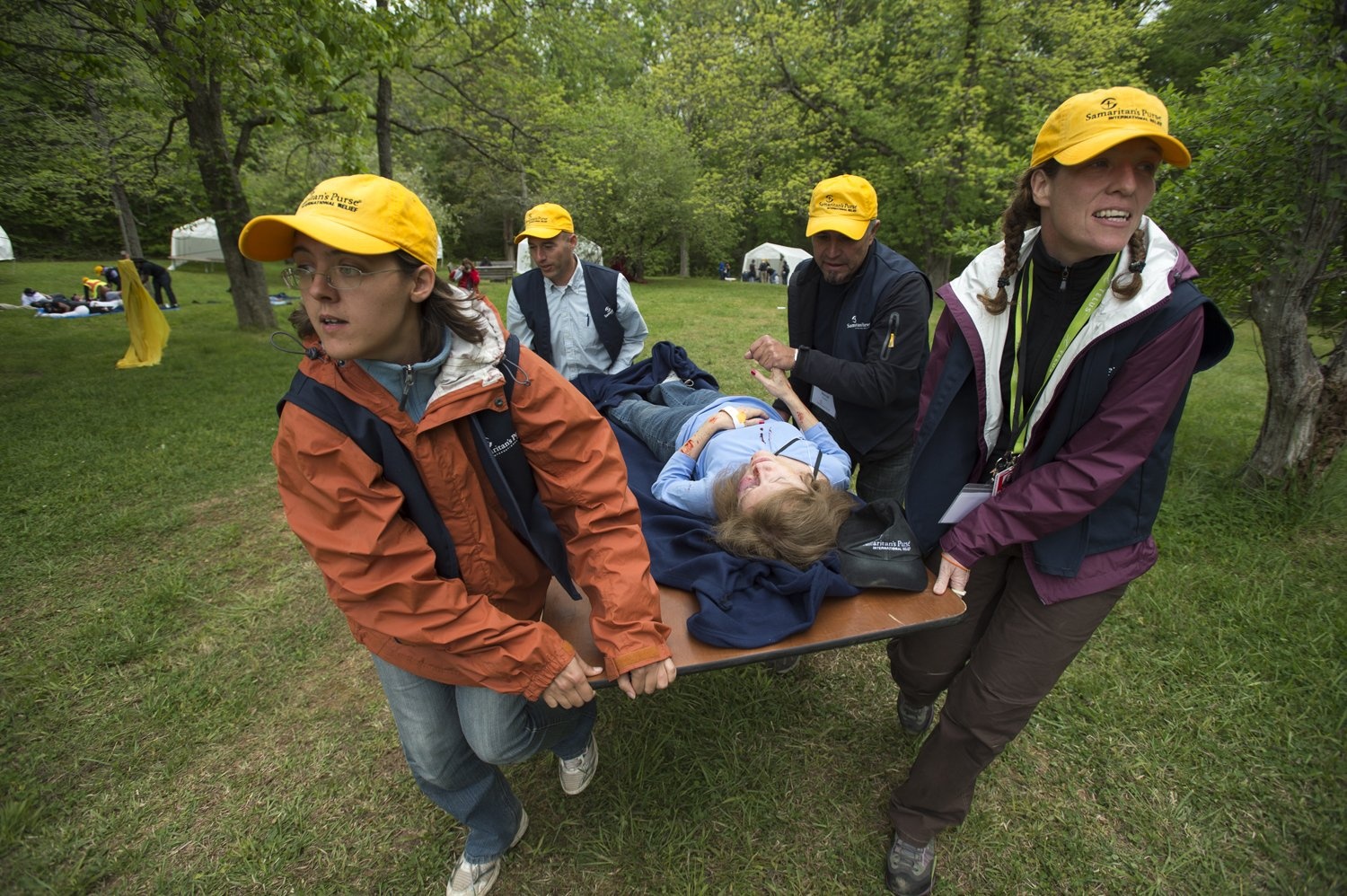
The scene was chaotic as aid workers converged on a summer camp in York, S.C., to evaluate injuries after a powerful earthquake. The wounded were in pain and distraught about missing loved ones. Workers had to quickly determine which of them needed immediate treatment, which ones could wait a bit longer, and which ones weren’t likely to survive their injuries.
Fortunately, the earthquake wasn’t real.
The simulated disaster—complete with volunteer disaster victims bearing mock injuries—was the culmination of an intensive weeklong training this past spring organized by Samaritan’s Purse, an evangelical-Christian relief organization that works in more than 100 countries.
Responding to emergencies is complicated work that requires careful preparation, says Ken Isaacs, the charity’s vice president of programs and government relations. Workers need to be ready for challenges that might entail coordinating the efforts of many government agencies and nonprofits or providing aid in a war zone.
“You can’t just grab a person with no experience and a willing heart and send them out,” he says.
Samaritan’s Purse spent more than a year planning the weeklong training, and the cost of holding it was roughly $250,000. Experts from Harvard University, the United States Agency for International Development, and the 82nd Airborne Division lectured on topics such as humanitarian law, water and sanitation, and the use of social media after a disaster to determine areas of greatest need.
More than 500 volunteers were recruited from area churches to play the roles of injured disaster victims, government officials, and translators. Volunteers were given detailed scripts to guide their responses during the exercises.
The simulations felt very real, even for veteran aid workers, says Karen Daniels, a registered nurse who participated in the training. She has worked for Samaritan’s Purse since 2002 and has spent the last eight years in Sudan and South Sudan.
The fake blood and wounds were “so realistic that one of my teammates, who is not a medical professional, turned to me and said, ‘I think I might faint,’” Ms. Daniels wrote in an e-mail message from her post in Maban, South Sudan. “She was carrying a stretcher with me and I was like, ‘Take deep breaths, take deep breaths!’”
Here, Ms. Daniels (right front) and her teammates transport a volunteer who is playing an injured earthquake victim during one of the simulations.





