An Innovative Program Helps Tame Some of Boston’s Toughest Citizens

By Ben Gose
Senior Editor
May 30, 2011 | Read Time: 3 minutes
The majority of the Boston Foundation’s grants go to provide operating support to proven organizations that seek to aid education, health, and neighborhoods.
Then there’s the stuff that Robert Lewis Jr., the foundation’s vice president for programs, prefers to talk about—long-shot attempts to reduce gang violence and tiny grants that people living in impoverished neighborhoods can use to great effect.
“I’m not reading from the same book” as other executives at the foundation, Mr. Lewis says.
Mr. Lewis, who is black, moved from East Boston to South Boston as a teenager when his family was “firebombed out” of its housing development during the turmoil over court-ordered desegregation of Boston schools, according to a story on the foundation’s Web site.
As a city employee in the 1990s, he helped create Boston’s first Streetworkers Program, which put young people on the streets of the city’s violent neighborhoods to work with gangs to discourage criminal activity.
The program is believed to have contributed to the sharp reduction in crime that is known as the Boston Miracle, but Mr. Lewis says the program declined in effectiveness after he left. Employees unionized and won concessions like not working after 8 p.m.
Less Gang Violence
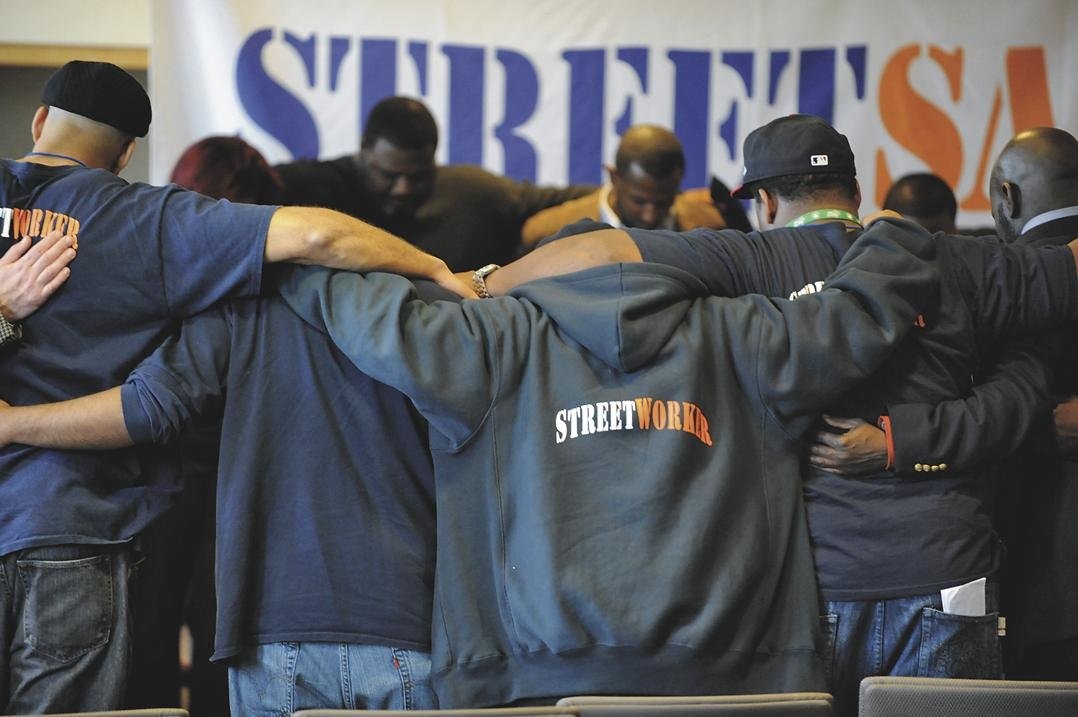
Mr. Lewis joined the Boston Foundation in 2007, and the foundation started its own version of the program, called StreetSafe Boston, in December 2008. The area focuses on a 1.5-square-mile area where 78 percent of the city’s shootings and homicides occur.
Unlike the city’s program, StreetSafe workers work late into the night—until 2 a.m.—and the program hires some workers who have criminal records. Those are the workers who are most likely to influence the city’s gang members, Mr. Lewis says.
“If they can walk out there with street cred, I’m gonna win,” Mr. Lewis says.
The foundation expects to spend $26-million over five years on the program, most of which will be raised from other sources.
The StreetSafe program tries to connect gang members to job-training programs and mental-health services, and some participants have already earned a GED.
A preliminary evaluation by Harvard University researchers released late last year found that shootings connected to gangs targeted by StreetSafe had declined, even as the total number of homicides in Boston rose sharply.
Nighttime Tour
Mr. Lewis also conducts a “Boston by night” tour, in which he takes civic leaders and donors to depressed areas at night to see baseball fields, an emergency room, and public housing. He says he’s given the tour to the majority of the chief executives of Boston’s largest companies, and that $2.5-million has flowed to StreetSafe and other inner-city programs as a result.
Paul S. Grogan, the foundation’s president, coaches a youth baseball team in South End Baseball, a league in which Mr. Lewis serves a “life term” as board chair.
“We wouldn’t be doing StreetSafe if Robert Lewis hadn’t come to the foundation,” Mr. Grogan says. “Robert’s got his own Rolodex, his own stature, and that’s great for us.”