

September 15, 2016 | Read Time: 5 minutes
Jessica McClard saw them everywhere when she jogged in her hometown of Fayetteville, Ark: the wooden boxes on stakes in front yards where people leave cast-off books for others to take.
Little free libraries, she mused. What a great idea.
Meanwhile, the longtime charity volunteer had seen “a ton of statistics” about hunger in her region. She had been talking with fellow members of her women’s aid group about how to help. And she’d read Malcolm Gladwell’s 2000 book The Tipping Point, and absorbed its lessons about how ideas go viral.
A new idea percolated. She talked to friends about it, she says, but “nobody got it but me.”
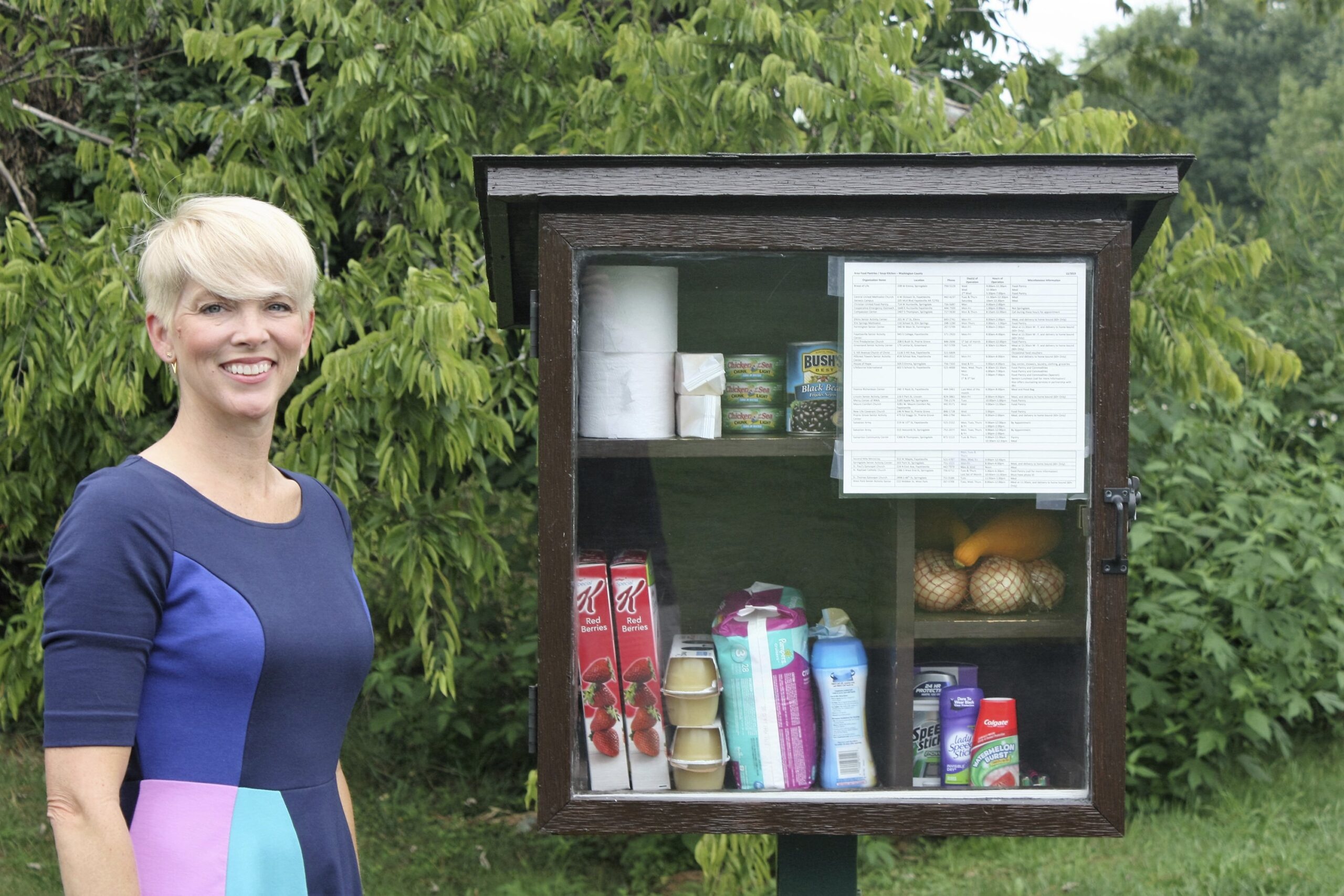
This past May, Ms. McClard, an associate at Christian financial-services nonprofit Thrivent Financial, used a microgrant of $250 from her employer to put up the first Little Free Pantry, stocking food in a box in her church’s yard. Then she posted a photo on a Facebook page she’d created. From her personal Facebook page, she asked friends to “like” the page for her new project.
What a great idea, people mused. In Ardmore, Okla. And in Kokomo, Ind.
And in Bunnythorpe, New Zealand.
“When it really got big was when it got picked up by The Huffington Post” in July, says Ms. McClard. That same month, she was interviewed for a feature on ABC Go. The Facebook page now has more than 16,000 “likes.”
Ms. McClard has lost track of exactly how many other Little Free Pantries have sprung up over the past few months, around the country and around the world. Pantry creators have stocked not only food items but also diapers and hygiene supplies, or crayons and soap-bubble kits for kids on summer break. The boxes are emptied fast; the original, standing outside Fayetteville’s Good Shepherd Lutheran Church, gets stocked by volunteers an average of five times a day and is usually cleared out in no more than 45 minutes.
Weather Challenges
Ms. McClard has a theory why the little boxes, whether holding books or food, have caught on.
“It’s actionable and manageable for one person. It seems really doable,” she says. “And it appeals to people’s neighborliness.”
Little Free Libraries, started in 2009 by a couple of Wisconsin men, Todd Bol and Rick Brooks, have become ubiquitous around the world. As of June, more than 40,000 tiny book stops have sprung up.
But there are some key differences between letting a few books sit in an enclosed box in all kinds of weather and leaving even canned food in an outdoor container.
Feeding America, the country’s biggest network of food banks, provides food to about 46 million people annually. It works through some 60,000 local partner groups that are trained in handling and storing food safely, says Matt Knott, the charity’s president. Cash given to antihunger charities, he adds, can buy more food than a volunteer can pick up at retail prices at a supermarket.
Still, charities that find Little Free Pantries rising in their communities should welcome them, Mr. Knott says.
“I think we need to bring more attention to the issue of hunger in America, and anything that does that is a positive,” he says. “It’s a big problem, and we need a lot of people with big hearts, like Jessica.”
Grass-roots efforts like that of Ms. McClard — and her many imitators — are valuable to more established organizations because they “bring energy and passion to the cause,” Mr. Knott says. “The big question is, can they be scaled?”
‘A Pretty Cool Concept’
One advantage a Little Free Pantry may have over a big food bank is 24/7 availability to people in need, says Kent Eikenberry, president of the Northwest Arkansas Food Bank, who calls Ms. McClard’s idea “a pretty cool concept.”
In Arkansas, one in four people is “food insecure,” lacking regular access to meals — a much larger share than the one in seven that go hungry nationwide. Mr. Eikenberry has embraced the Little Free Pantry as “another tool” to help groups like his solve that problem.
“They also offer an air of anonymity, from both the donor’s perspective and the user’s perspective,” he says. “I donate to a food pantry where I volunteer, and I’ve seen the looks on people’s faces, the looks of relief that we’re available to provide them food — but, to a certain degree, a look of embarrassment that they’re having to go to a food pantry and ask for help.
“At a Little Pantry, there’s nobody watching them, there’s no judgment. It’s strictly, if you need something, go get it.”
He has reached out to Ms. McClard, and welcomes her help in raising the cause’s visibility. “I’m also a member of a Rotary Club,” he says, “and we’ve been kicking around the idea of putting up a few boxes.”
Potential for Growth
As the grass-roots phenomenon she set in motion continues to grow, Ms. McClard finds herself grappling with what’s next.
She’s been busy continuing to educate herself about the hunger issue, conferring with local charities and activists. “I’ve learned some really great stuff from them,” she says, including ideas for which items to stock at night and on weekends, when food banks are closed.
And she’s been wondering whether she should try to organize the world of Little Free Pantries and apply for a nonprofit designation. But even creating a map of the little boxes, for the benefit of both donors and potential users, leaves her feeling conflicted. “It doesn’t feel like my information to share,” she says.
She also recognizes that a Little Free Pantry can’t compete with the scale and service of what a charity can offer hungry people. But, she says, “it’s a good entry point to service. People may not feel they have a lot of money to give, or that they don’t have a lot of time to give. But it’s quite easy to go to the grocery store, pick up a couple of extra things, and swing by there and put ’em in on your way home.
“When people do that, it feels so great. And it encourages those questions: What more could I be doing? Is there another way I can get involved?”





