As Haiti’s Rainy Season Begins, Relief Groups Work to Provide Shelter to Quake Victims

By NICOLE WALLACE
Features Editor
March 21, 2010 | Read Time: 3 minutes
Relief organizations are drawing on lessons from past disasters as they struggle to provide shelter in Haiti. The challenge is daunting: January’s deadly earthquake left an estimated 1.3 million people homeless, and the rainy season has begun.
“There are still a lot of people who don’t have anything waterproof over their heads,” says Isaac Boyd, an architect and technical advisor for shelter and settlements at Catholic Relief Services.
At the same time, charities are thinking ahead to the transitional housing that Haitians need, especially with the start of hurricane season just a few months away.
It will probably be several years until charities can start building permanent homes, especially since efforts are just now under way to demolish wrecked dwellings and remove debris. But aid groups and design specialists hope that the homes that are eventually built will be constructed to better withstand natural disasters.
Tarps Over Tents
In the immediate term, most charities are distributing tarps instead of the tents they have used in the past because plastic sheeting lasts longer and such shelters take up less space.
Catholic Relief Services has distributed more than 13,000 emergency shelter kits that build on the makeshift shelters people have already created out of salvaged wood and bed sheets. Each kit includes two heavy-duty plastic tarps, rope, nails, and a bicycle inner tube, which can be cut up to reinforce the tarps at the points where they are nailed to the frame.
More than 450 spontaneous settlements have sprung up throughout Port-au-Prince, says Mr. Boyd and “people are really packed in.” But getting enough plastic sheeting for those who need it has been difficult. Catholic Relief Services bought 40,000 plastic tarps very soon after the earthquake, but is still waiting for 50,000 additional tarps it ordered on March 3.
Supplies for sturdier housing also present challenges. Because of Haiti’s severe deforestation and the extreme damage to the country’s economy, most of the materials need to be brought into the island nation.
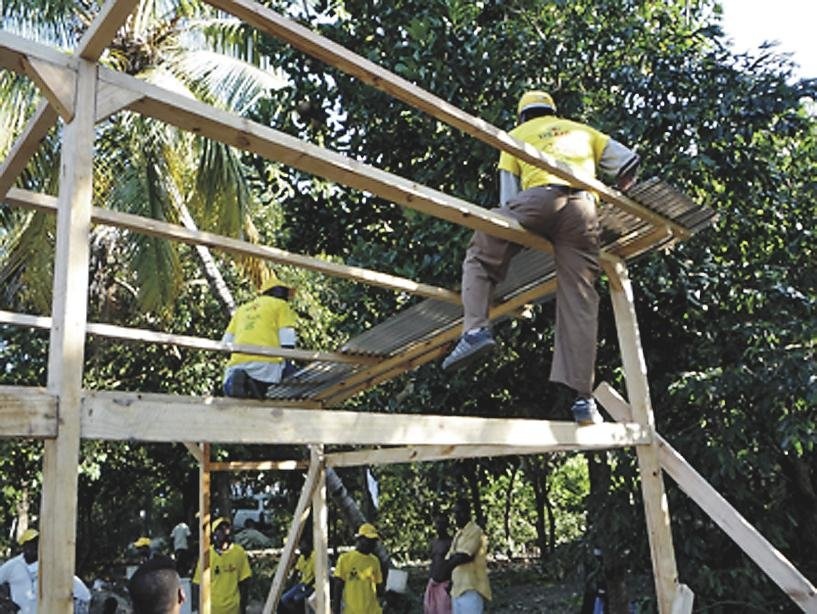
CHF International is securing material to build 5,000 transitional shelters based on a design that it has been improving since Hurricane Mitch in 1998.The units have a wooden frame, a corrugated steel roof, and walls made of plastic sheeting. They will be anchored to a base made of rubble and cement.
Each unit costs about $800 and takes a crew of three to four carpenters one or two days to complete. Steel recycling is picking up in Haiti as people salvage what they can from damaged buildings, and CHF expects to be able to buy steel locally, helping to stimulate the economy.
Location Questions
As aid groups get ready to build transitional housing, one issue still to be decided is where those structures will be located, says Rick Bauer, a public-health engineer and shelter specialist at Oxfam.
In the aftermath of the earthquake, survivors sought refuge in city parks, churches, school yards, and other public spaces, areas that are not appropriate for long-term transitional housing. The Haitian government is proposing sites on the outskirts of the city, but Mr. Bauer says that some of the sites are in flood plains, which make them unsuitable.
What’s more, he says, there are real questions about whether people will want to relocate there.
Mr. Bauer asks: “Do people from the center of Port-au-Prince want to move 15 kilometers outside of town, on the edge of the city where there’s no work, where there’s very few markets, where there’s not a good school system or medical facilities?”