At a University Archive, Yesterday’s Cutting-Edge Video Games Play On

By BRENNEN JENSEN
Contributor
May 1, 2011 | Read Time: 7 minutes
Austin, Tex.
Long before today’s Xbox 360, PlayStation 3, or Nintendo Wii systems, video games were decidedly simpler.
“Beware, foolish mortal, you trespass in Akalabeth: World of Doom!!”
So warns the hand-rendered cover of a 1980 video game on floppy disc, designed for the Apple II computer—a machine whose anemic 16-kilobyte memory would choke on a single e-mail message today. The crude drawing of a horned monster accompanying the disc looks like something a teenage boy might have drawn, which is not far off the mark. Chuckle though you may, Akalabeth—originally sold unceremoniously tucked within a Ziploc bag-was state-of-the-art gaming once.
How far we “foolish mortals” have come. Video games are now a slick, high-tech, nearly $25-billion business in the United States, eclipsing both the film and music industries in revenue (and sometimes inspiring hit movies, like Tomb Raider).
But this economic and cultural juggernaut’s lineage goes back a scant three decades to the decidedly homespun World of Doom and its similarly primitive brethren. Preserving the humble roots of an ever-surging industry that might not otherwise ever pause for posterity is now the work of the four-year-old University of Texas Videogame Archive, in Austin, under the aegis of the institution’s Dolph Briscoe Center for American History.
“I was just at the right age and right time to see the advent of personal computers,” says Richard Garriott, who donated his creation, Akalabeth, which he designed while still in high school. (Later, he was the mastermind behind the hugely popular Ultima and Tabula Rasa series of games.) “I invested my life savings of $200 in Ziploc bags and Xeroxed cover sheets and sat at home copying discs and stapling together the instruction manuals.”
‘Pack Rat’ Donors
Along with Akalabeth, Mr. Garriott has given the Briscoe Center many other artifacts from his career. (“I’m a bit of pack rat,” he allows.) The fear that much of the industry’s history and many of its artifacts might disappear is what led him and a handful of other industry pioneers, including Warren Spector (of Wing Commander, Deus Ex fame) and the noted video-game music composer George Sanger, to approach the university about creating the archive.
“It’s really no different than any other industry that historians are interested in and archivists are trying to preserve for researchers,” says Brenda Gunn, associate director of the Briscoe Center, which already maintains archives related to music, journalism, the energy industry, quilting, and other topics. “Video games have had an impact in many cultural areas, and there are all sorts of academic disciplines that would be interested in pulling information from the collection.”
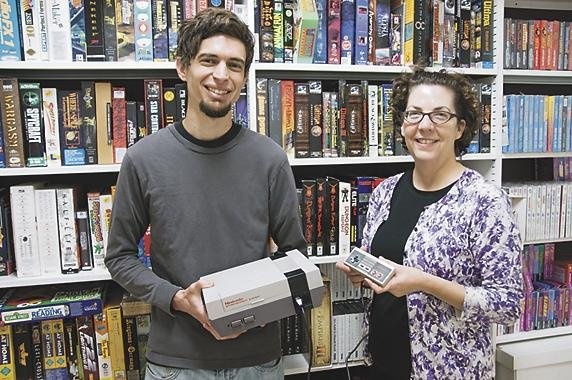
The archive, which has some 1,500 video games, dozens of gaming consoles and vintage computers, and more than 150 boxes of industry documents, manuals, and memos, joins a growing number of institutions focusing on the video-gaming industry.
While the University of Texas at Austin has announced that it will soon offer a degree in computer-game development, some colleges, such as the University of California at Irvine and the University of Michigan, have gone even further and started video-game-studies programs, similar to the film-studies programs that started to become popular in the 1960s. And if this analogy fits, it’s all the more reason for academic institutions to take an active role in archiving games.
“When films studies took hold, they discovered that lots of stuff was missing—they’d lost many early films,” says Zach Vowell, the digital archivist who works most closely with the Briscoe Center’s video-game archive. “We’re trying to mitigate such losses by raising awareness among folks in video-game design studios to maybe think twice about throwing something out.”
Mr. Garriott echoes this concern about preserving the industry’s early products. “While some people might not yet recognize computer games as a leading art form in the same way that books, TV, and movies are, it’s an art form that is only 30 years old and moving fast,” he says “I think it’s wise that we begin to set material aside before it’s lost forever.”
Plans for Endowment
Much of the Briscoe Center’s collection focuses on video games created in Texas, as Austin has long been an active hub of the industry and it’s where Mr. Garriott and many of his peers who helped start the archive worked. But now materials are filtering in from all over, such as a recent shipment of Sega game cartridges and consoles from a former head of that Japanese firm, whose domestic operations were based in California.
Word-of-mouth has done the most to promote the archives, though Mr. Vowell has also attended video-game developer conferences to solicit support. A fund-raising campaign is under way to create an endowment for the archive of between $3-million and $4-million, which would pay for a full-time archivist.
“We’re presently engaged in serious discussions with several donors,” says Ramona Kelly, the Briscoe Center’s associate director for development. “I’m talking with people who understand the importance of the video-game industry—no one thinks it’s frivolous. This is a real priority here at the center, and I’m optimistic.”
One of the goals of the archive is to highlight the creative processes required to develop games, and so the graph-paper sketches that the young Mr. Garriott used to design his crude monsters can be seen alongside the highly detailed concept art that later games employed.
For instance, a phone-book-size “design document” for Deus Ex, a 1997 game set in a dystopian future, carefully outlines settings, plots, and characters for programmers. The game’s main protagonist “is kind of a weird dude,” the document explains; later, it describes a “skull gun mounted behind a flap of skin on his forehead.”
A different sort of glimpse into the creative process—and the competitive, high-pressure world game makers often lived in—comes via a sharply worded memo from a vice president for development for a company making the first incarnation of the 1990s Wing Commander game. He browbeats his programmers for not working both Saturdays and Sundays.
“If I sound angry about this, it’s because I am,” the executive writes, “Must I continue to push and beg and cajole?”
Obsolete Formats
Collecting and maintaining such ephemera is one thing, but archiving the video games themselves presents real challenges, such as dealing with obsolete equipment and proprietary data formats. Indeed, one of the archive’s oldest items is a mid-1970s computerized fantasy role-playing game on a punched-paper tape—an archaic storage device system with no working computers left to read it.
“Our long-range strategy is to migrate as much information as we can from media like floppy discs and CD’s and into a digital repository the UT library maintains,” Mr. Vowell says. “This doesn’t guarantee that we’ll have the software able to run whatever it is, but it does avoid the problem of having some obsolete format.”
And video games, unlike passive entertainment such as film, are interactive. In a sense, the games only really exist when they are played, when their virtual worlds are up and running. Since the Austin project is a scholarly archive and not a hands-on museum, it has no permanent stations where folks can partake in some old-school gaming.
But they do fire up the vintage games now and again, such as during the recent “Explore UT” event, the university’s annual open house for local schoolchildren. Hundreds of youthful visitors to campus got to play on mid-1980s Nintendo and Sega consoles and a more obscure Vectrex machine, running throwback titles such as Sonic the Hedgehog, Super Mario Bros., Wonder Boy in Monster Island, Fortress of Narzod, and Castlevania.
“They were baffled at times by the rudimentary graphics, but they loved it,” Mr. Vowell says. “We sometimes had problems with kids playing too long, and we had to tell them to take turns. And these were games that came out before they were born.”
For more on how universities are archiving and using video games, see a new Chronicle of Higher Education article on the subject.