
Audacious Goals Help Some Nonprofit Groups Achieve Big Gains in Donations

By Holly Hall
Contributor
June 18, 2013 | Read Time: 3 minutes
In the bad economy, many charities are timid about asking donors to give a lot more than they did the year before.
But asking for much bigger gifts can pay off, as some local United Ways have learned by asking supporters to dig deeper.
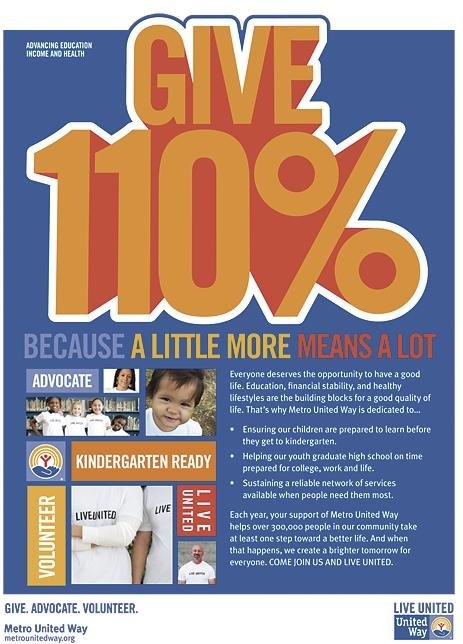
“Give 110 percent,” declared the workplace-giving campaign run by the United Way in Louisville, Ky. That appeal pumped up donations by 12 percent, a big change after the three previous years, when contributions grew by 1 to 4 percent.
The 110-percent message was printed on posters, flyers, and brochures pitching the United Way. What’s more, United Way gave everyone who previously contributed through their employers’ drives a personalized pledge card showing exactly how much they would need to give to exceed their previous donation by 10 percent.
“We really talked about getting back to pre-recession totals,” says Jennifer Adrio, the Louisville United Way’s executive vice president.
While the charity’s annual campaign is still not raising as much as it did before the 2008 economic crisis, she says, some 400 of the 1,700 campaigns at local companies accepted the campaign challenge and raised 10 percent more in 2012 than in the year before, and 8,000 individuals increased their giving by that percentage.
Community Push
The United Way in Decatur, Ala., is taking a different approach. Instead of asking everyone to give more, it set one ambitious goal for its entire community to reach by the end of this month: Increase donations by 30 percent more, to raise $2.5-million.
Sherry Pentecost, campaign director at the Decatur organization, says the big goal was motivated by steep cuts in government grants and contracts that have put local charities at financial risk, including Big Brothers Big Sisters, which is getting $75,000 less from government sources this year than in 2012, and Morgan County Child Advocacy Center, which had a $70,000 cut.
“We have been devastated by the loss of federal and state money,” Ms. Pentecost says.
She says her United Way will probably raise $2.2-million of its $2.5-million goal, which Ms. Pentecost declares a strong showing considering that the charity has lost 5,000 donors in the last few years, down from its peak of 13,000, largely because local plants closed or laid off workers.
New Options
The loss of so many supporters made it clear to the organization that it couldn’t pull off an audacious goal simply by relying on the people who now give generously.
So in March it decided to start a group for professional women who cannot afford to give the $10,000 annual donation needed to join United Way’s DeTocqueville Society, a group that honors the largest supporters of United Way.
So far 30 women have joined the new Women’s Leadership Initiative by giving at least $500 annually. They will be invited to two fundraising events a year, as well as four meetings with presentations by local businesswomen.
“We were going to start at a $1,000 required gift, but based on the growing number of women at younger ages, we bumped it down to $500, which is $10 per week,” says Ms. Pentecost. “It is working.”




