
Bay Area Grantees Learn What It’s Like to Be Grant Makers for a Day

By Caroline Preston
Contributor
January 15, 2012 | Read Time: 4 minutes
The seven people who filed into the offices of RSF Social Finance, a San Francisco nonprofit, one weekday morning last year spend much of their time on a single task: fundraising.
But on that winter day, the nonprofit officials, all leaders of charities that work in food and agriculture, were gathered to learn what it was like to be on the other side of “the ask.”
The occasion was the group’s first experience in turning grantees into grant makers and competitors into collaborators—at least for a day.
Kelley Buhles, who manages the nonprofit’s philanthropic-services program, says that grant making is typically shrouded in secrecy.
“We wanted to bring those grant-making decisions to the community that’s being affected by them,” she says.
Peer Exchange
Ms. Buhles and her colleagues got the idea from a similar program for teachers at private Waldorf Schools. The schools, like RSF (previously the Rudolf Steiner Foundation), were inspired by the thinking of the Austrian philosopher. As part of the program, teachers decide how to split up money among their schools.
RSF staff members decided to put up $50,000 of the fund’s money and try the experiment with their grantees. Seven groups were selected to participate from 17 who applied. “Any fundraiser knows about the difficulty and frustration at times of working in the current paradigm of foundations and nonprofits,” says Nikki Henderson, executive director of People’s Grocery, which helps West Oakland residents advocate for healthier food. “A model where the power dynamic was flipped on its head was very intriguing to me.”
Ms. Henderson and the other nonprofit leaders spent the morning learning about their peers’ work. They reviewed one another’s grant proposals and explained their organizations’ history and missions. After lunch, they answered questions about their work and how they would use the cash. Then came the toughest part: dividing up the money. Each participant got $7,000: $3,000 to keep and $4,000 to give away.
Decision Time
Some nonprofit officials took the path of least resistance: They split the money equally. Others followed a different logic, favoring the needier among them: They gave more to groups in less-affluent neighborhoods and those that would seem to have a harder time winning government grants.
Later, the food activists had the chance to give back a share of what they’d received. Three groups returned some money to RSF so the nonprofit could repeat the experiment in giving.
Others found new ways to collaborate. Ms. Henderson of People’s Grocery gave some money for her counterpart at the San Francisco Waldorf School to attend a class on horticulture therapy; the school runs a garden at a local hospital where students volunteer with patients. But the money came with a catch: Ms. Henderson asked that the Waldorf staff member share lessons from the class with People’s Grocery so the charity could put them to use in a garden it runs in a housing development.
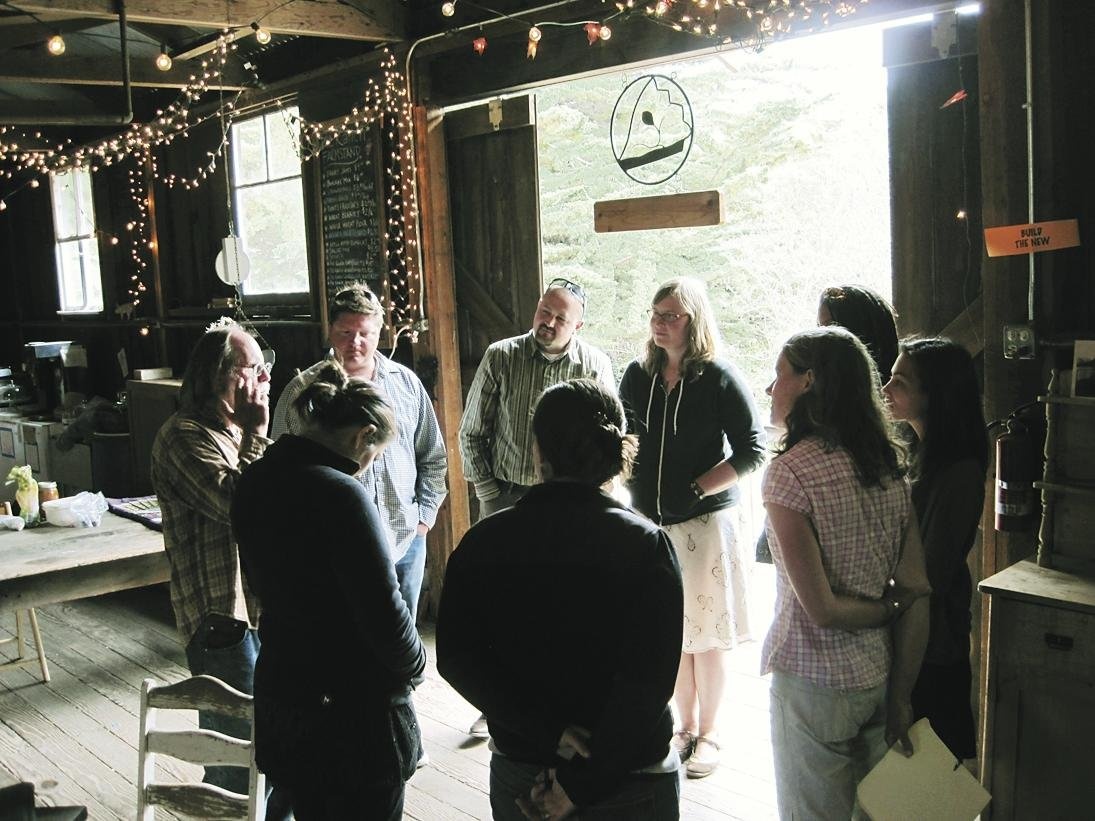
Pie Ranch, an educational farm in San Mateo County, got some money to bring all the participants together again, six months after their first meeting, for a discussion and barn dance.
Fostering Collaboration
RSF has raised $14,795 to try to do another day of reversing the tables for grant makers and grant seekers. Eventually, says Ms. Buhles, the organization would like to host one for every cause it supports.
She would consider making changes in how the day works, however. Bringing together groups that work in the same neighborhood, or on the same narrow cause, might foster more chances for collaboration, she says. Opportunities could include sharing back-office space or a part-time fundraiser.
Of course, a bigger pot of money to divide up couldn’t hurt, either, she says.
Participants like Jered Lawson, executive director of Pie Ranch, and Ms. Henderson said they hoped to have another chance to moonlight as grant makers in the not-too-distant future. Ms. Henderson said she hopes that more foundations choose to give nonprofits a louder voice in the grant-making process.
“Groups will not turn rabid and start foaming at the mouth if you give us a sum of money to distribute,” she says. “A lot of nonprofits feel that if we were more in partnership with those that have the funds, we’d be able to be more effective in our work.”




