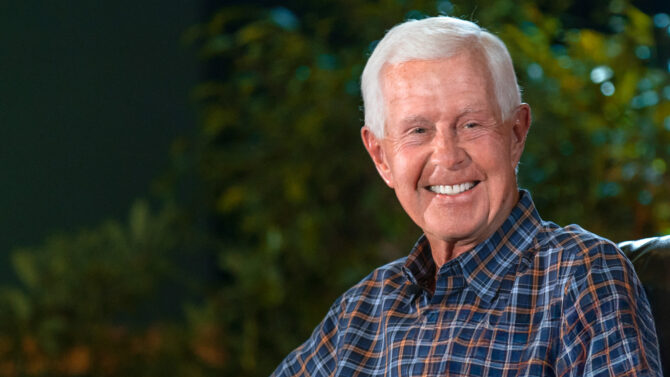
Bill Gates Lauds Worldwide Gains in Education and Health, but Inequality Remains a Stubborn Problem

By Maria Di Mento
Senior Editor
September 17, 2019 | Read Time: 5 minutes
While gains in global health and development continue worldwide, inequality remains a big hurdle in solving some of the world’s major problems, according to the Gates Foundation’s third annual “Goalkeepers” report released Tuesday.
“In almost every location, we are seeing progress on reducing childhood mortality and seeing more schooling,” said Bill Gates in a call with reporters.
But gaps in opportunities among countries and districts and between boys and girls show that much more needs to be done, he said.
The report says that even in the poorest countries, 99 percent of communities have seen declines in child mortality and improvements in education.
However, about one person in 15 still does not have access to basic health care and education. Place of birth remains the biggest predictor of a child’s future. And life remains much harder for girls than for boys no matter where they’re born, but especially if they were born in poor areas.
The Gates Foundation is the largest U.S. grant maker.
The annual Goalkeepers report is intended to be a companion to the United Nations 17 Sustainable Development Goals, established in 2015, which aim to make the world a better place by 2030. The goals include eliminating hunger, slowing HIV rates, and reducing inequalities, among others.
“Billions of people are projected to miss the targets that we all agreed represent a decent life,” Bill and Melinda Gates said in a statement included in the report. “If we hope to accelerate progress, we must address the inequality that separates the lucky from the unlucky.”
Gender Inequality
Despite some progress, educational opportunities for girls remain profoundly limited in many parts of the world by discriminatory laws and policies, gender-based violence, and restrictive social norms.
The gap between girls and boys in poor areas grows wider as children get older, the report says. In sub-Saharan Africa, for example, boys’ and girls’ progress is about the same until age 5, but after that girls receive an average of two fewer years of schooling. Many marry at a young age, with 21 percent entering marriage and motherhood before they reach 18.
Girls are also expected to do much more unpaid work, which limits their access to educational opportunities that could lead to good jobs. That gap is most pronounced in Northern Africa and Western Asia, but it exists in every region, the study found.
In sub-Saharan Africa, girls do three times the amount of unpaid domestic work such as cooking, cleaning, and child care by the time they reach 15 than boys do.
The report found that girls are more likely to get better jobs the longer they stay in school. Worldwide, there is a 24 percentage-point gap between men’s and women’s labor-force participation.
That gap not only disempowers girls, the report says, it also diminishes the lives of their children and slows or limits economic growth in poor societies.
Among the countries in sub-Saharan Africa, Botswana has three times more women in the formal work force than does Ghana, even though both countries average about eight years of education among girls. One main difference is that Botswana can boast much more progressive gender-inclusive laws and policies, according to the report.
The report urges governments and nonprofits working in developing locales to put more support behind projects designed to reach girls and should make the regions where girls need the most support a priority.
Success Stories
The report says Ethiopia, Rwanda, and Thailand have succeeded in delivering primary health-care programs to all of their citizens.
On the education side, most countries are now able to provide citizens with primary schooling, the report says, but the next step needs to be a bigger focus on the quality of education. So far, there is no consensus about how to improve education on a large enough scale so that all children in all countries benefit.
“When people talked about education in the past, there was a priority on getting kids into school, and the world made progress on that,” said Bill Gates in the call with reporters. “With that focus on access, there wasn’t enough emphasis on quality, so that’s a huge challenge now.”
Climate Worries
One crucial challenge in all aspects of the worldwide effort to fight inequality, said Gates, is climate change, which could exacerbate global inequality and gaps in opportunities.
The Gateses will host the third annual Goalkeepers event, where the report takes center stage, in New York on September 24 and 25, during the United Nations annual General Assembly meeting. They plan to release updates each year through 2030. This year, he said, discussions at the event will cover climate change and how to help countries adapt.
“Climate change is absolutely one of the headwinds that will make the progress we’re talking about much tougher,” said Gates.
Critics of Award
Attention surrounding the upcoming event took a controversial turn last week when a group of prominent South-Asian-American nonprofit officials publicly criticized the Gateses for their plan to award India’s Prime Minister Narendra Modi the Goalkeeper award to recognize his work to through the Swachh Bharat program to improve India’s sanitation and asked that the Gateses rescind the award.
In an open letter published on the site Medium, critics of the decision said Modi’s regime has committed a number of human-rights violations and because the Gates Foundation is held in such high esteem for its development work in India, the decision to give Modi the award would “undercut and demoralize the beleaguered civil society of India.”
They said the award would “signal the international community’s willingness to overlook and remain silent in the face of the Indian government’s brazen violations of human-rights principles.”
Responding to the criticism, the Gates Foundation said in a statement to CNN that more than 500 million people in India did not have access to “safe sanitation,” and that because of Modi’s efforts most now do.
“There is still a long way to go, but the impacts of access to sanitation in India are already being realized,” the foundation statement said. “The Swachh Bharat mission can serve as a model for other countries around the world that urgently need to improve access to sanitation for the world’s poorest.”
Maria Di Mento directs the annual Philanthropy 50, a comprehensive report on America’s top donors. She writes about wealthy philanthropists, arts organizations, key trends, and insights related to ultra-high-net-worth donors, among other topics.