
Bridging a Gap … and Finding a Friend
With the nation’s population aging, Generation to Generation works with local organizations to help children and young adults develop meaningful relationships with older people.

By Ariella Phillips
Contributor
April 30, 2019 | Read Time: 2 minutes
Eunice Nichols grew up in St. Louis, a child of immigrants. Then her grandparents came over from Taiwan to live with her family.
“They were my after-school program,” she says. “They played a huge role in my life transmitting culture and values and language.”
Nichols now runs Generation to Generation, a program of Encore.org, which helps children and young adults develop meaningful relationships with older people as the country’s population ages.
Encore.org analyzed census data with the help of a scholar at Boston College and found that for the first time in the country’s history, there are more people over age 60 than under 18. Gen2Gen, which Encore.org started in 2016, works with local groups to bridge the generation gap.
A pilot program at family-resource centers in California’s Santa Clara County is a model Nichols hopes to expand.
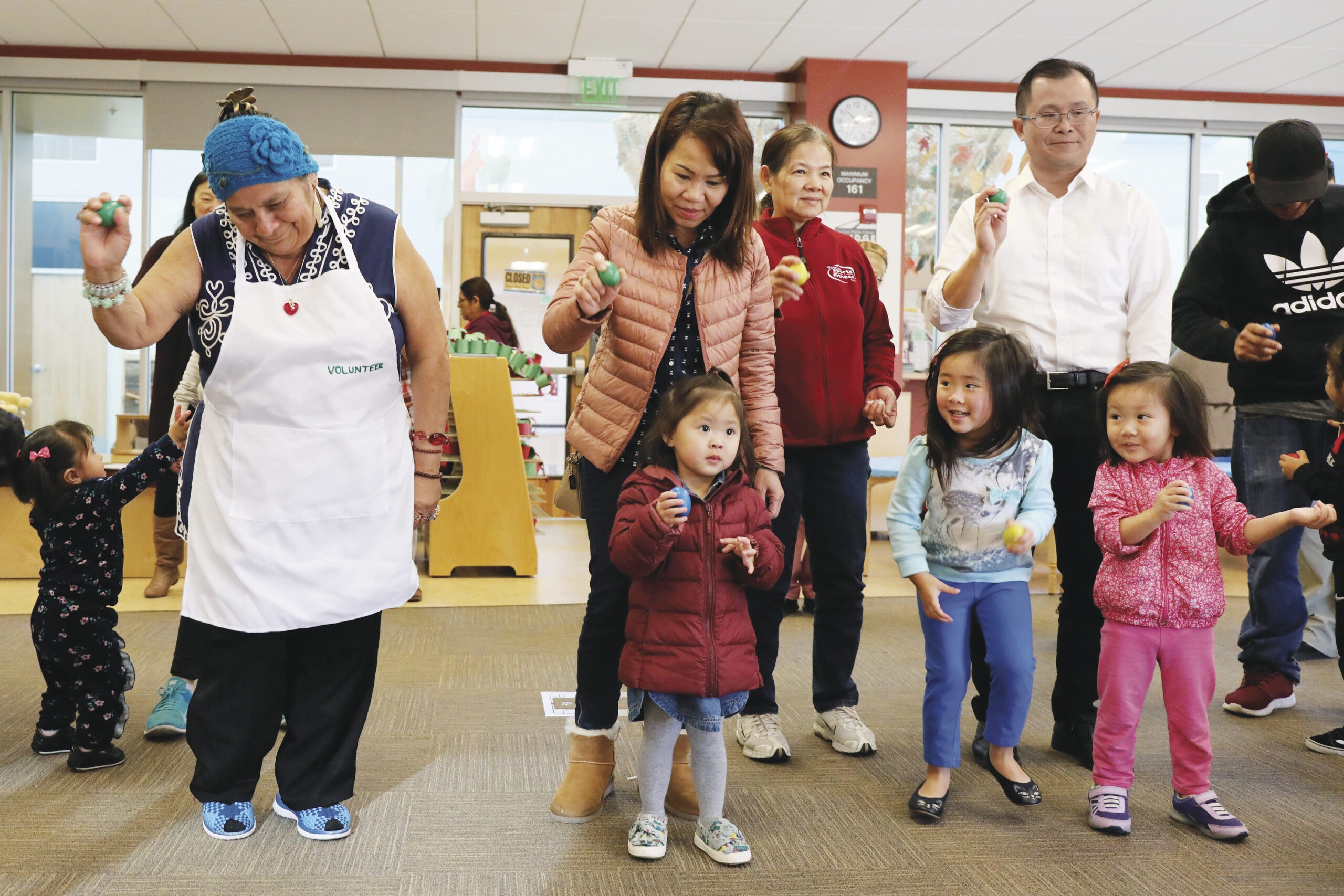
Volunteers like Amelia Morales Vargas spend time with — and entertain — children and parents in a weekly music and movement class at Educare of California at Silicon Valley. Morales Vargas, who speaks only Spanish, says she felt lonely when she moved to America.
“So I started coming to the program, and they were everything to me,” she says. “There are people here who care about us.”
Many of the seniors involved in the program felt isolated, either geographically or by language barriers, Nichols says. Gen2Gen gives them a chance to build community and gives children the opportunity to form grandparent-like relationships.
“There’s no space where an intergenerational component wouldn’t work,” Nichols says.
In February, the James Irvine Foundation honored Nichols with a $250,000 grant as part of its annual leadership awards. She hopes the Gen2Gen model will spread across California and eventually bring together people of all ages nationwide.
“We’re trying to support leaders and champions who are out there doing the work and lead them to do more,” Nichols says. “We’re working both top down and bottom up.”




