January 6, 2010 | Read Time: 3 minutes
International Medical Corps always knew that the photographs taken to capture the organization’s humanitarian work were important. For more than 20 years, the Santa Monica, Calif., organization stored a jumble of prints, negatives, slides, and even some Polaroids in a series of file cabinets, which the group moved from office to office as it grew.
Now, thanks to the efforts of a dedicated volunteer, the organization is marking its 25th anniversary with the release of a coffee-table book that features 255 of those photographs and chronicles the group’s health-care, medical-training, and water and sanitation projects in the wake of war, natural disaster, and refugee crises.
When Stacy Twilley, a volunteer at the charity’s headquarters and a photography collector, stumbled onto the cache of photographs, she was amazed by the quality of the images. Having a background in publishing, she immediately thought that a book would be the best way to share the sometimes haunting and difficult-to-look-at images with a wider audience.
“Nobody’s going to hang these on their walls,” says Ms. Twilley. “A lot of them are too tough to live with. That’s the challenge of photojournalism.”
Only 30 percent of the photographs in the book were taken by professionals. The rest were shot by the group’s employees and volunteers.
As Ms. Twilley winnowed the archive to 800 for possible inclusion in the book, she sometimes went through roll after roll of film shot by a doctor or another volunteer. She might look at 300 photographs before she found the one that really stood out.
“Right place, right time, right light, great composition,” she says. “Everything else on the roll, as a photograph or as an image, maybe didn’t stand up on its own, but that one was a gem.”
Ms. Twilley recruited the photography curators from the Los Angeles County Museum of Art, the J. Paul Getty Museum, and the Museum of Contemporary Art, Los Angeles, along with local collectors, to select the images that appear in the book.
International Medical Corps has an annual budget of $127-million. Roughly half of the organization’s funds come from government, while donations of medicines and other medical supplies account for 40 percent. Donations from individuals, foundations, and corporations make up the rest.
Volunteers raised money to print 4,000 copies of the book, which anyone can purchase for $75. Net proceeds from book sales will be donated to International Medical Corps.
The organization also plans to use the book to increase its visibility among potential donors, says Nancy Aossey, the group’s chief executive.
“Nothing captures the imagination of a person more than an image,” she says. “It’s been a great way to talk about our work, describe what was happening at the time a photo was taken, and what International Medical Corps was doing to try to help people.”
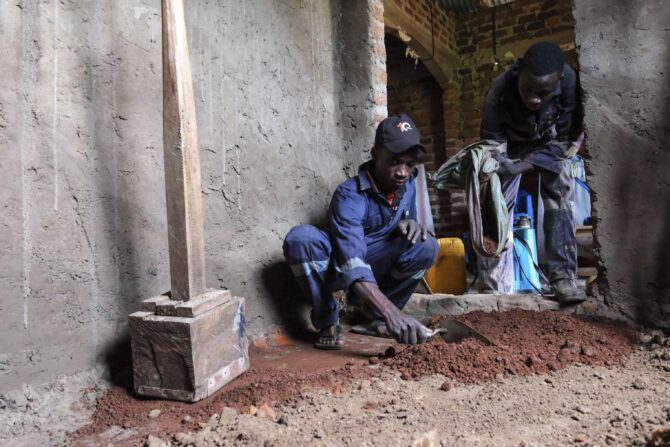
Here, in a photograph taken by a staff member, two International Medical Corps employees build a new well in Darfur.