
‘Cash Mobs’ Give Some Charities a Bump in Donations and Visibility

By Raymund Flandez
Contributor
October 28, 2012 | Read Time: 7 minutes
A month after making a tough decision to cancel its biggest annual fundraising event, the Hospice of Yuma was hit with an unusual sight in the lull of summer’s heat. Hundreds of people from the Arizona town came barging in to the charity’s thrift store to buy clothing, furniture, jewelry, picture frames, and other items.
A plastic jug appeared, into which patrons dropped $300 in donations. And in five hours of shopping, they spent $3,100, which was 435 percent more than on a typical day in August. The Hospice of Yuma, which has run its thrift store for 21 years, says the one-day spike in sales will make this fiscal year its best ever for the thrift store.
What happened was part of a phenomenon that’s been spreading across the country within the past year.
Like a “flash mob,” in which a crowd of strangers—connected via social media—gather in public to perform a choreographed dance or some other action, a cash mob gathers people to boost sales at financially strapped local retailers. Participants in cash mobs do so by purchasing items that typically cost less than $20.
And increasingly, nonprofit organizations are reaping benefits too.
“One of our thoughts was that nonprofits are struggling as much as the small business these days,” says Randy Nelson, director of Arizona Western College’s Small Business Development Center, which organizes the cash mobs in Yuma. “They’re relying more on alternative fundraising than what they were used to.”
Targeted by the ‘Mob’
For many of the small charities, the immediate cash infusion provides welcome relief. But they get other benefits too, including free publicity and a stamp of approval from local residents, which can sometimes be more important than the small amounts of money the mob response brings in.
The process of selecting beneficiaries varies. Some organizers put it to a vote on Facebook, while others do the picking themselves. The Hospice of Yuma, Mr. Nelson says, was chosen through an online vote.
Some groups that organize cash mobs limit their beneficiaries to nonprofits, while others broaden the pool to include businesses, with the caveat that the company must share its bounty with a local charity.
For instance, a cash mob in Memphis last month stipulated that 10 percent of the sales at a music store go to a local nonprofit.
While the publicity and profits may be temporary, some charities are trying to extend the goodwill by folding the new contacts of cash-mob participants into their e-mail lists or working with a cash mob’s organizers to arrange a date for the mob to return.
Schmoozing Donors
Participants in the Hospice of Yuma event were invited to an “after-mob” event at a nearby restaurant, at which people could show off their purchases and meet other cash mobbers.
All the thrift shop’s staff members and volunteers, and even some of the hospice’s board members, went to the after-mob event to support another business—and to schmooze with future donors.
The group has since added information about the cash-mob participants to its e-mail databases.
The charity needed the money and excitement the cash mob generated. Interest in its signature annual fundraising event, the “Roping Roundup,” a daylong Western-theme festival featuring a rodeo, country-music concert, dinner, and games, has waned since the economy soured, says John Williams, executive director of the Hospice of Yuma.
In its heyday, the event brought in $120,000. When the economy tanked, corporate sponsors pulled their support; this past February, the event brought in only about $15,000. During the summer, the nonprofit decided to discontinue the event.
That’s why the hospice, which has operated for more than 30 years, embraced the cash mob, despite the small contributions it brought in, for its fundraising novelty and vitality.
“Because we’re such in tough economic times, we can’t do things in the same way,” Mr. Williams says. “We can’t do big events and hope we’re going to make the same amount of money. The reality is, it’s not gonna happen.”
The one-day cash-mob event, Mr. Williams said, helped jump-start the thrift store’s sales in the following days and weeks.
Revenue generated from the thrift store has helped offset the cost of hospice services that aren’t picked up by private insurance or for those patients who have no insurance at all.
The experience has given the charity a morale boost as well as a bump in its fundraising, says Mr. Williams. “There was overwhelming support,” he says. “It was really something.”
Creating Goodwill
Some nonprofits are themselves running the cash mobs, to gain publicity that they hope will help generate goodwill in their communities and, ultimately, help in other types of fundraising.
Since January, the Genesee Center for the Arts and Education, in Rochester, N.Y., has been organizing cash mobs, which have descended on seven local retailers so far.
By asking people via its social-media outlets to vote on which businesses should get a cash-mob visit, the charity has seen the number of its Facebook fans and Twitter followers jump 30 percent since the start of the year. In addition, the nonprofit’s efforts generated significant coverage by the local newspaper and television station.
But more than that, Genesee Arts has attracted a sponsor for the cash mob: the Retail Council of New York State, which contributed a grant of more than $2,000, says Janice Gouldthrope, executive director of Genesee Arts
For the donation, the arts center provides data about the cash mob and participants, and information such as the fact that the small businesses usually see about a doubling in sales the day of the cash mob and on subsequent days.
In addition, the arts charity is communicating its cash-mob outreach to loyal supporters as part of its fundraising appeals, promoting the events on its Web site and in its mailings. So far, says Ms. Gouldthrope, the organization is on pace to equal last year’s fundraising efforts.
“We would be further behind had we not been able to gain publicity and recognition,” she says.
‘A Unique Event’
Charities’ involvement in cash mobs can vary widely.
In Charlottesville, Va., Bob Fenwick has helped organize seven cash mobs since April, all with a nonprofit partner.
The task for the charities is to spread the word about the cash mobs among their constituents; in return, the organizations often get publicity and sometimes patronage. In July, for instance, the Charlottesville Habitat Store, part of the local Habitat for Humanity, marked down items by 10 percent to 20 percent for cash-mob customers after promoting the event through social media, its Web site, and in-store fliers.
In Memphis, participants in a cash mob to benefit a local record store in mid-October were told that 10 percent of the day’s proceeds would go to the Cooper-Young Community Association, a neighborhood group.
“It was already a unique event,” says Kristan Huntley, director of the association. “It just added a whole ’nother spin to it.”
However, the event raised only a tiny amount for the association, just $100, after 70 people showed up for the cash mob. Ms. Huntley says she may use the money to buy trash bins for the neighborhood.
Downtown Blacksburg, in Virginia, has put together cash mobs every month since early spring; September’s and October’s events involved partnerships with charities and so will this month’s, says Laureen Blakemore, its director.
“People recognize the value of getting together and being supportive of downtown merchants and nonprofits,” she says.
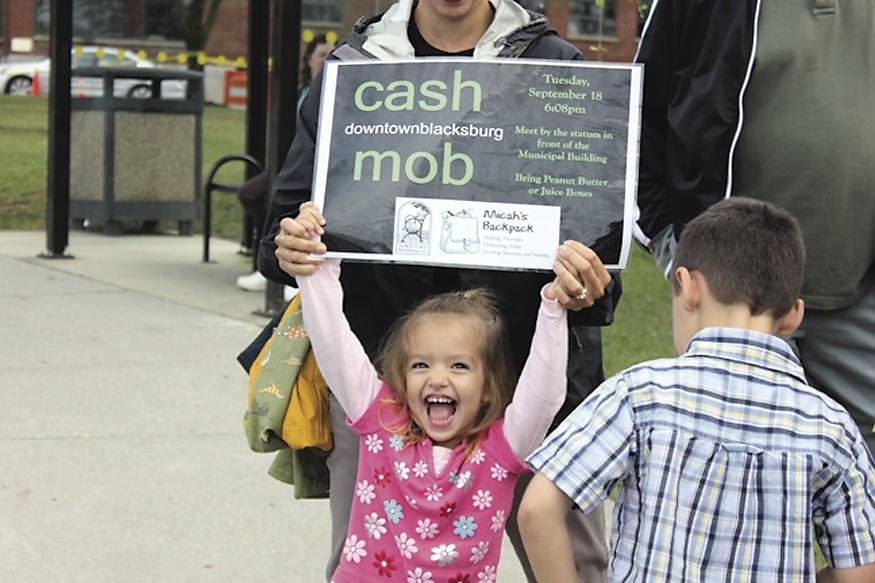
During September’s cash mob, about 40 participants who shopped at a kitchen specialty store also brought 120 food items for Micah’s Backpack. The nonprofit sends needy schoolchildren home on Fridays with packed meals for the weekend. The ad hoc food drive attracted volunteers for the charity as well as TV news coverage.
“This kind of food drive was a first for us,” says Jennie Hodge, Micah’s Backpack director. But she’s already asked Downtown Blacksburg to schedule her charity for next year’s September cash mob, during back-to-school time.
Mobbed Up
How a cash mob that benefited a Yuma, Ariz., hospice was promoted.




