Catholic Charities Hopes to Benefit From New Pope’s Focus on the Poor

By Doug Donovan
Contributor
October 20, 2013 | Read Time: 7 minutes
After a tough fundraising year, Catholic Charities USA hopes the popularity of Pope Francis can inspire a rebirth in giving. But the antipoverty group isn’t taking his potential influence on faith alone. The charity is also turning to the gritty world of national political fundraising to jump-start online donations.
Contributions to Catholic Charities USA dropped more than 8 percent last year, stretching the organization at a time when it says government aid, which provides two-thirds of the income its network of 160 affiliates receive, is insufficient to meet the cost of helping the growing number of people seeking assistance.
The decline in private donations, to $1.47-billion, was sharp enough to cause Catholic Charities to fall to No. 6 in the Philanthropy 400 rankings of the charities that raise the most from private sources. On last year’s list it was No. 4. But the charity is seeing hope as it begins to spotlight Pope Francis, who has been working to focus attention away from politically divisive issues and toward caring for the poor.
“Pope Francis has come along at a great time to give us an edge,” says Candy Hill, executive vice president of social policy, external affairs, and development. “We’ve never used the pope as a centerpiece for any fundraising strategy. We are going to utilize Pope Francis.”
The organization has just begun to test such appeals, so it’s not clear yet whether the approach will work.
“It will be interesting to see if there is a dramatic uptick in donations,” says the Rev. Larry Snyder, president of Catholic Charities USA. “He’s giving us these tremendous sound bites that we can put on our Web site and that we can build an appeal around. That may be the greatest contribution as far as fundraising.”
Pope Francis is not the first pontiff to emphasize a Catholic responsibility to help people in poverty, notes Father Snyder. What’s different, he says, is that the new pope is calling on Catholics to stop judging people by a morality based on the church’s opposition to gay marriage and birth control, rather than on the example set by Jesus, who welcomed everyone.
‘Francis Factor’
The charity’s first attempt to take advantage of the “Francis Factor”—as it was called recently at a Georgetown University forum on the new pope—came in early October.
The charity worked with its fundraising consultants, who previously advised President Obama on his campaigns, to design a 72-hour online appeal pegged to the Feast of St. Francis of Assisi, the pope’s namesake.
Although the group usually doesn’t refer to the pope, this time it did. “We’ve already seen how Pope Francis has reignited the spirit of fighting poverty around the world and how important this issue is to him,” the appeal said. It asked for a $25 donation.
The average gift sent in response was $94, Ms. Hill says.
“He’s really resonating with lots of different constituencies of people,” she adds.
Different Focus
As a result, Ms. Hill has asked the charity’s consultants to develop a campaign highlighting the pope’s messages, a move fundraising experts say should pay off.
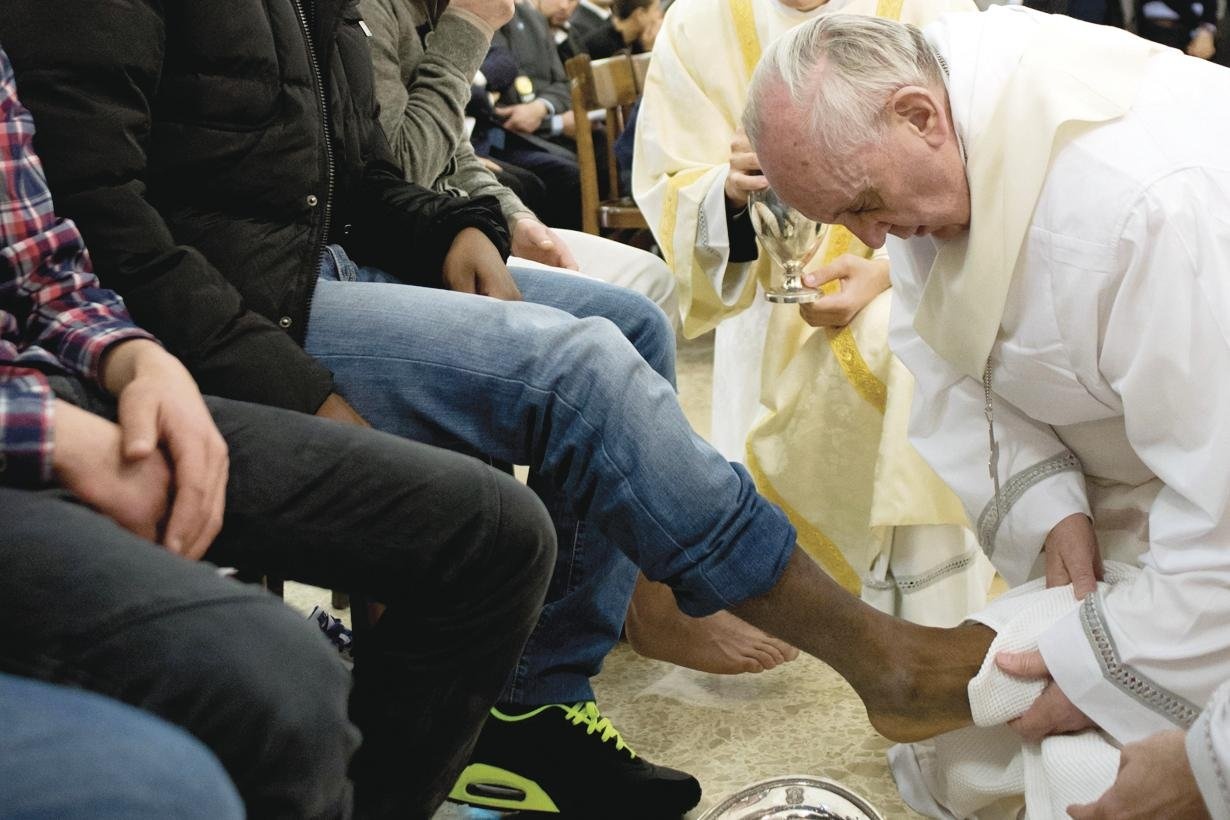
By refusing to live in the pope’s palace, washing the feet of the poor when he visited Brazil last summer, and taking other actions that have emphasized his humility, the pope is delivering the very kind of service he is calling Catholics to perform—or at least support.
“He feels like the common man. He’s tried to push aside the trappings of the office to relate to the common man,” says Rick Dunham, a fundraising consultant. “If you look at the way in which he’s conducting himself, he’s communicating a real need.”
Greg Fox, a fundraising adviser at Merkle, a direct-marketing consulting firm, says some Catholic donors may have grown hesitant to give over the years because of the stigma associated with opposing gay marriage and birth control.
“The pope is helping to offset that,” Mr. Fox says. The pope is not just asking Catholics to help the poor, he is providing his own example, which can help Catholic Charities spur donors to do the same.
“They have a very strong figurehead who can strengthen those asks,” he said.
New Techniques
Catholic Charities says its 160 affiliates are all feeling stretched to cover demand as the sluggish recovery has made it tough for low-income people to meet basic needs.
One way Ms. Hill is trying to help the affiliates increase donations is by putting a lot more emphasis on online donations and spreading techniques that work best on social networks.
The charity overhauled its Web site last year with the goal of improving year-end gifts, but it had to accelerate the Web development when Hurricane Sandy bore down on the Northeast last October.
“We were geared up on the digital fundraising when Hurricane Sandy hit, and we decided to pull the trigger earlier than we had planned,” she says. “That gave us some real-time data that showed that this could really work for us.”
The group raised $250,000 from online search ads that were posted on the day Hurricane Sandy hit last year on October 22. That was $14 for every $1 spent on online ads, the charity says. Through September 2013, Catholic Charities had raised $8.8-million for Sandy relief; $2-million of that was raised online.
The most recent end-of-year online campaign raised $4 for every $1 the charity spent in online advertising, Ms. Hill said. That was far less than after Hurricane Sandy, but it was still higher than Ms. Hill had anticipated.
“Both campaigns were extremely successful,” Ms. Hill says. “We’re running against the trends.”
Online Growth
Taking a more aggressive approach to online fundraising has increased the size of gifts donated through e-mail and the Web site. The average size of online gifts before the Web redesign was $70. With the launch of the new site and other steps, that has grown to more than $200.
The charity will continue to support its other traditional fundraising efforts. “But online is where we see our growth,” Ms. Hill says. Doing so will allow the charity to “diversify the people we’re reaching,” she says. “We have not seen a significant drop-off in our traditional donors.”
But it is possible that traditional, more-conservative Catholic donors could be alienated by Pope Francis’s stance.
“There are some people who are not as excited” about Pope Francis’s message of greater inclusion, acknowledges Father Snyder.
He and the charity have been criticized by conservative Catholic groups for collaborating with poverty-relief charities that do not oppose homosexuality and abortion.
Michael Hichborn, director of the American Life League’s Defend the Faith project, is one of the critics who have attacked the charity and Father Snyder.
He says Catholic Charities is concerned more with raising money to perpetuate its existence than with furthering the teachings of the Catholic faith. By hiring former Obama-campaign executives and working with non-Catholic organizations, the charity is being dishonest with donors, he says.
“They’re putting more faith in money than in Christ,” Mr. Hichborn says. “I can’t see how they’re not taking Pope Francis intentionally out of context.”
Father Snyder rejects the criticism. Refusing to work with other groups that disagree with Catholic teachings “is certainly not what Jesus did in the gospels,” he says.
In the past, he says, he faced opposition from bishops when he wanted to work with groups that didn’t share Catholic views.
“All of a sudden along comes Pope Francis and he says exactly the same thing we’ve been saying, that we have to work together,” he says. “It’s been a very liberating thing.”
Fundraising success could be one measure of whether that message of tolerance and inclusion appeals to more Catholics.
So far, online tests suggest that donors are responding best to the words “fighting poverty,” Ms. Hill says.
Photos of children and elderly women benefiting from services were far more powerful than religious images such as the Catholic Charities logo or a crucifix.
Ms. Hill says she will keep reviewing results of appeals that refer to Pope Francis.
“We want to use this moment in time in the church to strengthen the brand of the work we do every day helping the poor,” she said.
Catholic Charities USA
Rank on Philanthropy 400: 6
How much it raised in fiscal 2012: $1,477,062,798
Decrease from 2011: – 8.1 percent
How it fared in the recession: Donations are now 67 percent higher than in 2007 when inflation is taken into account