Caught in a Web of DAF Transfers
Donors get a tax deduction for donor-advised fund contributions, but billions of payouts each year are simply recycled to other DAF providers

By Ben Gose
Senior Editor

March 6, 2026 | Read Time: 6 minutes
One of the fastest growing areas of the philanthropic world involving billions of dollars a year doesn’t actually send any money to working charities.
Transfers from one donor advised fund to another are up by nearly 200 percent since the trend first drew attention almost five years ago. An analysis by the Institute for Policy Studies think tank finds that $2.9 billion moved from DAF to DAF at national providers in 2023, up from $1 billion in 2019.
When transfers from a national provider of funds to a community foundation are included in the tally, the 2023 number rises to $4.4 billion.
These DAF to DAF transfers are generally counted as payouts in reports about DAFs, including the annual report by the DAF Research Collaborative, even though the money is being cycled from one donor-advised fund to another. That makes it appear that DAFs are paying more money out to charities than they actually are.
“All of these transfers could have been made to an operating charity,” said Jon Pratt, co-chair of the Philanthropy Project, a reform effort focused on the lack of transparency at foundations and donor-advised funds. “Anyone reading the news can see that there are a lot of potential uses — and increasing needs.”
DAFs have been heavily scrutinized in recent years. Critics charge that wealthy donors are using them to obtain tax breaks and then warehouse assets that otherwise would be flowing to working charities. Donor-advised funds allow donors to take a tax deduction in the year they contribute the money but don’t require the fund to actually pay the money to a nonprofit. Private foundations must spend at least 5 percent each year on grants to nonprofits and other allowed expenses.
Advocates for DAFs point to statistics showing that, on average, DAFs pay out more than 20 percent of their total assets each year — much higher than the rates at private foundations.
DAF assets reached $326 billion 2024, and donors paid out $64.9 billion to charity. Danielle Vance-McMullen, an associate professor at DePaul University and co-founder of the DAF Research Collaborative, said removing the $2.9 billion in transfers from one national provider to another would have dropped the payout rate slightly in 2023 — from 24.1 percent to 22.8 percent.
“It moves the numbers, but it doesn’t change the overall trend around payout rates in the sector,” she said.
Vance-McMullen said the collaborative is interested in documenting and adjusting for DAF to DAF transfers in the future,but wants to make sure the data is meaningful. For example, a transfer from a national provider to a community foundation could be going into an individual’s DAF — or the money could be going into a special DAF account at the community foundation that is distributing emergency grants to charities immediately.
“We just feel like there’s not a great way to attack this yet,” she said.
A Web of Dollars
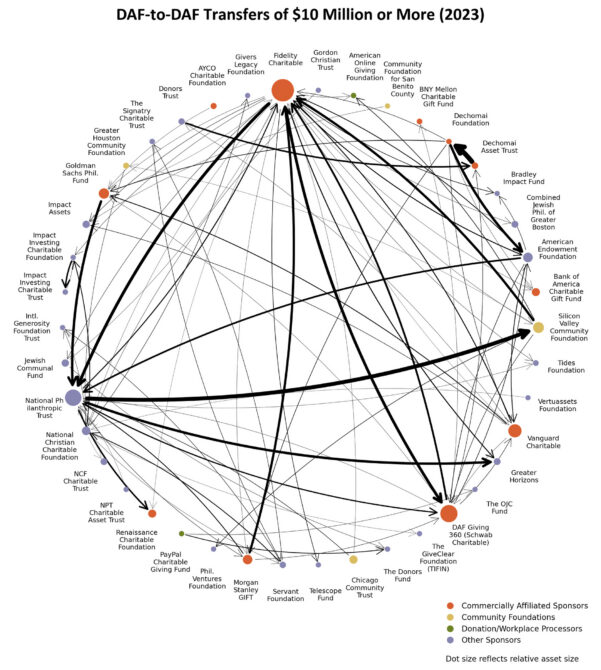
A new chart illustrates the web of dollars — already dedicated to charity — that flow back and forth, primarily between national DAF providers but also to a handful of large community foundations. The chart, envisioned by Pratt, a former executive director of the Minnesota Council of Nonprofits, uses 2023 data from the Institute for Policy Studies report.
The chart only tracks transfers of $10 million or more — and only includes transfers in which both the sender and the recipient do 80 percent of their grant making through DAFs. For example, $63 million moved from the National Philanthropic Trust to Fidelity Charitable, and $183 million migrated from Fidelity to DAFgiving360 (formerly known as Schwab Charitable).
At $4 billion, the DAF to DAF transfers represent a lot of money, but they are only a little more than 1 percent of the $326 billion sitting in DAFs.
As a percentage of annual payouts, these transfers are much more meaningful. A 2022 report by the California Attorney General’s office found that 11 percent of total grants by California DAF sponsors were DAF to DAF transfers.
Why Shuffle Between Accounts?
Advocates for greater spending from DAFs question why providers would even permit these transfers because donors legally give up ownership of the asset when they put it into a DAF.
“None of this money legally belongs to the donors anymore. They gave up their control over it when they gave it away to the sponsor,” said Helen Flannery, an associate fellow at the Institute for Policy Studies and one of the report’s co-authors. “If these transfers are happening so that donors can keep control over the money in some way, it makes the idea that the gifts were charitable look like a legal fiction.”
The unusual structure of donor-advised funds gives rise to the problem. Even though donors technically no longer own the assets they put into a DAF, nearly all commercial providers and community foundations effectively allow them to control how and when the dollars are distributed to charity. A natural outgrowth of that arrangement permits donors to transfer funds to another provider if they choose, some experts said.
A spokesman for Fidelity Charitable, the largest provider of DAFs, said a donor might choose to move an account to another provider to seek the local expertise provided by a community foundation, to gain the ability to distribute international gifts that some providers have developed, or as a values-based move to a religiously affiliated provider.
Many of the transfers can also be explained by inheritances, divorces, or people looking to consolidate with a single financial services provider, Vance-McMullen said.
Whether the free-flowing transfers are an economic loss or gain for the charitable sector is up for debate.
Pratt framed the transfers as an economic loss. He compared dollars zinging back and forth via electronic transfers to the notion of “trapped value” in the corporate world — where valuable assets sit underutilized on balance sheets.
But Vance-McMullen said that curbing transfers would eliminate competition between DAFs, which could cause fees to increase and service to worsen.
Younger Donors May Use DAFs More Effectively
Some of this may change over time as younger donors inherit more wealth, said Debra Shapira, a philanthropic adviser at the wealth management firm Brighton Jones.
Younger donors tend to be more focused on impact, and financial firms that can structure philanthropic plans that move assets to charities quickly and efficiently stand to manage a greater share of the total assets that young people inherit, she said.
Brighton Jones has taken on management of #HalfMyDAF, a matching program started by two of its clients, Jennifer and David Risher, that encourages people to distribute at least half their DAF funds to nonprofits.“It may seem counterintuitive that Brighton Jones has a team of people moving assets out from under our management,” Shapira said. “But when our clients fund their DAFs, we talk to them about their goals, and very few say, ‘I want to maximize my account balance.’ They want to ensure their wealth will be utilized in alignment with their values and to create a positive impact. My job is to help them do that.”