Charities Face Big Challenge in Rebuilding Haiti
The catastrophic earthquake will require many years and much money from America’s nonprofit groups

February 7, 2010 | Read Time: 6 minutes
Build back better. In the earthquake-shattered city of Port-au-Prince, that phrase has become a mantra for aid workers. As charities begin to sketch out their long-term operations in Haiti, many of their officials hope to seize an opportunity to rebuild a country in which endemic poverty has hobbled its development.
But they face a daunting task. The 7.0-magnitude quake killed more than 100,000 Haitians and hit the country’s capital, causing an urban calamity unlike other disasters. Toppled buildings severely injured thousands of people, while rubble and debris hamper efforts to build shelter for the estimated 600,000 to 1 million who now have no place to live.
In addition, charities that work in other parts of Haiti—and even some that work with Haitian immigrants in America—report a surge in requests for help.
In Haiti, “the entire country has been affected by this catastrophic disaster,” said Nan Buzard, the American Red Cross’s senior director of international response and programs. She said the most important question now is: “How do you get communities, individuals, and families back to some semblance of normality, of livelihoods, proper shelter, and at least a semifunctioning life?”
Next Steps
Charities are just starting to plan their next steps. As they work with the United Nations and other international institutions, they say it is too early to estimate how long disaster-related programs will last. But some could operate for five years or more.
While the rebuilding will be a complex and arduous process, many charities agree on one idea: Local people and the Haitian government are the key to its success.
“The long-term response is going to be in the hands of Haitians, whether the relief organizations like it or not,” said Joia Mukherjee, chief medical officer at Partners in Health, a Boston charity that has been in Haiti for more than two decades. It is working closely with the country’s Ministry of Health and hiring Haitian community health workers to monitor the medical needs in the spontaneous camps that have sprung up around Port-au-Prince.
Some veteran relief groups are concerned that too many small charities that lack local connections are flooding the country.
“It just adds confusion on the ground,” said Jeffrey Wright, emergency-response manager at World Vision, which has worked in Haiti for three decades. “Some of these organizations come in and they don’t know anybody here, they don’t have any contacts here, they don’t know how things work.”
Mr. Wright declined to name those groups.
Cash for Work
One way charities plan to get Haitians involved in the recovery is through cash-for-work programs. Oxfam, for example, has hired more than 150 people to collect trash, dig latrines, and do other tasks. The number of people employed by Oxfam could grow to 5,000 by the end of this month.
Such job programs played a big role in the rebuilding of Indonesia and Sri Lanka after tsunamis devastated their coastlines in 2004.
But charities cannot simply transplant what worked in South Asia to Haiti because the disasters are very different, say relief experts.
The Haiti earthquake primarily affected an urban population; the tsunamis largely hit rural areas.
The destroyed landscape of Port-au-Prince, which one aid worker said resembled a scene from World War II, could be a glimpse of what future disasters may look like; during the past five years, the world’s population has shifted away from rural areas, and now more than half live in a city.
“The urbanization of populations around the world has certainly been the trend of the last decade, and many in the humanitarian and development world have been grappling with it,” said Ms. Buzard of the Red Cross. For example, while disaster survivors usually form sprawling tent cities, in Haiti they lack the space to do so. They set up smaller encampments, making it harder for groups to deliver food and other aid, assess how many people require assistance, and provide security for women and children.
Building long-term shelter is also a challenge in an urban environment, said Jonathan T.M. Reckford, chief executive of Habitat for Humanity International. He said the housing organization wants to move quickly to build small, one-room shelters that are expandable over time and are constructed to withstand high winds, an important feature given that hurricane season starts in June.
But first it must find a way to clear the tons of rubble and debris that cover the city, a task made more difficult by the fact that bulldozers and other heavy machinery are hard to come by in Haiti.
Treating Amputees
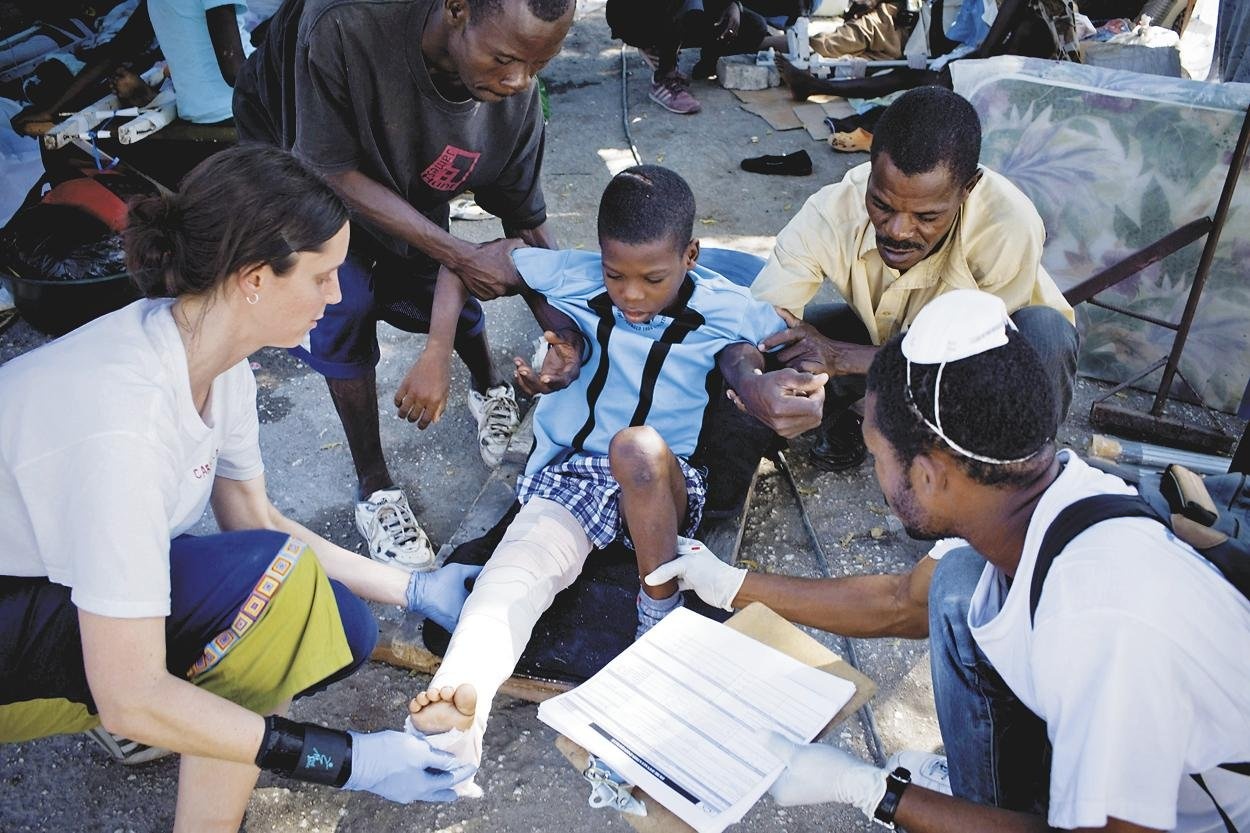
The collapsed buildings also caused long-term medical issues, such as treating amputees.
Handicap International estimates that the total number of people requiring new limbs could be between 2,000 and 4,000.
While a relatively small number of the total survivors, these people will require prosthetics and will need to be reintegrated into Haitian society, said Wendy Baston, executive director of the charity’s U.S. branch.
For example, she said charities need to make sure new buildings are accessible and that work programs hire them.
“Any person with a disability will tell you, ‘Stop telling me to be grateful for this damn limb. How am I going to support myself for the rest of my life?’” she said.
While Port-au-Prince and its urban survivors are the focus of humanitarian efforts, thousands of Haitians have left the city to seek refuge with friends and family in the countryside. The influx of people to the Central Plateau region north of the capital and other areas is straining food reserves and other resources, said Alex Wilson, deputy director for Latin America at Lutheran World Relief.
To help support the exodus of survivors over time, nonprofit organizations want to rehabilitate barren land and improve agricultural production.
“If the land was more fertile, if there were more trees, people could live off the land much more effectively, and they could actually generate an income” by farming,” said Ethan Budiansky, a program officer at Trees for the Future, in Silver Spring. Md.
His organization last year worked with 13 villages on the Arcadine coast of Haiti to plant more than 1 million trees; the trees help fix nitrogen levels in the soil and protect the land against wind and water erosion.
Ripple Effects
Beyond Haiti’s borders, charities in Miami, New York, and other cities have been affected by the disaster.
Catholic Charities of the Archdiocese of Miami faced a surge in requests for pastoral counseling and other services to help Haitian immigrants after the earthquake, said the group’s chief executive, Richard Turcotte.
Haitians also are asking for legal advice about how to apply for temporary protective status—a designation prompted by the disaster that protects Haitians living illegally in America from deportation for 18 months.
Robert Carey, the International Rescue Committee’s vice president for resettlement and migration policy, estimates that 80,000 to 100,000 people could be eligible for the special status but that “no one really knows until people start registering.”
As Haitian immigrants hope for a brighter future in the United States, back in Port-au-Prince, aid workers and others hope for a better Haiti.
“There is an opportunity here,” said Stuart Coles, a spokesman for Plan International, which has operated in Haiti since 1973, helping students with literacy education and reducing violence in schools.
The earthquake destroyed many of the schools Plan International worked in, a fact that Mr. Coles said is “depressing to think about.”
But instead of dwelling on the destruction, he said, the charity sees a chance of forging a stronger educational system—a sense of optimism and purpose that is shared by other international aid organizations.
“We’re not just talking about putting up any old building if you get the money to rebuild,” said Mr. Coles. “You have the opportunity to rebuild and do it right.”