
Charities Report Slow Progress in Haiti, Despite $1.4-Billion Raised in a Year

By NICOLE WALLACE and Caroline Preston
January 7, 2011 | Read Time: 8 minutes
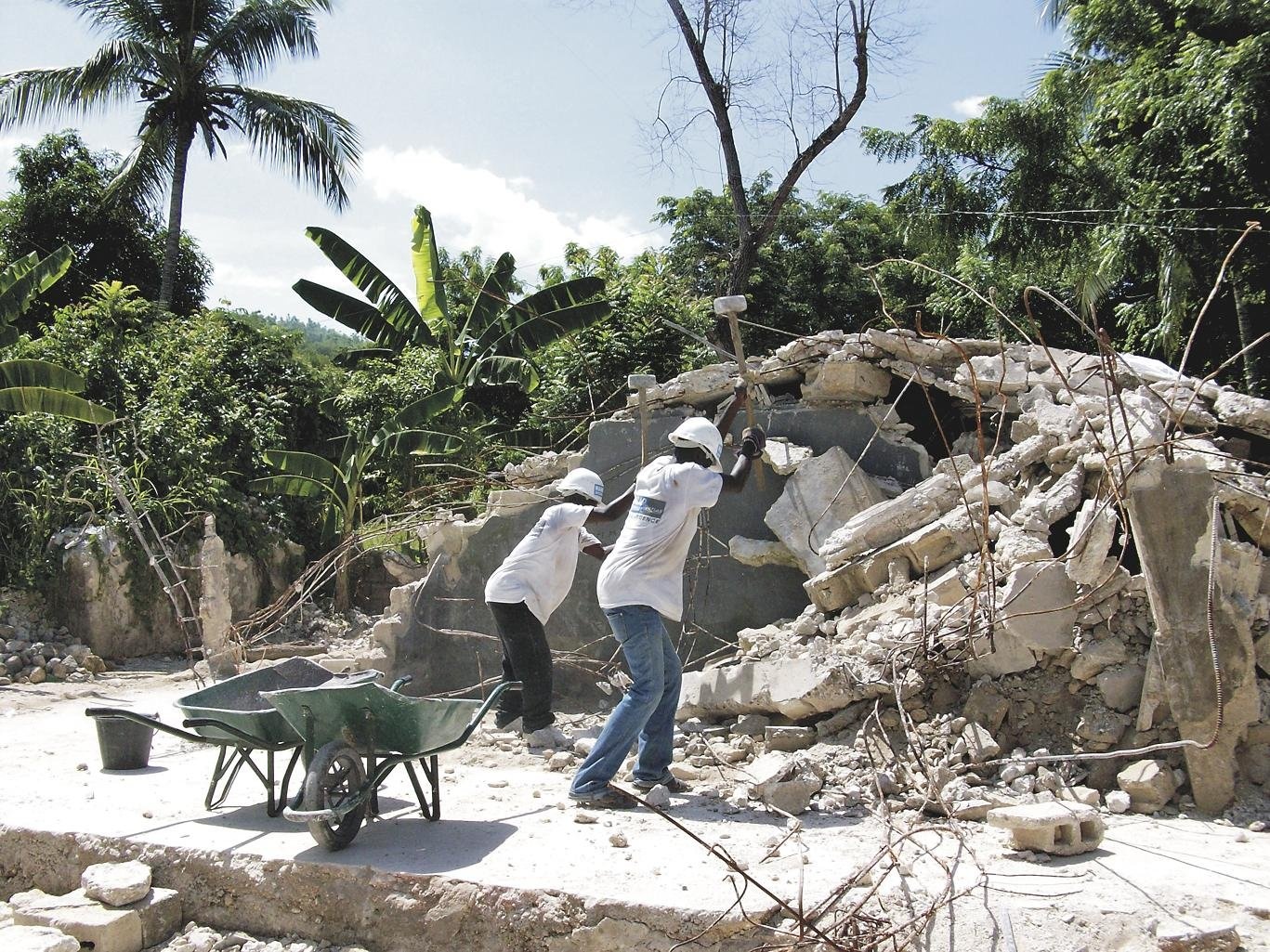
Nearly a year after an earthquake flattened much of Haiti’s capital, charities working to help the country recover say progress has been far slower than they had hoped. An estimated 31,656 transitional homes have been built, a tiny fraction of what’s needed to house the 1.5 million people left homeless by the earthquake. Just 7.5 percent of the rubble had been cleared from Port-au-Prince according to the latest estimates.
The groups say they are contending with a set of challenges that not even the most world-weary relief workers have tackled in concert before.
Port-au-Prince’s warren of narrow, unpaved streets makes rubble removal difficult; one estimate suggests it could take 10 years before the detritus is gone. The government was weakened first by the earthquake and now by a contested election. Confusion over land ownership has held up construction. And the deadly cholera epidemic has forced some groups to focus on stopping the spread of the disease before taking care of other needs.
Yet the vast sums that organizations have raised—a Chronicle survey found that 60 American groups had received more than $1.43-billion from private donors alone—are fueling criticism that charities are moving too slowly.
“There is a huge amount of frustration and a lot of talk about what is the impact of the hundreds of millions that have been raised,” says Wendy Flick, manager of the Haiti emergency-response program with the Unitarian Universalist Service Committee, in Cambridge, Mass, which has spent about a quarter of the $1.9-million it received.
About 38 percent of the money raised for Haiti has been spent. At the one-year anniversary of the tsunamis, U.S. charities had received $1.6-billion and spent a similar share. A year after Hurricane Katrina, they had received more than $3.3-billion and spent about 80 percent.
Unspent Money
Aid workers say they are doing everything they can in a tough environment. But many raise another concern: Big nonprofits aren’t doing enough to work with grass-roots leaders and government officials, and charities could further weaken the Haitian government if they aren’t careful.
Some of the criticism has centered on unspent donations. While a few charities have distributed all their money, others have big sums still on hand. For example, by the end of November, the American Red Cross had committed $188-million of its $479-million in private gifts. By the one-year anniversary of the earthquake, it will have committed $245-million.
Experts on disaster recovery, however, say the rate of spending has been appropriate. If anything, relief workers may be tempted to spend too fast because of public pressure, they say.
“There are some environments in which you just can’t spend a lot of money quickly. And Haiti is one of them,” says Peter Walker, director of Tufts University’s Feinstein International Center, in Medford, Mass. “If you want to fuel corruption, then sure, go ahead and pump a huge amount of money in.”
Despite the vast sums raised, some groups are already feeling a financial pinch.
Save the Children, which worked in Haiti for 30 years before the earthquake hit, has spent about half of the $30-million it raised in the United States. Now the group is cutting its staff by the hundreds, from a high of 1,200 after the earthquake. Some of that reduction was planned, but it’s happening more quickly than the charity had hoped.
Kathryn Bolles, emergency health and nutrition director at Save the Children USA, in Westport, Conn., says the group got money out the door quickly because it knew local organizations and officials. Transporting supplies to the island nation also zapped a lot of funds. “We gave it everything we had,” she says. Now the organization is making tough choices about what work it will phase out.
Waiting for Aid
Other groups are still waiting for government aid. A U.S. nonprofit has promised Fondasyon Limyè Lavi, a Haitian charity that fights child abuse, a share of its grant from the U.S. State Department. But some of that money may be held up in Congress pending the outcome of Haiti’s presidential election. (The charity declined to name the group because it still awaits the grant.)
As a result of that and another stalled grant, Fondasyon Limyè Lavi may be able to operate only in 10 camps instead of 20, says Coleen Hedglin, its program consultant.
As of late November, 60 charities polled by The Chronicle had received just $144.6-million from the U.S. government. The charities had received another $863.2-million worth of supplies from private and government donors. The U.S. Agency for International Development says it spent an initial $1.15-billion in relief money and will make available another $1-billion that’s been promised for rebuilding.
Meanwhile, the cholera epidemic has dealt another blow to the recovery efforts. More than 3,000 people have died so far from the illness, which is spread by bacteria in food or water.
Aid groups have opened cholera treatment centers, fanned out across camps to inform people about how to stop the disease’s spread, and provided tens of thousands of water-purification tablets. Those efforts have sometimes distracted charities from other work.
“That emergency requires a concentrated effort,” says Thomas Tighe, president of Direct Relief International, in Santa Barbara, Calif. “But if you’re doing that, you’re not doing other things that are also important.”
Some say the response has been inadequate. In December, Partners in Health, which began work in Haiti in 1985, issued an appeal for greater action. The group argued for oral vaccines and more widespread use of antibiotics, solutions that could be more expensive and require greater support from donors.
Lack of Cooperation
As aid groups struggle with those immediate challenges, they are trying to develop recovery plans in conjunction with Haiti’s government and local charities. Some say the attempts at collaboration have fallen short.
The formal organizational meetings are rarely, if ever, conducted in Creole, leaving out a large segment of Haiti’s population. Only a tiny percentage of money raised through a United Nations appeal has gone to Haitian-led groups, says Jean Claude O. Fignolé, Haiti country director at ActionAid, in Washington.
“There is a feeling of, Wow, these foreigners have taken over and are doing our work,” says Ms. Hedglin, of Limyè Lavi. “They’re telling us we’re supposed to be leading them and yet that’s not the case.”
Lack of cooperation can cause trouble. One example: Ms. Flick, of the Unitarian charity, says that large groups have set up stations in one camp for the women living there to report if they have been raped. That effort would have been much more effective, she says, if the charities had talked with a grass-roots group that had long been working with the camp’s women and already earned their trust.
On a larger scale, there is the risk of aid groups essentially replacing the government as the primary provider of public services. “What we want to remain conscious of is not creating a parallel universe,” says Ms. Flick. “There’s a significant danger of that happening.”
The British branch of the charity Oxfam, in a report this month, also highlighted this risk, and blamed the “standstill” in recovery largely on a failure of leadership on the part of the Haitian government and an interim commission overseeing the reconstruction led by former President Bill Clinton.
Longer-Term Solutions
But Ms. Flick and others say there are practical reasons why working with the government is so hard. Haiti’s government officials often lack computers. Or Internet. Or cars. Or the authority to grant building permits, because land titles were destroyed in the earthquake or may have never existed at all. Working with grass-roots groups, meanwhile, has been particularly difficult, in part because many were devastated by the earthquake. For example, the National Committee of Haitian Women’s Associations estimates that its member organizations lost between 20 and 30 percent of their community organizers in the disaster.
The presidential election has further complicated the equation.
“It’s a challenge in terms of being sure that your colleagues in government are looking at things with a longer-term perspective,” says Annemarie Reilly, vice president for overseas operations at Catholic Relief Services, in Baltimore. “Is the minister of health going to be there?”
Ms. Bolles, of Save the Children, says that many charities may have underestimated the challenges of working in a place as poor as Haiti. She describes one complexity of rebuilding schools: Many of Haiti’s schools are run by individuals who, in some cases, don’t want their land used for schools anymore. So nonprofits and the government are struggling to find new places to rebuild.
Still, she and other aid officials say it’s getting a little easier. Supplies aren’t getting stuck in customs the way they did right after the earthquake, says Ms. Bolles. Relationships with government and local leaders are being established and strengthened.
Now, nonprofit officials say, aid organizations need to shift from recovery mode to finding longer-term solutions to Haiti’s poverty.
Nora Rasman, interim director of Latin America and Caribbean policy with TransAfrica Forum, in Washington, says that Haiti can’t recover without bigger investments than the short-term employment programs charities are operating right now.
She urges nonprofits to hire more Haitians and to manufacture supplies in Haiti rather than importing them.
ActionAid’s Mr. Fignolé also stresses the importance of tackling the social, political, and historical reasons that Haiti hasn’t been able to escape from grinding poverty.
“If we can do that in a more comprehensive and coherent way,” he says, “then there could be an opportunity for real change in the country, even though it’s a very bleak time right now.”





