Charities Retool Their Web Sites as More Supporters Go Mobile

By NICOLE WALLACE
Features Editor
August 19, 2012 | Read Time: 8 minutes
The Humane Society of the United States is racing to keep up with supporters who visit its Web site while on the go.
In 2010, people who visited the charity’s Web site via smartphones and tablets accounted for just 4.5 percent of all of the nonprofit’s Web traffic. That figure has since spiked to 26 percent.
Now when people go to the nonprofit’s home page using a cellphone, they are automatically redirected to the Humane Society’s streamlined mobile site, which features news about the organization’s campaigns and lets people sign up for advocacy alerts or donate easily despite their smartphone’s tiny screen.
Until six or eight months ago, when people in the nonprofit world talked about mobile, they usually meant text-to-give or mobile-phone applications, says Lara Koch, the mobile-communications manager the charity hired last year.
“Mobile is so much bigger than that,” says Ms. Koch.
Instead of spending time and money on splashy apps, she says, nonprofits should focus their efforts on the mobile Internet, “giving people a place on the Web they can find you and learn about you, no matter how they’re choosing to do that.”
Nonprofits’ Web sites have become the primary means by which the public learns about charities’ work; a study released in June by Cygnus Applied Research found that 62 percent of donors researched nonprofits that way.
With forecasts that mobile Web traffic will overtake traditional desktop traffic by 2014—or possibly sooner—charities are scrambling to make sure their sites are easy to read and maneuver on smartphones and tablets. But, they say, figuring out exactly how to do that isn’t easy.
Beyond the Hype
The nonprofit world has greeted mobile apps with a lot of excitement, but organizations need to take a clear-eyed look at the hype, say technology experts.
Many charities are now finding that they are better off pouring their resources into improving their mobile Web presence rather than into creating or upgrading apps created for specific smartphones and tablets.
One problem with apps is that organizations have to persuade people to download and remember to use them, which can be a tough sell, says Holly Ross, executive director of the Nonprofit Technology Network. For example, if someone is looking for nearby hiking trails, she says, they’re much more likely to turn to Google than the app store.
“There’s more immediacy to working in the Web than there is in the app,” says Ms. Ross.
Mobile apps are a good idea when they solve a specific problem, usually for people who are already committed to a charity’s cause, says Laura Quinn, executive director of Idealware, a nonprofit-technology group. A good example, she says, is an app created by the Monterey Bay Aquarium, which users can whip out at the grocery store or a restaurant to get recommendations for seafood that is abundant and has been caught or farmed in environmentally friendly ways.
However, Ms. Quinn cautions that apps are an advanced option that nonprofits should consider only after they’ve covered the basics.
“It makes absolutely no sense to be thinking about mobile apps if you have not already optimized your e-mail and your Web site,” she says. “There are too many nonprofits saying, ‘Gee, we should do something about this mobile thing. We should get an app.’”
‘This Is All So New’
Organizations that seek to upgrade their mobile Web presence have to answer a multitude of questions—and quickly, to keep up with their supporters’ need for information on the go. They wonder whether to tweak their Web sites to make them more mobile-friendly or create separate mobile sites. Some are rethinking their Web design to adapt automatically to the device a visitor is using; some are gearing their e-mail communications to be read primarily on smartphones.
Charities that ignore the growth of mobile and do nothing risk losing out on potential supporters, especially young ones. And that danger, say experts, is likely to increase as more people use smartphones and tablets.
“Mobile is just the next step that the Web is taking,” says Nam-ho Park, director of mobile services at Forum One Communications, a technology consulting company that works with charities and government agencies.
But the relationship that people have with their mobile devices is different than their tie to a desktop computer, he says: “Since it’s always immediately available, that’s where nonprofits need to be.”
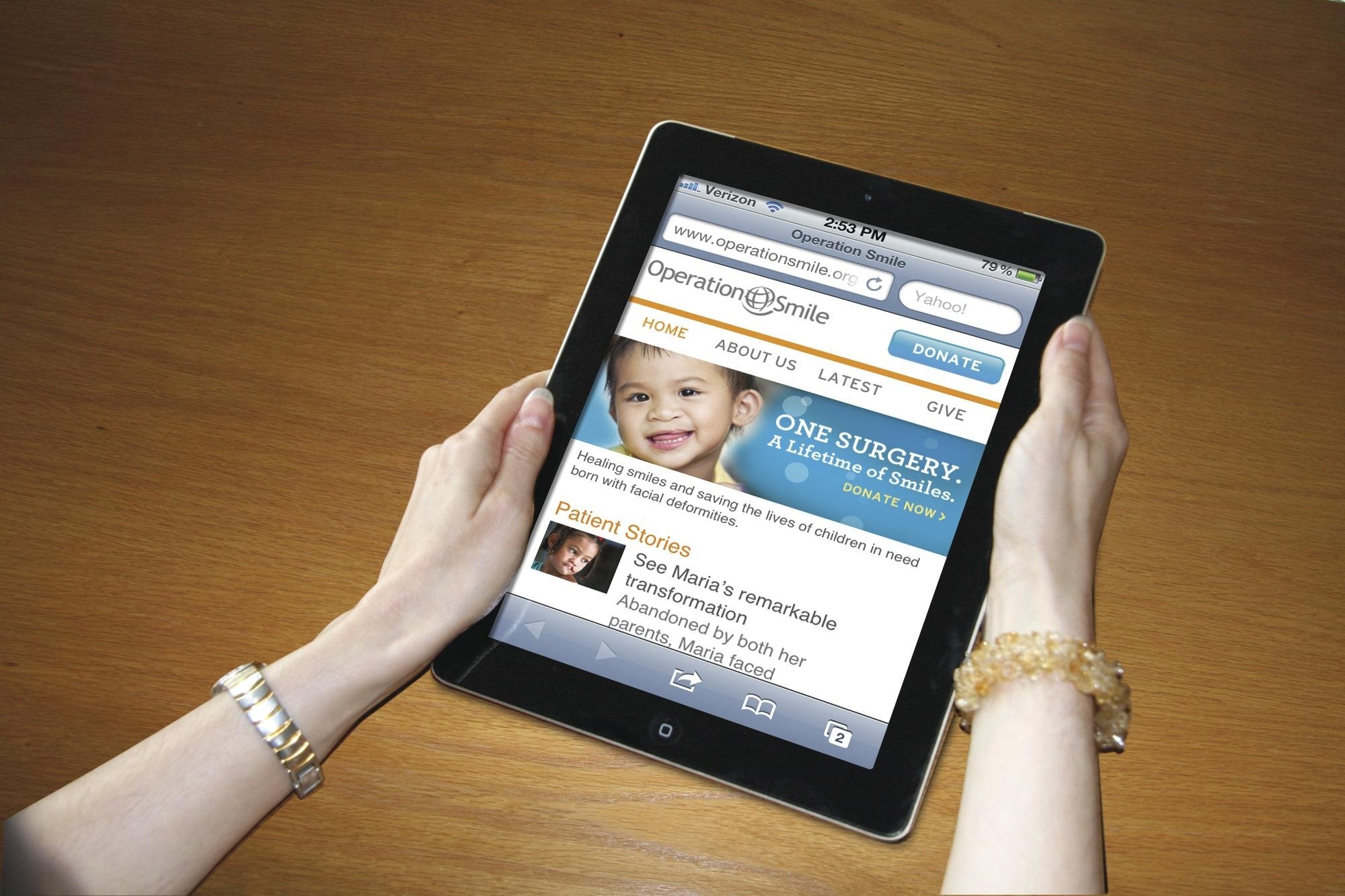
Operation Smile, a medical charity, got serious about creating a mobile site when it saw a steep drop-off begin in late 2010 in the share of mobile visitors to its Web site who took actions, such as making a donation, signing up for e-mail updates, or watching its videos.
“Mobile visitors over all were somewhat more forgiving before 2010,” says Jeff Swingle, the group’s senior manager for online and interactive. “But by late 2010, it was like everybody had a smartphone, and I think people at that point were saying ‘OK, I don’t want to see a site that’s hard to navigate via an iPhone.’”
The organization, he says, now sees its mobile site, which went live this spring, as an opportunity to experiment and learn more about what mobile visitors want. For example, the site gives visitors four ways to make a donation: Donors can use a streamlined form to enter their credit-card information, make a gift via PayPal, click on a link to connect to the charity’s call center, or make a $5 or $10 contribution via text message.
The organization plans to monitor closely how much money comes in through each approach. “Anybody who says they have the answers on this is lying,” says Mr. Swingle. “This is all so new.”
Trimming the Words
DoSomething.org, a charity that encourages young people to volunteer, has decided to adapt its Web site to make it more mobile-friendly rather than create a separate site for smartphones and tablets. Mobile devices currently account for 12 percent of the organization’s Web traffic, up from 6 percent in 2011.
“The key with mobile is to simplify,” says Bob Filbin, the organization’s data manager.
To that end, the group’s Web site uses large photographs and videos sparingly, because they can increase the amount of time it takes for the site to load, especially for people visiting over a mobile network rather than broadband. The group tries to focus on a single point per page and uses concise text to get its message across.
Most Web sites are far too wordy, says Mr. Filbin. “When you look at heat maps of where people scroll through on any individual Web page, most people are actually only looking at the top 20 percent of your page,” he says. “They’re not scrolling down to the bottom.”
DoSomething.org has also cut down on the amount of information it asks for on campaign sign-up forms, sometimes just asking for a first name and a cellphone number.
Says Mr. Filbin: “Once you get beyond those two, three fields, you’re going to lose your mobile users because it takes so much longer to input text on a mobile device.”
‘Ridiculously Inexpensive’
Goodwill Industries International decided to take a different approach. The organization took the information mobile visitors sought most often and created a separate mobile site in 2010 tailored to deliver those data. The site prominently features a search field that allows people to look up the location of Goodwill stores by ZIP code. Visitors can also sign up to receive job-seeking advice via text message from the mobile site’s home page and read the organization’s weekly client profile. Navigation buttons provide links to more information about the nonprofit and to a donation page.
Creating a mobile site doesn’t have to be expensive, says Arlene McCrehan, the group’s senior director for online media, who says the price tag for Goodwill Industries International’s initial mobile site, which the organization has since expanded, was $3,000.
“It was ridiculously inexpensive,” she says. “I think if we had known that we probably would have done it even earlier.”
A Focus on Simplicity
The World Wildlife Fund will soon move from having two sites—one for computers and one for smartphones—to a single design that will automatically adapt to devices of any type or size.
The move was prompted by the challenge of keeping two sites up-to-date as well as an increase in traffic from tablets. In the redesign, the organization is applying the lessons from its year-and-a-half-old mobile site, making the new site simple and giving it a sense of purpose, says Diane Querey, the fund’s Web-site director.
“At the time that we launched our mobile site, our desktop site was just going kind of crazy,” says Ms. Querey. “It had a lot of stuff on there, and it was really hard for a user to know, ‘What do you want me to do?’ Ask them to go to the mobile site, and it was really clear.”
Design Tips for Mobile
- Analyze the organization’s Web data to figure out why mobile visitors come to the site.
- See how the site looks on different mobile operating systems by visiting mobilephoneemulator.com.
- Some smartphones initially display only the upper left-hand corner of full-size Web sites. Make sure that corner helps mobile visitors get to the most crucial information.
- Write concisely and increase text size so it’s legible on a small screen.
- Make buttons and fields bigger and put more space between Web-site elements. Fingers on a touch screen are far less precise than a mouse.
- Keep photo file sizes small and use video sparingly to reduce download times.
- Streamline the number of fields on donation or advocacy pages. The fewer fields, the more likely mobile visitors will complete a form.
- Consider more advanced options, such as a separate mobile site or responsive design, which adapts to different types of devices.