
Charity Leader Reveals Hardships and Lessons of Work in Poor Countries

By Caroline Bermudez
Contributor
September 22, 2013 | Read Time: 5 minutes
Jim Ziolkowski left a job in finance at GE to found BuildOn, a charity that offers after-school programs in American cities and takes its teenage participants on trips to build schools in poor countries. Since it was founded in 1991, the charity has raised $66.4-million. In an interview with The Chronicle, he discussed his new book, Walk in Their Shoes: Can One Person Change the World?
What has been the toughest experience in your career?
My brother, Dave, and I had gone to Misomali, a village in Malawi, to live and work with the community [to build a school].
Dave collapsed from malaria and almost died. About eight days later, I had a 104-degree fever, lost consciousness, went into convulsions, and by the grace of God, Dave was able to drive me to one of two hospitals they had in the entire country. I don’t even know how long I was out.
When I came out of it, the doctor came into the hospital room and looked at me and said, “Two more hours and you would have been dead.”
I was fortunate. I was back on my feet in two or three days.
I decided to go back to the village. I’m looking around and seeing these community members and realizing that when they get malaria, they do not have a near-death experience, they die. Why did I survive and they didn’t?
It’s because of extreme poverty. They don’t have the $20 to go to a hospital. They don’t have a few bucks for a mosquito net or any money for medications. It was overwhelming. I almost turned around and started walking in the other direction.
Then I thought, If we can get this school built, then maybe over time they can break that cycle of extreme poverty through education.
We got the school built. It took six months. Now it takes us about 10 weeks to build the same [kind of] structure.
What advice would you give to people who want to start nonprofit organizations?
Never give up. After I left GE, we set out to build three schools on three continents ourselves and to mobilize students from three American high schools.
We didn’t know anything about mobilizing American youth and engaging them, we didn’t know anything about engaging communities in developing countries, we didn’t know anything about construction. We had never been to Africa or South America, let alone done any meaningful work there.
We had bitten off more than we could chew.
About six months in, we were facing seemingly insurmountable rejection from corporate donors, foundations, and individuals. Not only would they say no but they’d give us reasons we were going to fail. It was demoralizing because those reasons were legitimate.
We received a faxed message from Malawi. The fax said, “Today we announced to the community that you’re coming to build the school. The kids immediately broke out in song and dance.”
They weren’t supposed to tell them. We had not raised a penny. It went on, “Needless to say, if you fail to come we’ll be equally disappointed.”
As a last-ditch effort, we had a fundraiser. The night before the event, we got 40 RSVPs only. Four hundred people showed up. We raised $17,000. Within 10 days, we had gotten word from GE and McGraw-Hill that we were going to get $25,000 and $10,000, respectively.
How do you persuade local residents and students in America to participate?
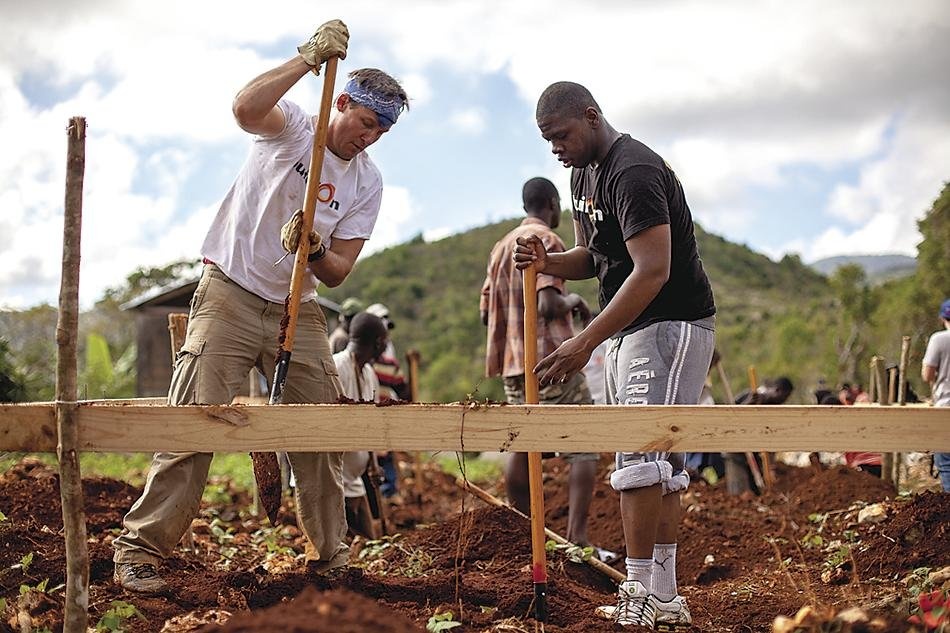
Community members sign a covenant before we build. They have to send their daughters to schools in equal numbers with their sons and contribute labor. They contribute 2,000-plus volunteer work days to build a school and they have a leadership committee of six women and six men. We have a team of skilled labor and construction supervisors embedded in the village and we bring in the materials, but they build it.
We form partnerships with the Ministry of Education. We only build in places where they can provide teachers.
We engage [American] kids in direct service: working with elders and homeless people and younger children, folks with AIDS. At the same time, they help to build schools in developing countries. We’re taking kids from the South Bronx to West Africa to build schools.
Ninety-four percent of the urban youth we work with not only graduate, they go to college.
Your organization managed to grow during the downturn. How?
I built a financial dashboard that I was able to monitor.
We put together—we still do—a playbook before the fiscal year begins outlining where we think the revenues are going to come from. There’s categories of corporations, foundations, and individuals.
I broke the individual list down into three different categories: renewals—people who had given to us and the highest probability that they were going to give again; strong prospects—people we had advanced relationships with; and new prospects.
By the end of the second quarter, we see what we’ve raised in new prospects, we see what’s in the pipeline for renewals and strong prospects, and we’re able to then make decisions as to whether to pull the trigger and expand programs in the second half of the year.
That has been the most useful tool in navigating the recession.
What’s in store for BuildOn?
We want to grow on the international side by at least 30 percent year over year. We want to expand our U.S. programs by at least 15 percent over the next year.
Our longer-term goal over the next 18 to 20 years is to have more than 1 million students attending BuildOn schools in developing countries around the world.
We’d also like to see our programs reaching and engaging 100,000 kids every single week; right now it’s about 4,000 to 5,000. But the most important aspect of our vision is empowering alumni, igniting the fire of education.




