
Creating Changemakers
A black-led nonprofit in Harlem is keeping kids in school and out of trouble by giving them tools to transcend racism, poverty, and the coronavirus.

By carmen.mendoza
Contributor
May 22, 2020 | Read Time: 13 minutes
As the organization, which works to help disadvantaged youths of color, celebrated its 25th year, it was primed for a breakout.
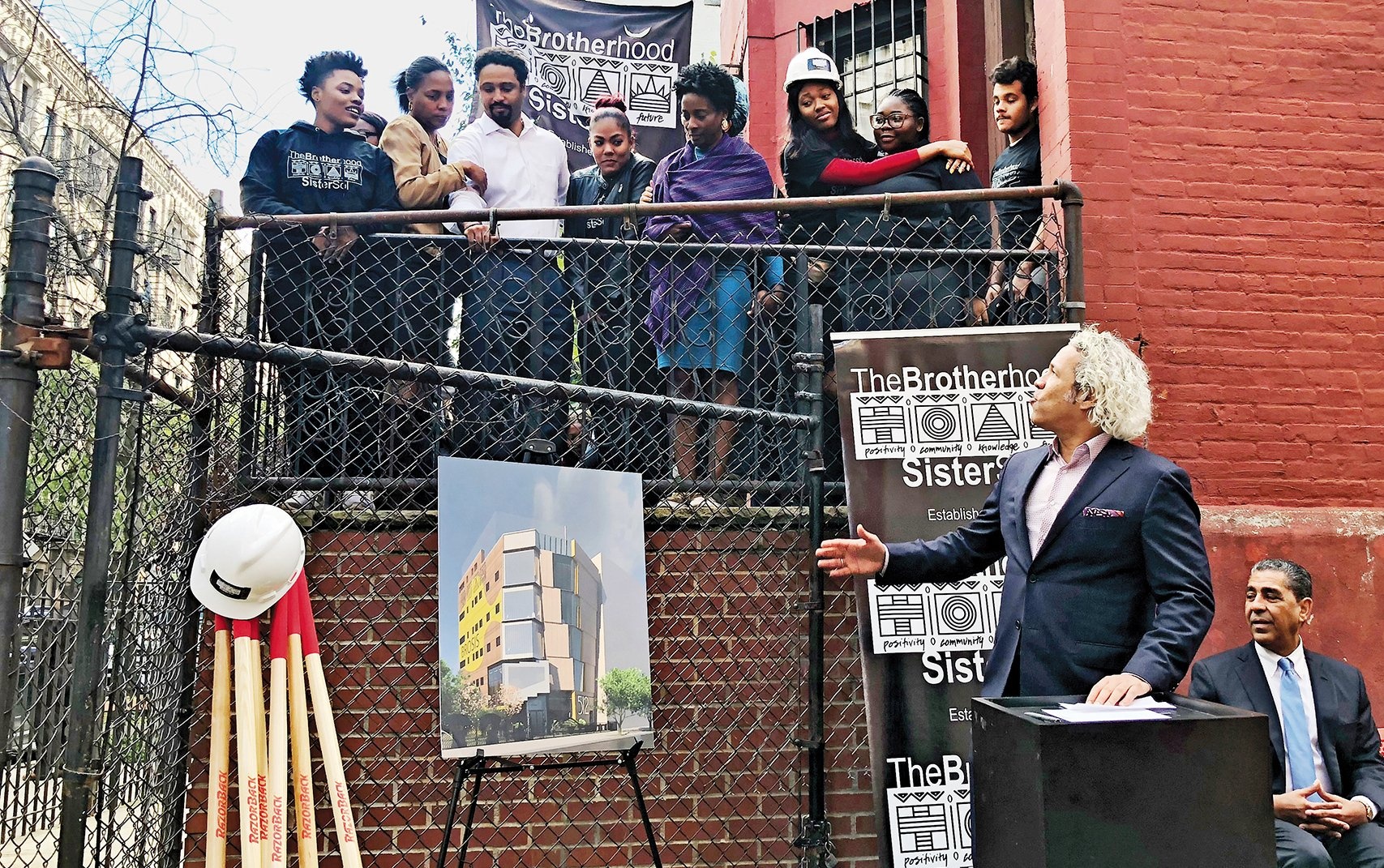
Bro/Sis, as participants and staff members call it, recently broke ground on a new state-of-the-art, 20,000-square-foot headquarters in Harlem and was looking forward to moving in within a year. It was planning to expand its arts and mental-health programs and add one that highlights cooking and nutrition. And after years of struggling for funding, Bro/Sis leaders finally could move forward with a fresh degree of confidence.
Then Covid-19 hit. As with virtually all organizations, Bro/Sis has had to change everything it does. Out went a summer international study program for New York teenagers that the group had long run in Ghana, as well as on-site after-school programs at 12 New York public schools and at the organization’s temporary headquarters in Harlem.
Its annual fundraising gala, originally scheduled for May 14, has been postponed until October — meaning Bro/Sis will have to wait at least six months longer for gala donations, which typically make up 25 percent of its $6 million annual budget. Covid-related delays in construction have pushed back the opening date of the new headquarters. What’s more, a foundation that is among the group’s top seven donors responded to stock-market losses by cutting the amount of its grant from $275,000 to $125,000.
Less quantifiable, but of much more concern, is the atmosphere surrounding its headquarters. “The sirens are constant,” says Khary Lazarre-White, the group’s executive director and co-founder. “People are desperate. There’s a level of anxiety about how long this all might go on.”
Surge in Need
To meet this new, unanticipated level of need, Bro/Sis has expanded how it works to help take care of its young participants, some of whom have lost parents to the pandemic. Most of the workers in the area are blue-collar. Many are suddenly unemployed and without money for basic necessities. The organization has handed out around 10,000 meals to the needy since the pandemic turned New York into a viral hot spot.
Bro/Sis’s 43 staff members need more support, too. Some are facing daunting challenges at home — sick relatives, jobless heads of households. Sometimes work has to take a back seat. “I asked one staffer why she hadn’t completed a rather simple task,” says Lazarre-White. “She broke down. People are overwhelmed. We can’t expect people to perform at the same level.”
The organization has arranged for employees in need to get help from mental-health professionals. It also has linked them to virtual yoga and mindfulness programs.
While it has kept its after-school programs running by temporarily taking them online, Bro/Sis staffers have reached out to its 1,000 youth members and many alumni to make them aware that the organization is still offering — albeit virtually — mental-health, mentoring, and tutoring services and is available 24/7.
Meanwhile, Bro/Sis’s leaders communicate more regularly with board members, the organization’s executive committee, consultants, and government-relations firms — both to learn more about the effects and trajectory of the virus and to shore up its budget during the crisis.
“Right now, we look to be fiscally stable for the next quarter,” says Lazarre-White. Bro/Sis will continue to pay full salaries to its employees, all of whom now work remotely. “But if we’re looking at 12 to 18 months of this virus, as some people are saying, I’m not sure what we’ll do.”
Strong Reputation
If anything will keep the nonprofit running through these challenging times, observers say, it is the solid reputation Bro/Sis has built through its programs. Community leaders and others have long lauded the group’s ability to do more to help its participants and their families than other organizations here that serve young people.
Though Bro/Sis’s strong political stances have sometimes rankled high-profile politicians and rich donors and lost it some support, it has won more of them over in the long run. City and state officials, having taken notice of the quality of the group’s work, approved a total of $11 million toward construction of the new building, which will cost $18 million.
“To be honest, there aren’t many extraordinary youth programs here,” says Gale Brewer, the borough president for Manhattan. “If you’re going to give a lot of money to a group because they do excellent work and take on unique challenges, then this is where you put it. They benefit the public in a lot of different ways.”
Emphasis on Family Life
Bro/Sis offers education targeted to young people of color, including African and Latinx history and global awareness, as well as lessons on social issues such as mass incarceration, police profiling, and sexism. One of the goals of its programs is to help participants develop critical-thinking skills that can give young people the confidence to raise their voices against oppression. The organization also places a strong emphasis on family life and personal development.
“We want to help develop moral people who form families and can find their own way,” says Lazarre-White.
Jason Warwin, who founded the group with Lazarre-White, adds that those young people often have much to overcome. “We’ve inherited this level of struggle, one that lives on through the young people we serve,” he says. “We want young people to define what the issues are in their lives and try to create change.”
Bro/Sis’s gateway program, called Rites of Passage, reaches children as young as 8 with after-school offerings that include the arts and homework help. Other programs extend its reach further, including one held in an urban garden that hires young people to sell its produce at a farmers market. The goal is to encourage youths from troubled neighborhoods to develop the strength they will need to succeed in a nation that has often treated people like them unjustly.
Modest Budget
Bro/Sis occupies a hallowed place among New York nonprofits, Brewer says. “They’re right up there with Geoff Canada’s group,” she says, referring to the Harlem Children’s Zone, which works to increase the rates at which the area’s children graduate from high school and college.
Like that organization, Bro/Sis has a record of improving outcomes. A Bro/Sis participant is 50 percent more likely to graduate from high school than the average New York youth. As a young adult, he or she is three times more likely to graduate from college or have a job than a typical young resident of Harlem. Similar metrics regarding participants’ incarceration and teen pregnancy rates are equally stark.
Though the group wants to show the strong results of its work to foundations, which often require such metrics before making grants, it rejects the typical measures preferred by them. “We developed metrics that we determined instead of adhering to those proscribed by foundations,” says Lazarre-White.
Though support hasn’t been as consistent as its leaders would like, Bro/Sis has become a household name among many prominent foundations.
“We’ve been fortunate to have national foundations, as many as 15 of them, support us over the years,” says Lazarre-White, ticking off the Ford, Kellogg, NoVo, Doris Duke and Robert Wood Johnson foundations as among the organizations particularly instrumental in the organization’s development. “They see that we have national outreach and that we do organizing and social-justice work that has value.”
Over the years, the group has had to operate within a modest budget, forcing it to focus on what it does best and not grow too quickly. While some have wondered whether its model could be expanded in New York or used in other regions, Bro/Sis has kept its size in check.
“The economic crisis in 2008 hit organizations like ours really hard,” Lazarre-White says. “We survived by the skin of our teeth, partly because we hadn’t expanded whenever we wanted to. For us, having growth with substance has meant going slowly and developing high-quality programs organically.”
‘A Safe Space’
The cautious approach has earned Bro/Sis admiration from some grant makers.
“They have been disciplined in a way that keeps them relevant but doesn’t dilute the programs they already run,” says Sonni Holland, senior program officer at the Charles Hayden Foundation, which has made grants totaling $2.6 million to Bro/Sis.
The group has long had to fight for funding — something familiar to groups led by people of color. Hayden hesitated in making its first grant 20 years ago because part of the group’s name — the Brotherhood — sounded too radical, Holland says.
“Some investment banks have said they wouldn’t give us grants but that instead they’d send three young MBAs over to help us run our nonprofit,” Lazarre-White says. “That might be because of our race or because the corporate world is more valued than nonprofit organizations. It’s something you learn to deal with.”
Modeled in part after the Student Nonviolent Coordinating Committee, a group co-founded by Julian Bond in 1960 to give young African Americans a voice during the struggle for civil rights, Bro/Sis attempts to mold kids and teens into citizens with a solid understanding of their place in the world — and the tools to transcend the limitations that can come with growing up there.
Lazarre-White and Warwin, kindergarten pals from Upper Manhattan, founded the organization after graduating from Brown University. While there, the two started a work-study program to help young men in Providence. “We created a safe space where people could talk about what was going on in their lives,” says Warwin, who serves as Bro/Sis’s associate executive director for programming and training. “Many were living in the projects and selling drugs.” Believing that they could benefit from an open, supportive community, Lazarre-White and Warwin called the group the Brotherhood.
The duo took what it learned and opened the Brotherhood in 1995 as a haven for male teenagers and young men. Four years later, Sister Sol — a loose, partly Spanish approximation of “Sisters of the Sun” and a nod to the area’s Latinx population — came into being after Brotherhood leaders saw a need for a girls’ group.
Changed Lives
Though Bro/Sis has otherwise closely controlled its growth, it has been open about sharing its youth-development model. It has been put to use by hundreds of organizations and schools in the United States and in Bermuda, Brazil, and Ghana — countries where Bro/Sis has run free-standing programs. More than 1,500 people — religious leaders, teachers, United Way representatives, and youth-group workers — have been trained via its Liberating Voices/Liberating Minds program during the past decade.
Workshops led by Bro/Sis officials can become searing experiences for those who take part.
A few years ago, when a group of principals at Boston schools got together for a Warwin-led training session, several men in the group became teary. “Some of them had a strong emotional reaction to the curriculum, especially when talk turned to fatherless households,” Holland says. “It was clear that they had work to do on their own. They were struggling with many of the same things that the kids are going through.”
Bro/Sis’s emphasis on reaching deep and developing the whole person has changed lives, say some alumni and members.
At age 12, Fode Diop was drawn to the warmth of an old brownstone that then functioned as Bro/Sis headquarters. Growing up nearby in Sugar Hill, a sometimes-chancy Harlem neighborhood, he had gotten used to finding safe places to visit. A friend introduced him to Bro/Sis, and he was hooked.
Diop credits the organization with drawing him out, giving him a sense of his people’s history, and teaching him how to think broadly and critically. “Talking with people there was completely different from talking with my teachers, who couldn’t really relate to students,” he adds. Being at Bro/Sis “felt like unconditional care and love. They were there for our success and to keep us from becoming a statistic or another victim of oppression.”
‘A Feeling of Home’
The group embraces all youths who want to join it, though it reserves the right to ask people who are sexist or violent to leave. The organization gets its message out by using its connections with local high schools, social media, regular open houses, and word of mouth. It now operates temporarily out of four old bodegas it rehabbed and now rents.
“We try to bring a feeling of home into this old storefront,” says Silvia Canales, the organization’s director of college, career, and wellness. “When people walk in, they’ll see a flag that represents the country they’re from or art or graffiti they had a hand in making. They want to be here.”
Firdaws Roufai, a first-generation Togolese, came from the Bronx to join the group’s liberation program, which organizes young people to develop campaigns against social ills, as a 16-year-old. Like others, she found Bro/Sis to be a haven in a sometimes-kaleidoscopic world.
“It taught me how to navigate growing up in America,” she says. “There were people there — Dominicans, Haitians — who, like my people, were experiencing a diaspora. We learned what we had in common and went from there.”
Now an intern at Bro/Sis, Roufai was one of many program participants who took aim at New York City’s stop-and-frisk policy. Some members joined a lawsuit against the city to pressure it into reversing the practice. One of them, Nicholas Peart, who now runs a Rites of Passage program at the Harlem headquarters, wrote an article in the New York Times telling of his many unpleasant encounters with police.
“Youth activism is central to Bro/Sis,” says Roufai, a sophomore at Hunter College. “The liberation program taught me to question any norm, to get away from this hyper-individualistic space so I can see clearly the systems that can harm black and brown women.”
Emergency Response
As the organization moves — haltingly, for the moment — into a new era, it is allowing itself to expand. The new five-story building will make it possible for Bro/Sis to add programs, including one centered on overall wellness, which will include some athletics. The group has already received a $100,000 grant for a rooftop basketball court from the charitable foundation of NBA star Kevin Durant.
But before the organization can hold a grand-opening celebration, it will need to help its community get through the here and now of the pandemic.
For the time being, it has broadened its mission. In the past few weeks, Bro/Sis has made $50,000 in emergency grants to more than 100 members and handed out 50 laptops or provided mobile hot spots to participants so they can complete their schoolwork, even as schools have closed.
“We did an analysis of the needs people would have during the crisis,” Lazarre-White says. The problems it found aren’t exactly surprising, he adds: inequality and an inadequate social safety net. “We’re seeing a deepening of the issues people in poverty face every day in this country.”
