Cross-Disciplinary Solutions and Small Infusions of Cash Spark Innovation

By NICOLE WALLACE
Features Editor
November 17, 2013 | Read Time: 8 minutes
Camden, Me.
The Theater group Outside the Wire uses drama to help people confront harrowing, deeply personal issues. Through its staged readings of ancient plays about war, for example, soldiers are given a forum to talk about the psychological toll of combat.
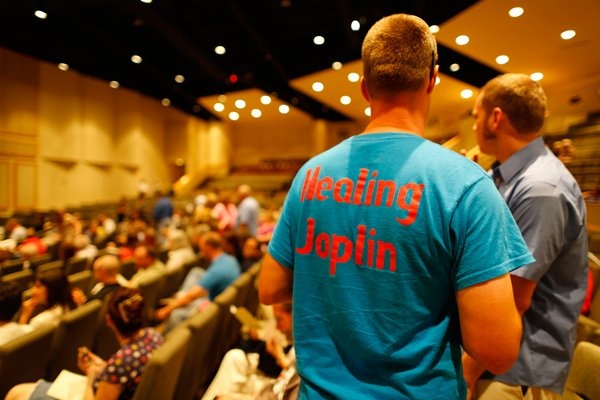
A year after a deadly tornado ripped through Joplin, Mo., the group was invited to perform a text to help residents come to terms with their losses. It settled on the Book of Job but needed $10,000 to stage the reading. Enter PopTech, a nonprofit innovation group, which stepped in with a grant.
The emotional event in Joplin led to performances of the Book of Job in communities recovering from Superstorm Sandy and a new project with survivors of the earthquake and tsunami in Fukushima, Japan.
PopTech is on a mission to spark cross-disciplinary solutions to complex social problems—like combining theater with disaster-recovery work—and to experiment to find the best ways to accelerate them. Along the way, the small but ambitious nonprofit hopes to help solve a problem that has long vexed philanthropy: figuring out how to foster innovation.
Andrew Zolli, who leads the 17-year-old nonprofit, believes that, over time, philanthropy will incorporate some of the approaches PopTech uses, such as its reliance on collaboration and nimble grant making: “What we’re doing is in many ways what foundations and other kinds of institutions will be doing in five, 10, 20 years.”
Spurring Collaboration
Long host to an annual conference that showcases cutting-edge ideas, the nonprofit has created fellows programs to help social entrepreneurs and scientists refine their approaches and better communicate their ideas.
It organizes meetings that bring together experts from diverse fields to discuss big, multifaceted problems like helping cities prepare for disaster and providing financial services to the poor. The group also coordinates collaborative projects that involve multiple players, such as PeaceTXT, a program in Kenya that uses mobile technology to quell rumors designed to incite political violence.
At the core of PopTech’s work is the belief that breakthroughs happen when people working on different causes talk to one another. Too often, its leaders believe, health experts talk only to other health experts, engineers talk to other engineers, and so on.
Being segregated in their fields makes it harder for experts to imagine the best solutions, says Lauren Abramson, a 2010 PopTech Social Innovation Fellow and executive director of a conflict-resolution group called the Community Conferencing Center.
“If we had attacked polio that way, we would have ended up with the best, smallest iron lung there is, but we wouldn’t have had a polio vaccine,” she says.
‘Too Fast, Too Weird’
PopTech is also looking to foster innovation with an adventurous approach to grant making.
With its new Impact Fund, the group is experimenting to see how small infusions of money at just the right moment can help fast-moving or unconventional projects get off the ground —like the money it gave for the Joplin event, the first of two grants so far from the fund.
PopTech itself runs on an annual budget of roughly $4-million, raised mostly from foundations, corporate donors, and revenue from events. The group counts Nike and the Rockefeller Foundation as supporters.
Because most foundation money goes to already established programs, there’s a dearth of risk capital available to try new things, says Mr. Zolli.
The Impact Fund, he says, is designed both to provide seed money to projects that are “too fast, too weird, or too high-risk” to win traditional grants and to demonstrate a model that grant makers can adapt to support innovation.
PopTech’s annual conference, held each October here in this picturesque town on the Maine coast, and its fellows program have helped spark unexpected collaborations, which have led to just the sort of problem-solving innovations the group seeks.
Nithya Ramanathan, a 2011 Social Innovation Fellow, spoke at PopTech’s annual conference about her work creating low-cost sensors that plug into mobile phones that make it easy to collect sound, pollution, and other information from remote locations around the world.
Josh Nesbit—head of Medic Mobile, a nonprofit that uses technology to improve health care in developing countries, and a fellow from the previous year—was in the audience and wanted to learn more.
Over lunch, the two discussed her organization’s technology, which at the time was being used to determine if new cook stoves in India were reducing indoor air pollution. When Ms. Ramanathan talked about a temperature sensor that was part of the project, Mr. Nesbit immediately saw another potential use: to monitor the temperature of vaccines whose effectiveness is compromised if they get too hot or too cold.
Working together, the two groups developed ColdTrace, a system that sends out text messages to clinic workers if vaccines approach critical temperatures. In a six-month trial at eight clinics in Kenya, the technology helped save about 2,000 doses of vaccines. The project has won two grants from the Bill & Melinda Gates Foundation totaling $1.1-million and $300,000 from the Vodafone Americas Foundation.
“Without that meeting with Josh, it’s not clear that all of this could have happened,” says Ms. Ramanathan.
Focus on Communication
More unlikely connections are forged through PopTech’s fellows program. Each year, the program selects a batch of social entrepreneurs with promising approaches for solving difficult problems and scientists doing cutting-edge research.
During a week of intensive training, experts in a variety of fields help the fellows refine their approach, think about measuring results, and develop a plan for expanding their work. One topic that’s singled out for special attention: communication.
Too many nonprofits discount the importance of communication or think about it as a set of discrete activities, like building a website, rather than as a strategy, says Cheryl Heller, founder of the Design for Social Innovation master’s program at the School of Visual Arts and an expert in branding and marketing who works with the fellows.
“There is an assumption that a mission is enough,” she says. “There’s an assumption that having important work to do is enough to make people find you.”
But good communication is key to building support for an organization’s mission and finding partners, says Mr. Zolli: “If you can’t explain to a nonspecialist what it is that you do, then you can’t explain to a nonspecialist what it is that you need.”
Ms. Abramson, of the Community Conferencing Center, says she came away from the fellowship training with a better sense of what it takes to explain how her organization mediates conflicts to people who aren’t already steeped in the work.
In fact, she invited Peter Durand, an artist who draws visual interpretations of PopTech’s conference, to document what happened at one of her group’s events.
The result was a series of six illustrations that help explain the nonprofit center’s complicated mission: It convenes juvenile offenders, their victims, and family members on both sides in the aftermath of a crime to decide on sanctions and a plan to prevent repeat offenses.
“I can say we’ve been keeping hundreds of kids out of the court system, and the re-offending rates are 60 percent less at one-tenth the cost,” says Ms. Abramson. “That’s one thing, but it’s another thing for somebody to look at these drawings and really get a much richer sense of what we do.“
The charity, she says, has used the drawings in material it sends to donors, lawmakers, and others whose support it seeks.
Meeting Innovators
Like the more famous Clinton Global Initiative, TED Talks, and Aspen Institute’s annual Ideas Festival, PopTech’s annual conference gives attendees a chance to sample a smorgasbord of speakers from a variety of fields.
This year Jim Olson, an oncologist, told the audience about “tumor paint,” a substance he and his colleagues developed that locates and lights up cancer cells. Lisa Servon, a New School professor who studies poverty, described the unexpected lessons she learned working at a check-cashing store in the South Bronx. The skateboarding legend Rodney Mullen mesmerized the crowd as he recounted what his sport had taught him about perseverance.
But as PopTech’s work has changed, Mr. Zolli says, the role of the conference has evolved. Now, instead of just being a chance to hear about new ideas, it’s an opportunity for people in the group’s orbit to gather.
Even with advances in communication technology, it’s important for people to meet face-to-face, he says, “There’s a reason why people have clubhouses.”
On the first morning of this year’s conference, Mr. Nesbit, of Medic Mobile, and Raj Panjabi, founder of Last Mile Health and a 2010 Social Innovation Fellow, took to the stage to talk about their joint project to use mobile technology to improve health care in an area of Liberia so remote that the first cell tower went up only last month. The collaboration is the winner of the second grant from PopTech’s Impact Fund.
Several hours later the two men walked to a meeting a block away. The short trip took a long time as conference participants stopped them to offer congratulations and recommendations of other people they should meet. One man offered to nominate their project for a Danish award that honors social entrepreneurs and comes with a prize of more than $670,000.
At PopTech, Mr. Nesbit notes, “You come here expecting to collaborate.”