January 8, 2019 | Read Time: 2 minutes
The ability to go outside, look up at the night sky, and see the Milky Way is becoming increasingly rare.
The glow of artificial lighting hides our galaxy from more than one third of people worldwide. The problem is especially pronounced in industrialized countries. Only 20 percent of North Americans can see the Milky Way without the aid of a telescope.
The International Dark-Sky Association was founded in 1988 to combat light pollution and protect the science of astronomy.
“Astronomers — amateur and professional alike — need to be able to see the cosmos to enjoy the night sky but also to discover new things,” says Amanda Gormley, the organization’s communications director. “We can actually time travel by looking at the night sky because it takes so long for light to reach us.”
But the group quickly learned that light pollution also harms human health, interrupts the migration and life cycle of nocturnal animals, and wastes energy.
To call attention to the problem, the organization celebrates communities, parks, and other areas that have taken steps to curb light pollution. Earning an International Dark Sky Place designation is a rigorous process. Land managers conduct an inventory of all their outdoor lighting and replace high-pollution fixtures with responsible lighting and create educational programs to teach people about the importance of the night sky. Since the program’s start in 2001, more than 100 places have won the designation.
The nonprofit, which relies on contributions from individuals for roughly three-quarters of its budget, also evaluates outdoor lighting and offers a seal of approval on products that minimize light pollution. A searchable listing of dark-sky-friendly fixtures is available on its website.
“We like to ask people to think about what we lose when we lose the night,” Gormley says. “That seems to be a powerful way to get people to find their own motivations for joining this effort to protect the natural nighttime environment.”
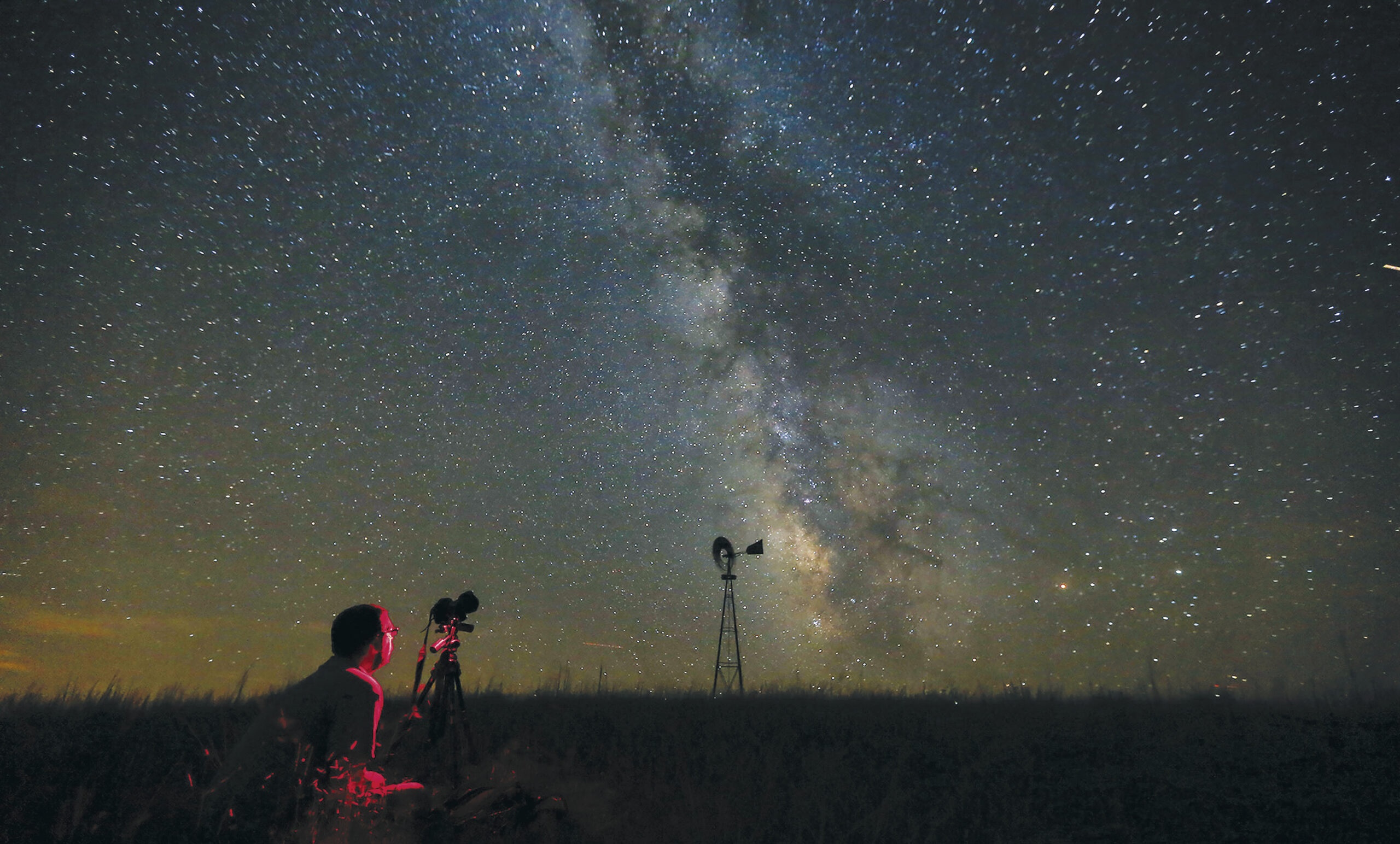
Here, Lane Hickenbottom photographs the night sky in a pasture near Callaway, Neb., with the Milky Way visible to the naked eye.