January 29, 2010 | Read Time: 3 minutes
The availability of medical care in Haiti is slowly improving, but people with serious injuries still have a long road ahead of them, says Wendy Batson, executive director of the U.S. branch of Handicap International.
Handicap International has six teams that are going to camps to look for the most severely injured.
“That is still really a harsh triaging,” says Ms. Batson. “Right now, we’re still telling people who have enclosed fractures—broken legs where they haven’t broken the skin—to wait.”
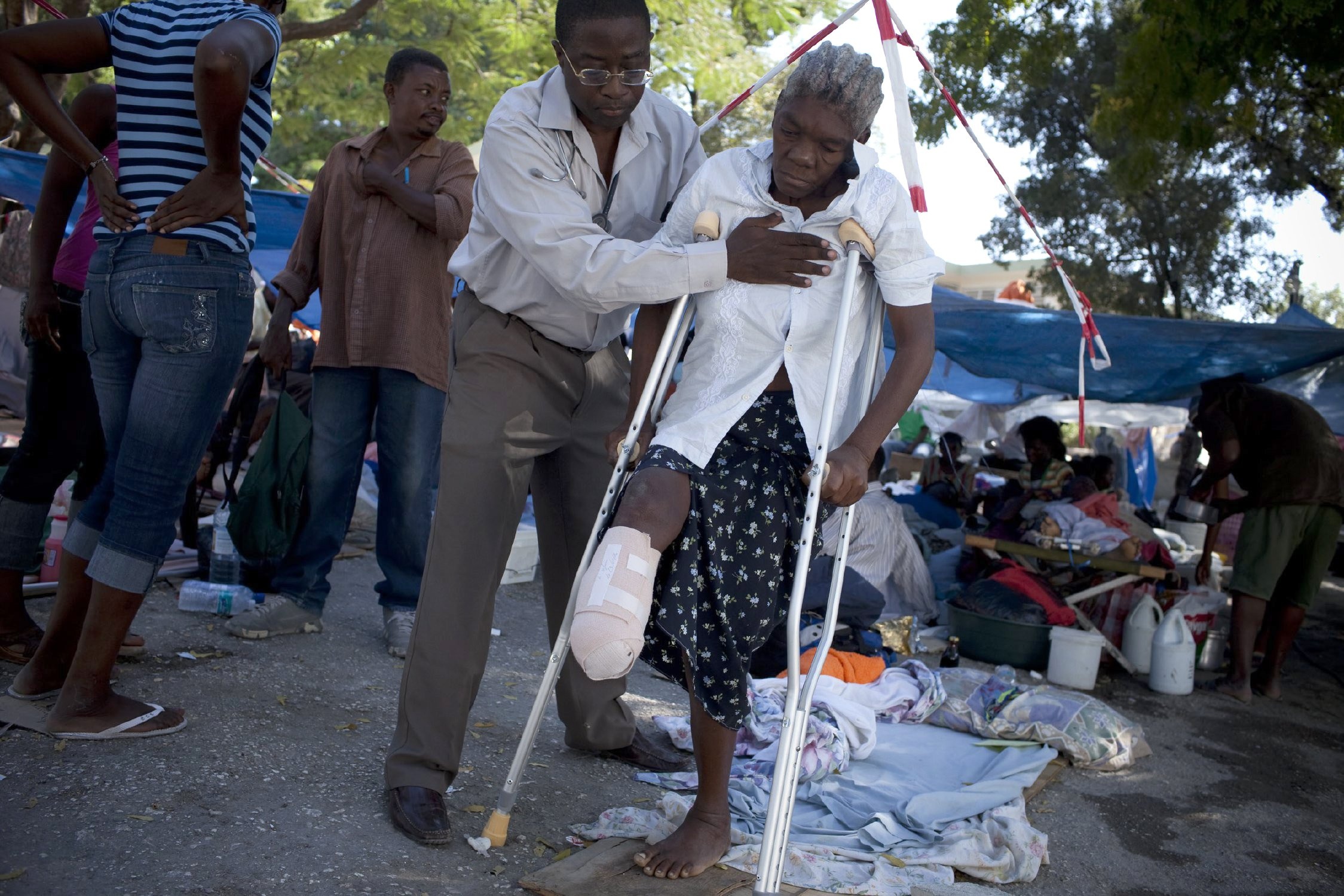
People with infections and crush wounds, especially when those likely to require amputation, take priority because those injuries are life-threatening, she says.
Handicap International estimates that the total number of amputations as a result of the earthquake is likely to range between 2,000 and 4,000.
Good post-operative care is critical for making sure that people who have had to have limbs removed have the best possible outcomes, says Ms. Batson. Right now, she says, that means making sure that their bandages are being changed, that the wounds are kept clean to protect against secondary infections, and that these “newly vulnerable” people are getting enough food and water.
But because of the large number of injured people still being brought to field hospitals, there’s not a lot of room for people who have already had surgery.
“In some instances, they’re already being told, ‘If you have some other place to go, we need you to go there because we need the space,’” says Ms. Batson.
Temporary Prosthetics
Handicap International is working to increase the flow of crutches, secure tents for the most vulnerable, and recruit physiotherapists and occupational therapists with acute-care experience to come to Haiti. The charity has also set up a database to track people who are recovering from severe injuries.
The organization expects to begin fitting people who have lost parts of a leg with a special cast that can act as a temporary prosthesis in March. Many patients will be ready for the cast after a four-to-six week recovery period.
“It enables people to move around, and your recovery is a whole lot better if you can avoid atrophied muscles,” says Ms. Batson.
The next step, she says, will be fitting people with prostheses in a way that will be sustainable in a poor country like Haiti. That will require setting up programs that produce high-quality, low-cost prosthetics locally and train the technicians and physiotherapists who will be needed to provide care for many years to come.
Getting a prosthetic limb is not a one-time event, says Ms. Batson.
“Your limb is going to need to be replaced every 12 to 36 months on average, depending on what you do,” she says. “Sooner or later you are going to need to walk back into a rehabilitation center and say, ‘My joint’s not working anymore.’”
According to Ms. Batson, Handicap International’s physical rehabilitation centers in countries like Cambodia can produce a below-knee prosthesis for $35 to $45.
While the focus right now is on medical care, reintegrating people who are newly disabled into Haitian society will require that their needs are considered in longterm recovery strategies, says Ms. Batson. It will be important to make sure that new buildings are constructed to be accessible for everyone.
“Are we making sure that a child who is now in a wheelchair or using a prosthetic limb can get into the school bathroom and use it?” she says. “Can that kid get into the school?”
But perhaps the biggest challenge, says Ms. Batson, will be to help people find work.
“Any person with a disability will tell you, ‘Stop telling me to be grateful for this damn limb. How am I going to support myself for the rest of my life?’” she says. “That’s the big issue on people’s mind.”