Employees Take On a More Active Role at Restructured Community Foundation

By Ben Gose
Senior Editor
March 8, 2010 | Read Time: 3 minutes
During Ronald B. Richard’s first months on the job as head of the Cleveland Foundation, he says he often stepped over homeless people on his way into the office.
“So I came in and asked the program director for social services, ‘What are we doing about the homeless?’’ he recalls. “She said, ‘We don’t have a grant request.’”
Appalled to learn that his most-senior people were spending their entire days responding to grant requests, Mr. Richard quickly revised the staffing structure at the foundation.
Under the new system, eight program directors, focusing on topics like economic development, education, and energy, no longer spend time evaluating proposals. That work has been delegated entirely to five junior staff members, who have sole discretion for evaluating proposals and awarding grants regardless of dollar level. In exchange for that autonomy, they are told when hired that they will stay in these jobs for only three to five years before making way for a new crop of program officers.
“After they do the job for a period of time, they get into a certain routine where they don’t think out of the box,” says David Goldberg, chairman of the foundation’s board.
Mr. Richard says he promises to help the junior people find another job when it’s time—and says he has done so for three employees already.
The program-director jobs now offer higher pay than before—more than $160,000 in some cases—and Mr. Richard charges these senior people with developing comprehensive strategies for how the foundation can make a difference in dealing with specific issues. Such strategies often include a plan for advocacy and for attracting government dollars.
Now 85 percent of foundation spending goes to foundation-initiated projects, he says, with only about 15 percent going to fulfill grant requests.
“The new personnel system, more than anything else, has changed the entire dynamic of this foundation,” Mr. Richard says.
Innovative Schools
Helen Williams, the foundation’s program director for education, says Mr. Richard asked her to develop a “proactive strategy” for improving education shortly after she joined the foundation in 2005. She helped lead a committee of Ohio grant makers, chaired by Mr. Richard, that wrote two reports advocating for changes in state education policies; 70 percent of the recommendations were adopted in the 2009 budget.
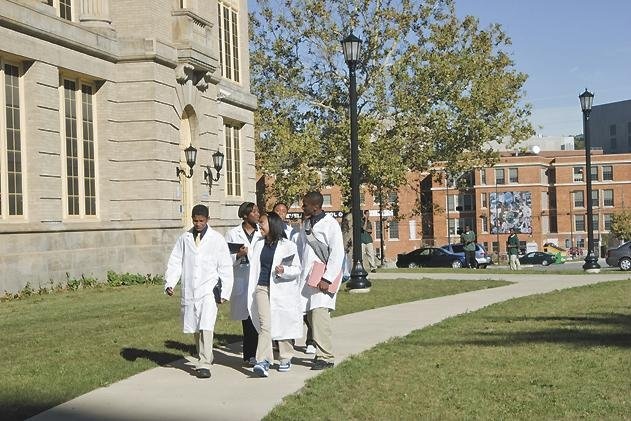
The foundation also has paid to start eight innovative schools within the district, including the Cleveland School of Science and Medicine, where Mr. Richard is co-chairman of the board. The schools, which operate like charter schools, are outperforming other schools in the district, and they helped prompt Eugene Sanders, the district’s chief executive, to unveil an ambitious plan for the entire system in January. The foundation paid for three studies that underlie the plan, which would close 18 schools and hold teachers more accountable.
Altogether, the Cleveland Foundation has also poured more than $5-million over the past four years into the Cleveland Metropolitan School District. (That doesn’t count an additional $3-million to start the Cleveland Center for Arts and Technology, a job-training and after-school program, which is a replica of Pittsburgh’s highly successful Manchester Bidwell training center.) Mr. Richard expects to spend millions more.
Support from the Cleveland Foundation and other grant makers allows the district to try new approaches that wouldn’t otherwise be affordable, Mr. Sanders says. In return, the Cleveland Foundation gets an extraordinary platform through which to help policy.
“I’ve joked on occasion that Helen Williams is a full-time staff member,” at the district, Mr. Sanders says.