Fewer Groups Got Charity Status in 2015, but Numbers Still High

By Alex Daniels
Senior Editor, Foundations
March 30, 2016 | Read Time: 3 minutes
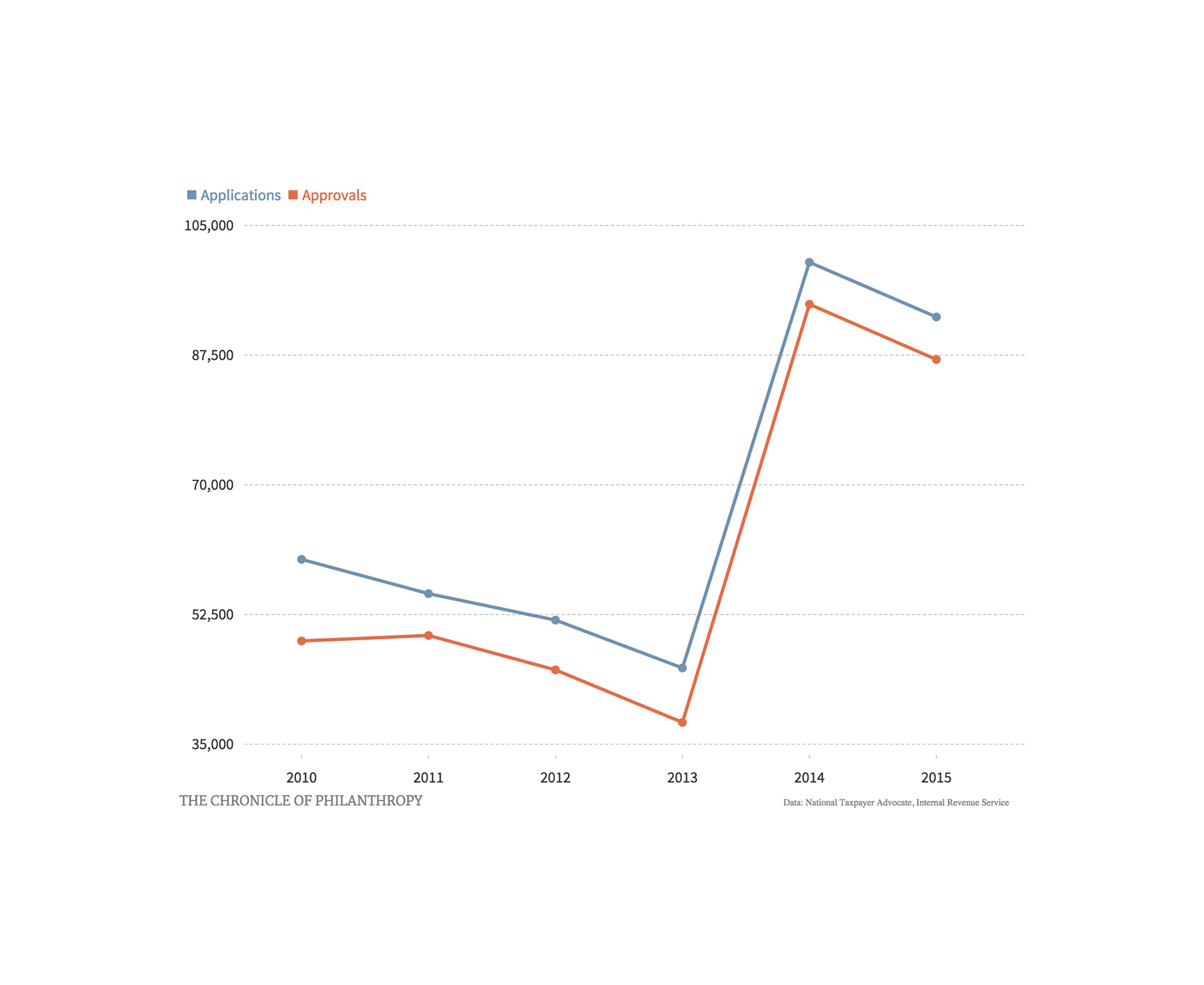
The Internal Revenue Service granted about 8 percent fewer 501(c)3 tax-exempt designations in fiscal 2015 than in the previous year, according to an annual compilation of agency data released Wednesday. However, the number of annual approvals still remains far above the level of just a few years ago, when the IRS implemented a major policy change.
In the fiscal year that ended Sept. 30, 2015, the IRS approved 86,915 applications for 501(c)3 status, the designation reserved for charities, down from 94,365 in 2014, the first year a streamlined application form was in use.
Beginning in July 2014, most organizations with annual gross receipts of $50,000 or less became eligible to use the 1023-EZ, a three-page electronic form, instead of a 26-page application.
Following the introduction of the 1023-EZ, 501(c)3 application approvals more than doubled in fiscal 2014. In each of the three years prior, the number of annual approvals was less than 50,000.
Not everyone is enthused by the accelerated pace. Critics have warned that the shorter tax form makes it more difficult for the IRS to root out fraud. The longer form, they say, gives the agency more insight into an organization’s proposed mission.
The IRS decided on 92,653 501(c)3 applications last year. No action was taken on 5,681 of them, either because they were withdrawn by the applicant, they were not complete, or for other reasons. Fifty-seven applications were denied.
In total, there were 1.7 million nonprofit organizations in 2015, by the agency’s count. Of those, 1.2 million had 501(c)3 status, reflecting a steady increase in the total number of charity, religious, arts, and educational nonprofits. Five years ago, there were 100,000 fewer charitable organizations.
Easy Approval
Virginia Gross, a tax attorney and member of the IRS Advisory Committee on Tax Exempt and Government Entities, said the low denial rate shows that it is relatively easy to get tax-exempt status.
“Most get approved,” she said. “The ones that are unfavorable are usually pretty egregious.”
The approval rate — 94 percent — is much higher than it was before the introduction of the shorter form. In fiscal 2010, for example, the agency approved 82 percent of applicants.
The higher rates helped clear a backlog of applications, but a study by the National Taxpayer Advocate suggested that many approvals were improperly granted. The advocate’s office, an independent entity within the IRS, reviewed 408 recent applications from 20 states and concluded that more than one-third should not have been approved.
In its most recent report to Congress, the advocate’s office found the agency’s attempts to regulate nonprofits lacking: “Because Form 1023-EZ does not require applicants to provide supporting documentation or substantiation, but only to attest they qualify for exempt status, the IRS has in effect relinquished its power to educate and regulate taxpayers before it confers status.”
During the second quarter of 2015, the IRS split legal oversight of tax-exempt organizations into two divisions, one that focuses specifically on tax-exempt groups and government entities and one that supports the broader efforts of the agency’s Office of Chief Counsel.
Combined, the two divisions worked on 1,925 court cases and enforcement actions. The IRS closed 1,993 cases, and at the end of the fiscal year there were 1,255 cases pending.
The IRS’s budget for enforcement has declined from nearly $5 billion in fiscal 2013 to $4.8 billion last year. The agency’s headcount has shrunk too. In 2014, the IRS had 76,126 permanent employees; last year, there were 74,580.