

September 22, 2013 | Read Time: 7 minutes
The sluggish economy is no longer a strong influence on how much donors plan to give, but the Great Recession has changed how Americans decide where their charitable contributions go, according to a new survey.
For the first time since the economy hit its worst point five years ago, more than 80 percent of Americans now say that the financial crisis won’t affect their donations.
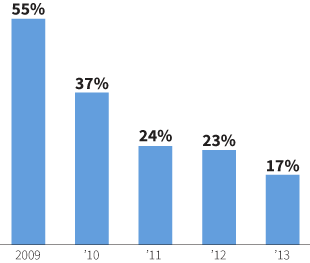
At the height of the financial crisis, more than half of all Americans said that hard times were forcing them to reduce their giving. That number has stayed stubbornly above 20 percent until a new survey of 16,500 donors released this month found that just 17 percent plan to decrease contributions next year because of the slow recovery.
But the study, by Cygnus Applied Research, also found some worrisome signs for fundraisers about the ways the Great Recession has shaped donor habits:
- Half of all donors in the survey said they are more likely than they were five years ago to stop giving to charities that bombard them with fundraising appeals.
- One in five said they are more likely than they were five years ago to take into account whether charities are spending too much on fundraising.
- A third of donors say they are more likely to seek out charities that provide measurable results and to do research before they make donations.
What’s more, the bad economy reinforced a trend that started even before the downturn as more donors limit the numbers of groups they support, the study found.
Forty-three percent of donors ages 35 to 64 are contributing to five or fewer causes, compared with 25 percent of people 65 and older.
“Donors are moving toward managing their philanthropy in a more purposeful, deliberate, and independent way than they were 10 years ago—and especially 20 years ago,” says Penelope Burk, president of Cygnus Applied Research.
The irritation that donors feel about nonprofit spending on appeals came across in comments donors made in the survey. “I worry about the amount of money spent on fundraising, and I am reminded of its high cost whenever I am solicited,” one participant wrote. “I no longer respond to these appeals.”
Wrote another: “I can do so much more than write a check, and if I start to feel like that’s all an organization wants from me, I lose interest.”
Among other findings of the study, which surveyed donors provided by charities who had given at least once during 2011 or 2012:
Events motivate donors more than other fundraising tactics. Free gatherings that recognize donors’ contributions and educate people about a charity’s work spur donors to give generously, the survey found, far more than conventional approaches like publicizing a donor’s name.
“I like interacting with other donors who are passionate about the issue or organization,” one respondent wrote. “My best experience with this has been with educational institutions that send out their professors/deans to give a lecture and mingle with guests. There is no reason why other organizations can’t do similar events.”
Fifty-two percent of donors said they attended at least one such charity event in the past two years.
Of those donors, 87 percent said the events had a positive influence on their decision to support the charities hosting them. And since attending their most recent event, 31 percent said it motivated them to give again without being asked, another 36 percent said they contributed when asked, and 20 percent more said they had not yet been asked but would give again. “There is a huge tangible connection between being invited to an event and the good feelings a donor has about a nonprofit,” says Ms. Burk. Events, she adds, “take a lot of time and effort to organize, but when you get results like this, they are worth it.”
Other tactics used by fundraisers did less well. For instance just 12 percent of donors were motivated to give because a charity publicly listed their names, 11 percent because the group invited them to join a giving club, and 7 percent because the charity sent them token gifts such as address labels or greeting cards.
“If you show me you are not using my money wisely by sending trinkets or too much paper, it’s the first way to get off my list,” one person wrote.
Prompt thank-you letters and calls matter. More than 30 percent of donors in the survey said they would probably not keep supporting a charity that fails to acknowledge their donation within two weeks of receiving it.
Thirty-two percent of donors said they had received a thank-you telephone call after making a gift.
More than a third of those who received a thank-you call and gave afterward attributed the donation to the call, with many donors giving more generously than they had previously.
The study also found that it didn’t matter whether a donor spoke directly with a charity official or got a voicemail message. But donors were more likely to give again and make larger gifts when they received thank-you calls from board members, chief executives, or other prominent staff members than from fundraisers.
For example, 14 percent of donors who got a thank-you call from a board member said it prompted them to give again before they were asked, more than double the percentage of donors who got a call from a fundraiser.
Donors want results from people in charity programs. After being thanked for their donation, what donors said they wanted most was information on results achieved with their gift: Three-quarters of donors said that was their top desire and that they most wanted to hear about results from someone helped by the organization or staff members in charge of the programs their gifts supported, not from top charity officials or board members.
Fundraisers waste time on some tasks. Fundraisers put a lot of effort into compiling donor listings, but putting donors’ names in newsletters, in annual reports, or online has very little effect on people’s decision to give, Ms. Burk says. And charities risk alienating supporters by misspelling or omitting their names.
Ninety-two percent of donors in the survey said they would have given the same amount regardless of whether their name appeared in a charity’s communications.
Ms. Burk also suggests that fundraisers find alternatives to placing donors’ names on a wall. Three-quarters of the donors surveyed said that made no difference in their decision to give.
Young donors want charities to court them. The study found stark differences in how much people of different ages donated to charity.
Among more than 12,000 donors who provided figures for their giving in 2012, those 65 and older gave the most, $39,371 on average, while those ages 35 to 64 donated an average of $26,344. By comparison people under 35 contributed just $1,719.
That may explain why many fundraisers focus so little attention on donors younger than 35, says Ms. Burk. Yet they have potential: Sixty percent of donors under 35 in the survey, for example, said they increased their donations last year, far more than middle-aged donors (43 percent) or those over 65 (37 percent), and 88 percent reported household incomes over $70,000.
“Catch us while we are young with ways to engage other than just monetary donations, so that when we have the funds, we will know your organization and be more motivated to give,” one young donor wrote.
Because of their potential now and in the future, Ms. Burk says, charities should consider asking donors under 35 to join their boards and find other ways to involve them.
An electronic version of the complete 2013 Burk Donor Survey may be ordered online at cygresearch.com. The cost is $75.
Back to Normal: Economy Is No Longer A Worry for Donors
When the recession was at its worst, more than half of charity supporters said they would give less because of economic conditions. Today only 17 percent say so.
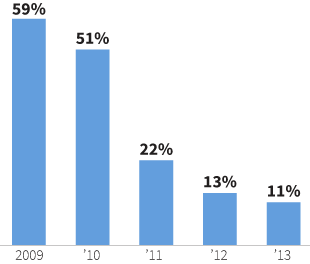
The financial crisis prompted nearly 60 percent of donors to say they would increase their giving to basic-needs groups. Now only 11 percent say so.
SOURCE: Cygnus Applied Research




