Former Education Secretary Looks to Build Bush Foundation’s Programs

By Ben Gose
Senior Editor
October 6, 2013 | Read Time: 5 minutes
Margaret Spellings, best known as a former U.S. education secretary, was one of President George W. Bush’s longest-serving advisers—and she’s not finished yet.
In September, Ms. Spellings became president of the George W. Bush Foundation and the former president’s policy institute.
She replaces Mark Langdale, who raised more than $500-million for the Bush center, which is located in Dallas on the campus of Southern Methodist University. The center, dedicated in April with all five living presidents attending, houses the policy institute and Mr. Bush’s presidential library and museum.
Last year the Bush Foundation was included for the first time on The Chronicle’s Philanthropy 400, a list of U.S. organizations that have raised the most money. A campaign to pay for the new center helped bring in nearly $161.2-million.
Future fundraising success, says Ms. Spellings, will depend largely on the strength of the institute’s programs. “The focal point is shifting toward the institute and away from the building,” she says. “The next five years will be key in determining if we are going to build something that has staying power. “
No Big Shift
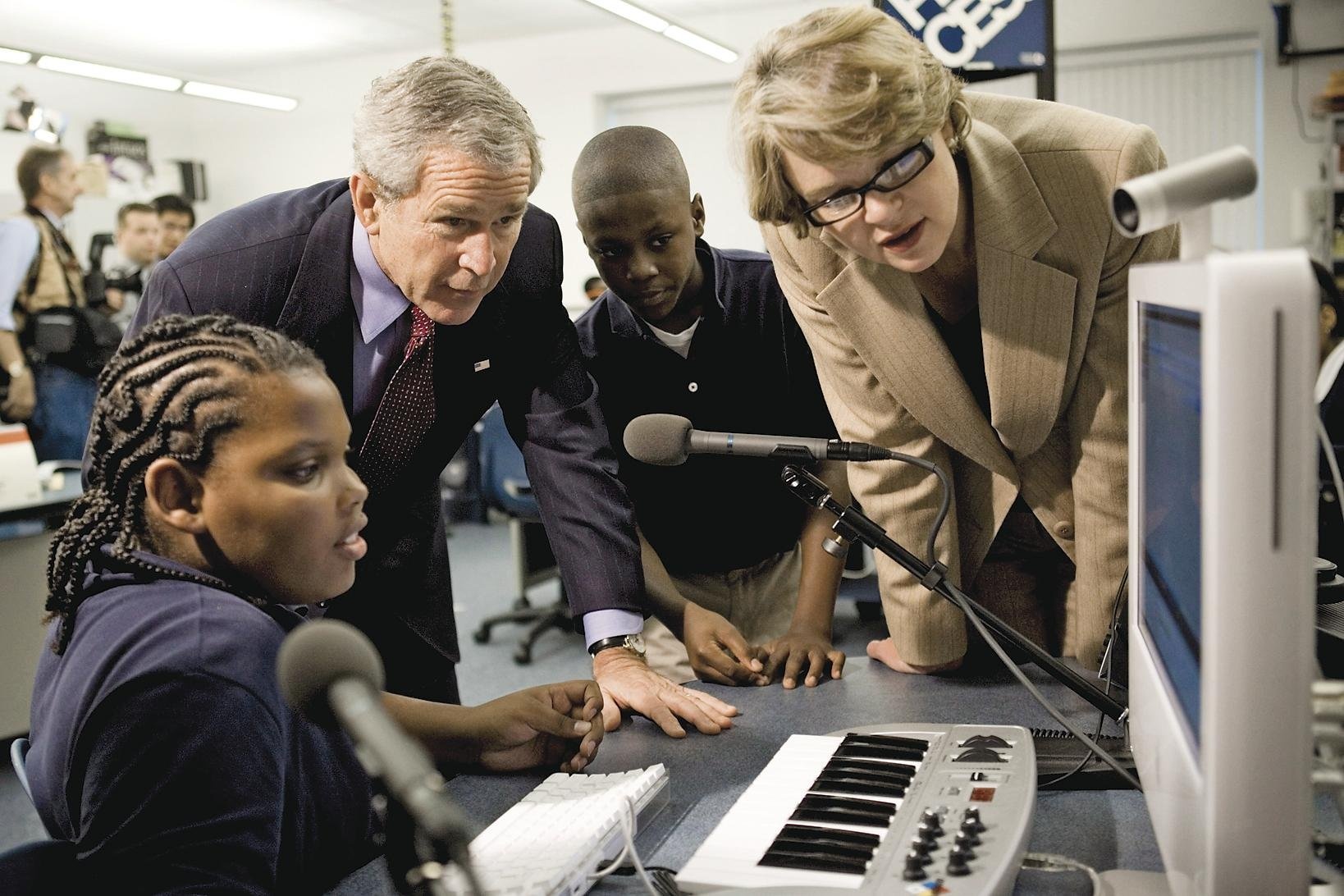
Ms. Spellings served as the nation’s education secretary from 2005 to 2009, and she is one of the architects of the controversial No Child Left Behind Act, which imposed an unprecedented level of testing in public schools.
Education was already one of the policy institute’s top priorities. Her appointment, she says, doesn’t reflect any shift in focus at the foundation.
Other priorities that will remain intact, she says, include programs in the areas of global health, U.S. economic growth, and human freedom, as well as efforts to support military veterans and improve the lives of women around the world.
“Our operating principle is around freedom, including freedom from disease, freedom to pursue your dreams, and what it takes to keep America free,” she says.
She says she’s “in despair” over waivers that have allowed many states to stop collecting and reporting data on the academic performance of low-income and minority students, as the states have been required to do under the No Child Left Behind Act.
“Even though the results are often shameful, we can’t take the ostrich approach and make ourselves feel better,” she says.
The foundation’s strategy for encouraging greater educational accountability is “under construction,” she says.
Back to Texas
Ms. Spellings grew up in Houston and held staff jobs at the Texas Legislature before becoming the top lobbyist for the Texas Association of School Boards in the early 1990s. She met Mr. Bush when he was an owner of the Texas Rangers baseball team and was mulling a run for governor of Texas.
She became a senior adviser to Mr. Bush after he was elected governor, and she served as his domestic policy adviser during his first presidential term, when she helped develop his $15-billion effort to fight the global AIDS pandemic.
For the past five years she has run an education-consulting firm in Washington and led the U.S. Chamber of Commerce Foundation.
President Bush persuaded her that heading his foundation and institute offered the right opportunity to return to Texas, Ms. Spellings says. “Once a Texan, always a Texan,” she says.
She’ll give up some of the independence she has enjoyed since leaving political office, but she says she’s comfortable with the tradeoff since she sees eye-to-eye with Mr. Bush on most issues.
“The opportunity for ideas coming from places outside of Washington is a ripe one,” Ms. Spellings says. “There’s a lot of space at the moment for people who are sensible problem solvers.”
Sandy Kress, a Texas lawyer who helped craft the No Child Left Behind education law, describes Ms. Spellings as “extremely bright and accomplished.”
“She’s awfully darned effective at getting things done, and she cares deeply for the president and Mrs. Bush,” Mr. Kress says.
Global-Health Focus
The Bush Institute may be best known for its leadership in creating Pink Ribbon Red Ribbon, a public-private partnership to expand the availability of cervical- and breast-cancer screening and treatment for women in sub-Saharan Africa and Latin America.
Ms. Spellings says she hopes to expand on the model of the institute’s global-health program, which is led by Eric G. Bing, a professor at Southern Methodist University.
“We’ll do more of that sort of thing across the program areas as we get going,” Ms. Spellings says.
She also plans to hire more local staff members at the foundation and the institute. So far, she says, the organization has relied on stringers around the country: “I’d like to build more human capital in Dallas.”
Ms. Spellings says she wouldn’t have resumed working for Mr. Bush if she didn’t enjoy it. “We have a lot of fun together. We laugh a lot,” she says. “And mega-dittoes for the First Lady.”
The best thing about working for Mr. Bush, she says, is that he is open to new ideas—as long as there’s a concrete plan for carrying them out.
“The sky’s the limit,” Ms. Spellings says, “if you can figure out how to block and tackle.”
Margaret Spellings, president, George W. Bush Foundation
Education: B.A., University of Houston, political science
Career highlights: U.S. secretary of education; domestic policy adviser to President George W. Bush and senior adviser to Mr. Bush when he was governor of Texas; head of governmental and external relations, Texas Association of School Boards
Salary: She declined to disclose it.
What she’s reading: Where’d You Go, Bernadette, by Maria Semple