
Founder of For-Profit Lighting Company Wins $100,000 Bronfman Prize

By Caroline Bermudez
Contributor
June 16, 2014 | Read Time: 5 minutes
Sam Goldman did not intend to become a businessman. But after seeing a child suffer a painful accident, he saw starting a business as the best way to help save the lives of the world’s neediest people.
In 2004, Mr. Goldman was a Peace Corps volunteer in the West African country of Benin, living in a village without electricity, when he saw a neighbor’s child badly burned by a kerosene lamp. The child, who survived, endured multiple operations.
Lack of safe, reliable lighting, Mr. Goldman learned through subsequent research, caused millions of accidents and was catastrophic in villages with houses made of wood and thatch.
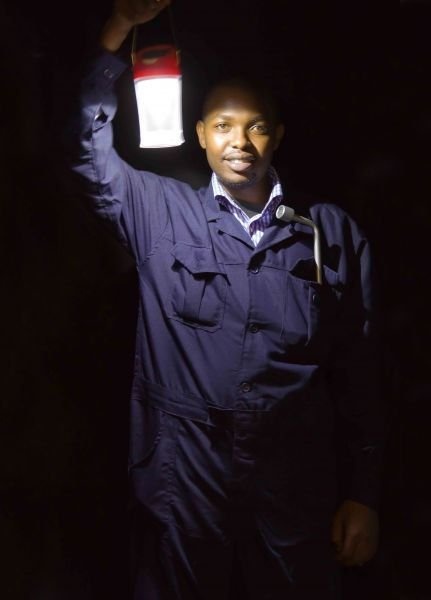
The child’s accident, combined with Mr. Goldman’s long-held interest in technology (particularly, LED lighting), led him away from a career in international development and instead to Stanford Business School, where he co-founded d.light design, a for-profit social enterprise in San Francisco that creates and distributes solar light and power products for people who lack reliable electricity.
Since its founding in 2006, d.light has reached 33 million people in 62 countries. In recognition of his work, Mr. Goldman, 34, has won the Charles Bronfman Prize, a $100,000 annual award given to a humanitarian under age 50.
The prize holds several distinctions this year: Mr. Goldman is the 10-year-old award’s first Canadian recipient, the first person working at a for-profit enterprise, and its youngest winner ever.
A Wide Impact
Ellen Bronfman Hauptman, a co-founder of the prize, says Mr. Goldman was chosen because his efforts have wide impact: “We’ve honored people that are in the fields of environment, education, health, and he seems to cover all those fields.”
Although Mr. Goldman’s efforts are for-profit, Ms. Hauptman says, his work meets the same criteria the judges use to select winners from nonprofits. “What he’s doing is philanthropy,” she says. “There our two tenets in the prize: We’re recognizing people that are improving the world and are trying to provide inspiration to the next generation. He fit those things in our minds.”
Mr. Goldman says the prize is a continuation of the valuable support d.light has received from philanthropy. The company has won financing from both venture-capital firms and grant makers. Its latest round of investments, totaling $11-million, includes money from the Omidyar Network and the Acumen Fund. The Shell Foundation, the charitable arm of the oil company, is a partner.
Philanthropic support, Mr. Goldman says, is what enables d.light to be bold in its plans to attract more consumers. “If we were to have to do it only with equity or venture-capital funding, we wouldn’t be able to do it,” he says. “Or we’d do it at a much smaller scale and we wouldn’t take the same risks.”
Path to Business
The former “hard-core environmentalist” decided to go to business school when he saw the need for an alternative to kerosene lighting in villages similar to the one in Benin.
Dependency on kerosene, Mr. Goldman says, did not make any sense. The fuel is expensive, harmful to the environment, and produces poor light.
“It really is an inequity today that people are still living by kerosene,” he says. “Why should they be burning a flame for their light when we have the means available to give them proper light?”
At Stanford Business School, Mr. Goldman sought to answer that question. In addition to learning about product design and how to work with clients, he joined a team of students interested in renewable energy.
After creating some prototypes of solar lighting, his team traveled to meet with a nongovernmental organization in Myanmar to make a presentation and encourage local residents to use their products.
The team knew its efforts were successful, Mr. Goldman says, when, after trying to retrieve their prototypes, the people who had been using them cried at the prospect of doing without the lights. They said the products had changed their lives.
The seeds for d.light were thus planted. With the team, Mr. Goldman devoted nights and weekends during his second year of school to starting the company. Early on, the company enjoyed a critical vote of confidence as it pitched venture capitalists: It won $250,000 from Draper Fisher Jurvetson, a Silicon Valley firm that invests in new, promising companies.
D.light, Mr. Goldman says, is his way to solve manifold problems that have long concerned him through a single means. “This business is one that has environmental gains, massive social gains, education, health. It was the perfect embodiment of all the things I cared about in one answer: solar power.”
Energy for All
D.light design has more than a dozen offices worldwide and four distribution centers in Africa, China, South Asia, and the United States.
The company has sold more than 6 million products, and Mr. Goldman says it has seen exponential success: Every year d.light has reached more people than all other previous years combined. It seeks to serve 100 million people by 2020.
Believing someone else would be better suited to expand d.light, Mr. Goldman stepped down as the company’s leader in 2011. Donn Tice, an experienced technology executive, now runs it, with Mr. Goldman acting as its chief customer officer.
He says d.light will participate in “Sustainable Energy for All,” a campaign by the United Nations Foundation to advocate for increasing needy people’s access to renewable energy.
Ensuring regular access to better sources of energy, Mr. Goldman says, is key to lifting the economies of poor nations.
“If we can bring light to them, we can bring power for communication and business, then that enables them to create opportunities in education, health, employment,” he says. “That’s the story of what d.light is going to be able to do for hopefully a couple of billion people.”




