Funders Step In to Help Nonprofits Facing Legal Threats Over DEI
Civil rights laws haven't changed, but racial equity nonprofits feel exposed to lawsuits because of the Trump administration's conservative interpretation of the law.

By Alex Daniels
Senior Editor, Foundations
February 13, 2026 | Read Time: 8 minutes
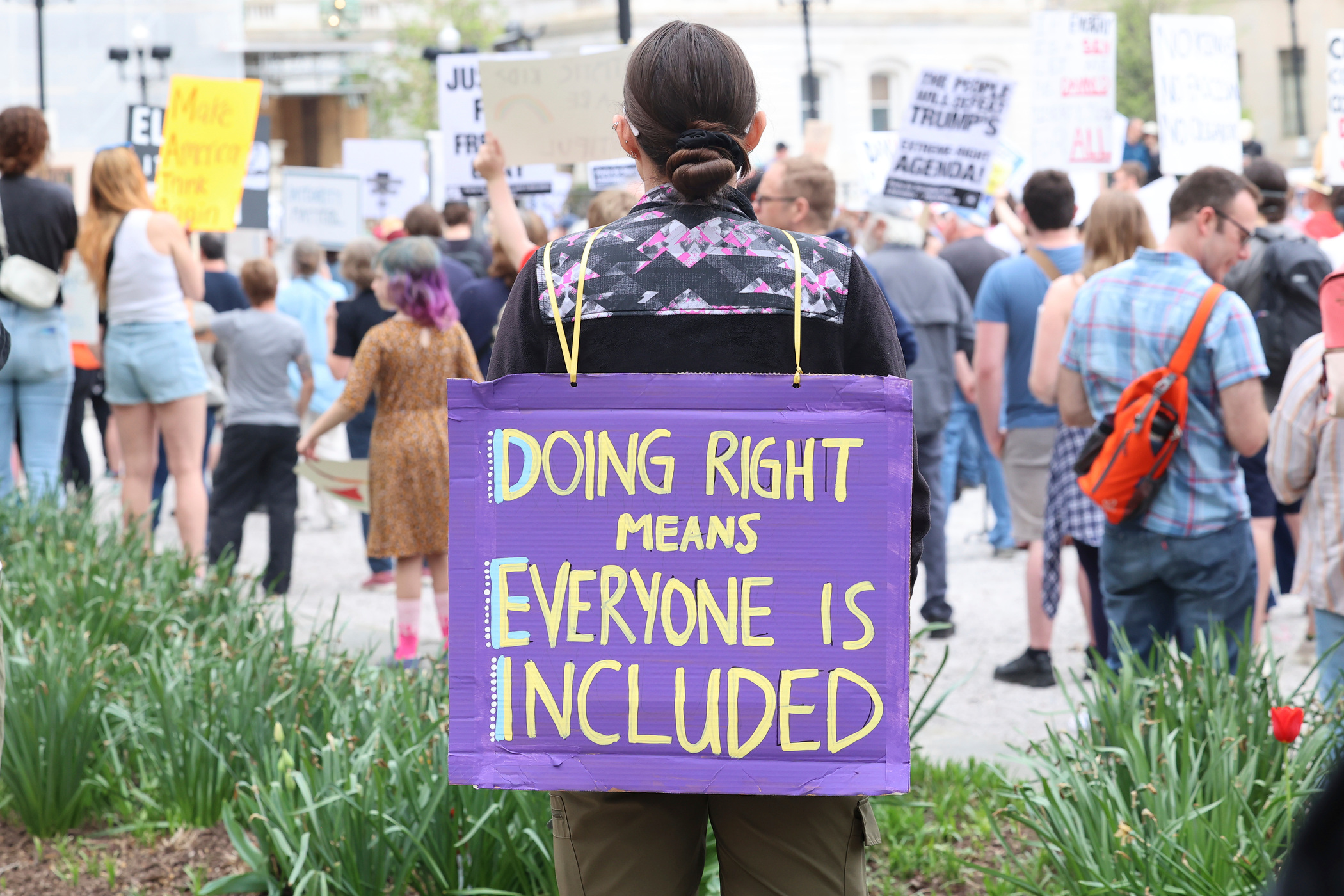
A collection of networks to provide pro bono legal counsel has emerged to protect nonprofits that fear their race-based work will land them in court. The nonprofits are fighting the Trump administration’s effort to bulldoze diversity, equity, and inclusion programs.
One of them, the Nonprofit Legal Defense Network, was created following Trump’s January 2025 executive order that prohibited federal DEI programs and called for investigations into foundations and nonprofits that base funding decisions on race.
The order sent tremors through the ranks of progressive nonprofits, recalls Anna Chu, executive director of We the Action which, along with the Alliance for Justice, started the network.
While Trump’s directive did not have the full force of law, it signaled that the administration took a dim view of programs designed to help people of color and would train its gaze on the work of nonprofits. The shift emboldened GOP members of Congress, who held hearings on DEI, and conservative legal nonprofits, which filed lawsuits against corporations and nonprofits.
Though civil-rights law has not changed in the past year, Chu, like many progressive nonprofit leaders, worries that following a landmark 2023 Supreme Court decision prohibiting race-based college admissions decisions, courts will interpret civil-rights law differently.
For small nonprofits, many of which are understaffed and this year faced cuts in federal grants, the prospect of defending against an expensive lawsuit or, worse, the revocation of its tax-exempt status is daunting, Chu said.
Her group is not alone in offering support. Some foundations have set up legal support funds, including Robert Wood Johnson, which in 2023 created a separate line of grant making to assist nonprofits in DEI programs. The approach provides grants for nonprofits that offer legal advice on how to protect against litigious threats and general operating support for nonprofits that are going on the offensive to challenge anti-DEI orders in court.
“Nonprofits are really swamped,” Chu said. “A lot of them might not have a general counsel, a lawyer on their staff, or any lawyers on their board.”
Free Legal Help
Late last year the network hosted two risk-assessment clinics in which nearly two dozen nonprofits were paired with lawyers who are part of We the Action’s network of 55,000 attorneys who provide pro bono advice.
The goal, Chu said, is to ensure that participating nonprofits have done everything by the book. While a DEI lawsuit might not gain any traction against a nonprofit, the trial process could allow DEI opponents to “look under the hood” at an organization’s operations, searching for the smallest excuse to discredit them, such as a conflict-of-interest issue or advocacy that strays beyond what the law allows.

Free legal help is essential because the game plan of DEI opponents is to bleed progressive nonprofits dry, said Keith Thirion, Alliance for Justice’s interim co-president.
“The bigger goal is to get nonprofits so focused on defending against each and every one of those attacks that they’re no longer able to fulfill their mission,” he said. “Every penny that goes there is a penny less that goes towards fulfilling their mission.”
Some foundations and nonprofits, acting on the advice of their lawyers, have minimized references to race on their websites and recast their programs as race neutral. For nonprofits that view consideration of race and diversity as central to their calling, the Alliance for Justice has created a program, AFJ Law, which in the coming months plans to offer lawyers to provide free legal representation.
“You can have legal advice that is ‘stay quiet, keep your head down, scrub your website,’ and all of that,” said Deepa Padmanabha, the program’s director. “AFJ law is really about understanding the mission of the groups and grounding the legal advice in advancing that mission.”
The Alliance for Justice received $340,000 last year from the MacArthur Foundation, and We the Action, was created with funding from the Emerson Collective, the Palo Alto-based company that invests in innovators and social entrepreneurs. Both declined to provide details on current funding for the Nonprofit Legal Defense Network.
Demand Outstrips Funding
Philanthropic support for legal advice stemming from the DEI order has been uneven. Some grant makers are sitting on the sidelines, but others are pitching in. Last summer a group of large foundations said they would commit a total of $250 million to pro-democracy efforts, which would include legal defense. And a coalition of philanthropy groups that support Black, Asian American, Hispanic, and Native American people created the Racial Equity Advancement and Defense Initiative last year.
The fund distributed $850,000 in November and seeks to raise a total of $5 million. Citing security concerns, fund leaders declined to identify grant recipients.
Demand for more help is strong, said Connie Chung Joe, president of Asian Americans/Pacific Islanders in Philanthropy, one of the groups behind the fund. In its first round of funding, it received more than 470 applications that requested a total of $32.5 million.
Rather than focus on risks, Chung Joe advises foundations to develop their “courage quotient” and shore up the legal defenses of vulnerable nonprofits.
“You do have some foundations that are on the forefront, making big moves, but I think a lot of foundations have been a bit reserved or deliberate in allocating funding in areas that might be race-explicit,” she said.
Investigations, Lawsuits and Loss of Funding
In the year since Trump took office, legal experts say the administration has veered sharply from decades of practice in interpreting civil rights law, and that has created a lot of uncertainty for nonprofits.
In September, Trump created the National Joint Terrorism Task Force to investigate political violence. One of the hallmarks of those that engage in or fund domestic political violence is an “extreme” view on race, according to Trump’s directive creating the task force.
In December, the Department of Justice issued new regulations saying it would no longer enforce “disparate impact” discrimination claims. The change shifts the bar for proving discrimination. In a case involving disparate impact, it is not necessary to show intent to discriminate: A group can be held liable by just showing that an action harmed a large proportion of people of a protected class — say, people of a certain race or people with a disability. Now intent has to be proven, something often very hard to do.
The changes, combined with the realization that organizations in other sectors — like universities — have been dragged before congressional committees, investigated, and even lost hundreds of millions of dollars in funding before any court ruling, has given nonprofit leaders whiplash, said Julia Judish, a Washington, D.C., lawyer who represents tax-exempt organizations.
“The administration’s interpretations of the law and its policies, and positions about where it wants the law to go, are contrary to what was understood to be the law a year ago,” she said.
Joshua Thompson, director of equality and opportunity litigation at the Pacific Legal Foundation, a conservative nonprofit, agreed that civil-rights law has not changed. But he argues that even preceding the 2023 affirmative action decision, it was against the law to make any hiring, admissions, or funding decisions based on race except in rare circumstances.
What the Supreme Court decision did, and the Trump executive order on DEI supercharged, was the willingness of conservative lawyers to file lawsuits, he said.
“A lot of these race-conscious programs are just being struck down or abandoned after litigation commences,” said Thompson.
Since the executive order, there have been some high-profile changes to philanthropic programs. Drugmaker Pfizer discontinued its fellowship program for people of color after a court challenge, and the Fearless Fund, an Atlanta venture capital firm, and its foundation canceled a grant program for Black women entrepreneurs after being taken to court.
Robert Wood Johnson’s Grantees Fight Back
Those victories for conservative interpretations of civil rights notwithstanding, the broader response in the courts to DEI cases is far from clear, said Giridhar Mallya, senior policy officer for the Robert Wood Johnson Foundation.
Mallya points to two cases in which two Robert Wood Johnson grantees have scored early victories. In one of those, the American Public Health Association, with the support of the American Civil Liberties Union, challenged the termination of National Institutes of Health grants to nonprofits that had DEI programs or policies. In the other, a Robert Wood Johnson grantee, the Lawyers Committee for Civil Rights Under Law, won an early victory representing the Chicago Women in Trades, which supports women trying to succeed in male-dominated careers. Both cases have been appealed by the Trump administration.
Robert Wood Johnson has put $8 million toward the DEI legal protection, and Mallya said the grant maker is committed to the effort for several more years. If properly represented, he believes nonprofits that manage race-based programs can defend themselves in court.
But he said that success will come with a cost.
“If you design these programs thoughtfully and implement them thoughtfully, they can stand up to scrutiny in courts,” he said. “But you are going to face a lot of pressures, political, rhetorical, and otherwise.”