Government Gridlock and Spending Cuts Prevent Social Progress, Say Grant Makers

By Doug Donovan
Contributor
December 9, 2013 | Read Time: 4 minutes
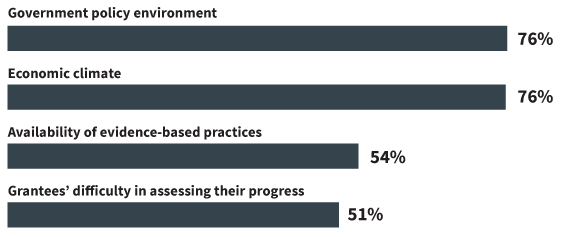
Foundation chief executives overwhelmingly cited government gridlock and spending cuts as the most significant barriers to their ability to improve progress on major social issues, according to a survey released today.
The Center for Effective Philanthropy’s survey of 211 foundation chief executives found that “the current government policy environment is a source of major frustration for foundation leaders.”
The foundation CEOs also named the sluggish economy as a major impediment to advancing their missions in causes such as education and health.
The center’s researchers said they were surprised that grant makers identified those particular pressures, rather than issues within foundations and at nonprofits, as the primary barriers to progress.
Those who participated in the survey run many of the nation’s largest funds.
Search for Answers
The majority of executives said they believed they were taking effective steps toward getting results, such as collaborating with other organizations, gathering feedback from grantees, and supporting nonprofits’ efforts to collect performance data.
But they said they were at a loss as to how to deal with government spending cuts, threats from state regulators, and proposed federal tax-code changes.
“We thought the barriers would be more of a mix of things that are under a foundation’s control and things that are not,” said Ellie Buteau, vice president of research at the center.
Government cuts in social programs or grants to the nonprofits that run them requires foundations to step in to help those charities deliver more basic services, she noted.
The survey results were welcomed by Tim Delaney, chief executive of the National Council of Nonprofits, who has been sounding alarms for years about government cuts.
“I’m excited to hear that our foundation partners recognize that these cuts by government” impede progress in achieving their missions, he said. “These survey results suggest it’s getting much worse. There’s talk about the economy recovering, but governments are still struggling.”
And as state and federal governments struggle, donors are being asked to fill in the gaps in financing, he said.
Kathryn Merchant, chief executive of the Greater Cincinnati Foundation and chair of the center’s board, said she was not too surprised by the findings.
Foundations may perceive their efforts as being influential locally or regionally, but “they pale in comparison to government resources and the weight of economic inertia,” she said.
Mixed Perceptions
The report also found a big difference between how foundation leaders rated the progress of their own organizations versus that of philanthropy as a whole.
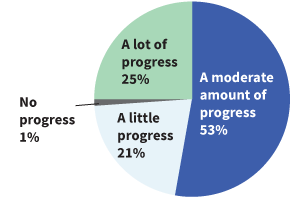
Only 25 percent of chief executives in the survey believed that overall, “a lot of progress” has been made in meeting primary goals. Yet 60 percent said their individual foundations have “contributed a lot” to the progress that has been made.
The report equates that contradiction to what psychologists call “positive illusions”—or “the tendency of humans to see themselves as better than typical.”
Part of the issue, according to a report on the survey, is that foundation CEOs are often surrounded by grantees who tend to provide “affirming feedback.”
In an essay he prepared for the release of the findings, Paul Brest, former president of the William and Flora Hewlett Foundation, attributes the disconnect to the “above-average, or Lake Wobegon, effect, where every foundation performs better than its peers.”
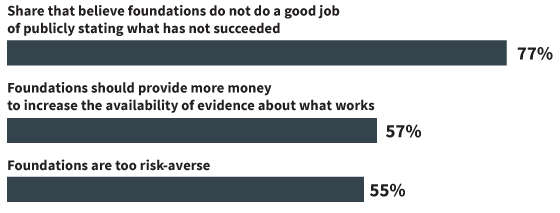
Foundation leaders agreed that they might do better if they shared their program results more readily, established standard benchmarks for measuring their efforts, and made data more available.
Mr. Brest is skeptical that foundations will put more efforts into such efforts, although “that would all be nice,” he said. “What’s difficult is that foundations are always disclosing news after it’s happened.”
Foundations, he said, should pursue their goals much in the way that drug companies conduct clinical trials. “They need to publicize what they are doing before they do it,” Mr. Brest said. “Foundations, for better and for worse, are not accountable.”
He said the Center for Effective Philanthropy’s report should provide “a new stimulus for foundations to gather and disseminate basic information about their goals, strategies, progress, and outcomes.”
The report is available on the center’s website.
Foundation Leaders’ Views of Progress in Advancing Their Mission
Main Barriers CEOs See
What Foundation CEOs Think About How Much Progress All Grantmakers Have Made
How Chiefs Think Grantmakers Could Improve