October 31, 2010 | Read Time: 3 minutes
Ten years ago Diane Brown lay in a CT scan machine, scared by her sterile surroundings and by what doctors might find in her body. Then Ms. Brown closed her eyes and found comfort by imagining an artwork by Matthew Ritchie creeping up the white walls and onto the ceiling.
“I wanted to get out of there, and the only way I could was through my imagination,” says Ms. Brown, now 62. “After I was done I thought, I would like to do this for real—put museum-quality art into hospitals.”
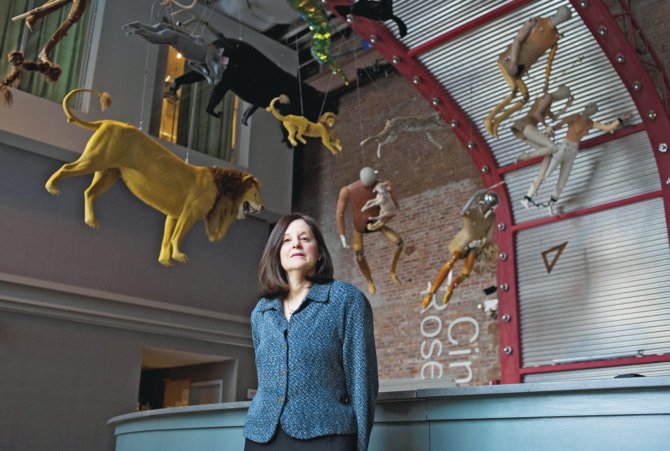
Today Ms. Brown, a former contemporary-art dealer, is healthy and so is her nonprofit group, RxArt, in New York. In the past decade the group has completed 18 art projects in health-care facilities around the country.
When children arrive for a CT scan at Advocate Hope Children’s Hospital, in Oak Lawn, Ill., they find four huge monkey faces smiling at them from the front of the blue-painted machine. Giant images of a purple heart and red balloon dog, as well as a portrait of a donkey, adorn the room’s candy-colored walls. The lighthearted, vibrant images come from the pop artist Jeff Koons, a megastar in the art world. He waived his artist’s fee for the $25,000 project, paid for by Kiehl’s, a cosmetics company. Now the hospital and RxArt hope to raise the same sum for Mr. Koons to reinvent the dreary CT scan waiting room.
“I don’t want to put something expected in a room,” says Ms. Brown. “I want to put something that is challenging in a positive way, something unfamiliar so that the person who is in that room can examine it, and that is time they are not really in the hospital in their minds.”
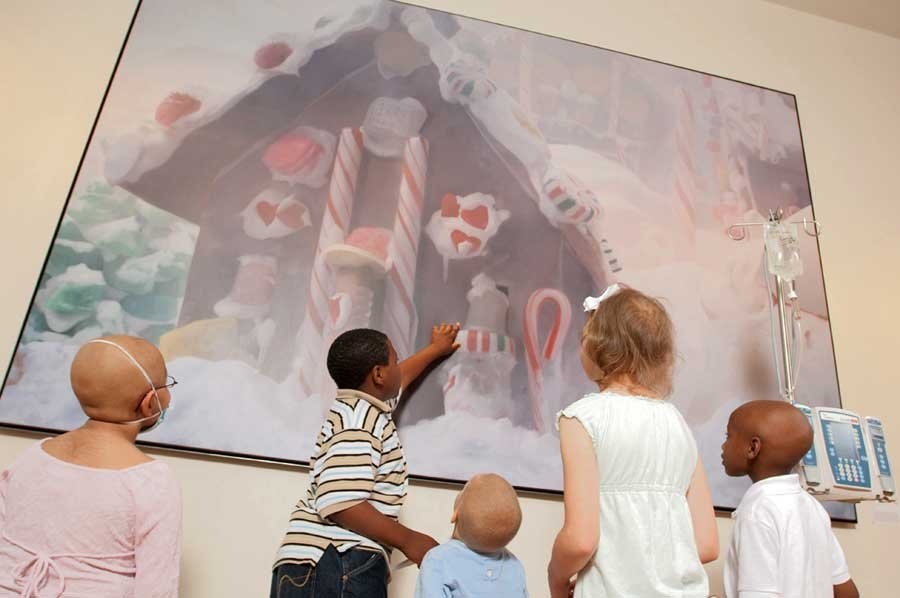
While patients and their doctors eat in the cafeteria at St. Jude Children’s Research Hospital, in Memphis, they are kept company by images of giant, dreamy, gingerbread houses by Will Cotton and colorful pandas on a glittery surface by Rob Pruitt.
Delicate strands of grass and yellow, red, orange, and purple wildflowers twist up the wall leading to the bone-marrow-transplant unit at Mount Sinai Hospital, in New York. The work, “Traveling Seeds,” by Jason Middlebrook, offers a hopeful message in its parallel between the plant and human worlds. “Patients have received bone marrow from other people, somewhat like seed pods floating from one destination to the next to spawn life,” Mr. Middlebrook has said.
RxArt’s budget fluctuates between $300,000 and $600,000, depending on money raised at its annual party, which accounts for 80 percent of its revenue. Foundations, corporations, and individuals have also contributed or paid for specific projects. Supporters can buy copies of two coloring books, which contain images from artists including Andy Warhol and William Wegman, on the group’s Web site, which also produces income. The books are distributed free in health-care facilities where RxArt has placed work.
Ms. Brown, who runs the group with one full-time staff member and two volunteers, says she keeps a waiting list of organizations keen to participate in the RxArt program. The process is collaborative—Ms. Brown chooses the art together with doctors, nurses, and other staff members. “If they are not on board, it’s a catastrophe,” she says. “They live with the art all day.”