
History, Culture, and Justice Among the Stops on a Miss. Donor Trip

By NICOLE WALLACE
Features Editor
October 31, 2010 | Read Time: 10 minutes
Greenwood, Miss.
Candlelight flickers in the churchyard as Sylvester Hoover stands by what might be Robert Johnson’s grave—three cemeteries claim to be his final resting place—and tells the story of the legendary bluesman’s life and mysterious death.
But the storyteller also talks about his own childhood in the waning days of the sharecropping system, which for decades kept many Southern blacks indebted to the owners of the cotton plantations whose land they worked.
“Daddy would go to the commissary to settle up, and Mr. Whitaker would tell him, ‘You almost broke even. You owe me $200,’” Mr. Hoover recalls. “I could see Daddy’s face drop. That really hurt his feelings, because he had worked his nine kids—even my sister with polio, she had to pick cotton—and then he didn’t make any money.”
That kind of potent mix of history, culture, and social justice is never far from the surface on the annual bus trip that the Mississippi Center for Justice organizes to introduce potential donors to its work and to re-energize longtime supporters.
The trips, highlighted by local guides and storytellers like Mr. Hoover, have proven to be a popular way to get contributors excited about the organization’s work, with some passengers returning multiple times.
On the bus the next day, staff members from the nonprofit advocacy group, based in Jackson, talk about the center’s work to combat the present-day trap of payday lending, which hits minorities and the poor especially hard.
In Mississippi, lenders are allowed to charge up to $22 for each $100 borrowed for a two-week loan period, the equivalent of a 572-percent annual interest rate. Many borrowers cannot repay the loan and fees when they come due and must take out a second loan to pay for the first, which is often the beginning of a spiral of debt.
Many of the center’s supporters are lawyers, and the discussion morphs into brainstorming. If all of the payday lenders charge the same rates, could the center challenge the businesses on the grounds of collusion?, one bus-trip participant asks. Another person wonders about the source of the money lent, and if drawing public attention to the investors could increase pressure for change.
Martha Bergmark, chief executive of the Mississippi Center for Justice, is blunt about the relationship between the state’s painful racial history and the social- and economic-justice issues Mississippi faces today.
Standing in the aisle of the bus, she tells trip participants, “There’s not an issue we touch that doesn’t go back to our Confederate heritage.”
Keeping Donors Involved
The Great Mississippi Road Trip was born out of a challenge the center faced soon after it started: How could the group help out-of-state grant makers and affluent donors better understand the problems Mississippi faces and connect in a meaningful way with the center’s mission to combat discrimination and poverty?
The first trips—which started in 2004, a year after the center got its start—consisted of six or seven people driven around by staff members in two or three cars. Interest shot up in 2006 and 2007 when the center took supporters to the Mississippi coast to see recovery efforts after Hurricane Katrina, including the center’s work to help survivors file claims and resolve rebuilding disputes. Since then, the trips have drawn 20 to 30 guests each year, and the center charters a bus.
The people who started the Mississippi Center for Justice always assumed that after the group was established in Jackson, the state capital, it would set up an office in the Mississippi Delta, the most impoverished region of the state. After Hurricane Katrina and then the financial crisis put those plans on hold, the organization is again looking to the Delta and hopes to open an office in 2011.
With that goal in mind, the Delta became the destination for the Great Mississippi Road Trip both last year and this year.
Each person who participated in the two-day tour last month paid $350 plus the cost of one night in a hotel room. The center plans carefully to make sure that participant fees cover the cost of running the trip, including hiring the motorcoach, a driver, and a guide. But the group doesn’t make any money on the event.
Roughly three-quarters of the center’s budget comes from foundations, and individual donations account for the remaining quarter—a ratio that has remained constant as the group’s budget has grown from $700,000 in 2004 to $2.4-million in 2010. Individual contributions, which have come from both out-of-staters and people who live in Mississippi, are particularly important because they can be used for the center’s lobbying efforts on issues like payday lending.
On their own, the bus trips are not enough to win a big gift, says Ms. Bergmark. But she thinks they have played an important role in cementing the group’s relationship with donors who might have drifted away otherwise.
“The trip was an experience that is keeping them with us for the long term,” she says.
Ghosts of Mississippi
For some participants, the road trip is a way to renew old ties to the state of Mississippi. The stories they share give the tour much of its power and poignancy.
David and Barbara Lipman, who now live in Miami, moved to Mississippi from Pittsburgh in 1970. Mr. Lipman, who serves on the board of the Mississippi Center for Justice, took a job as a civil-rights lawyer, and Mrs. Lipman started her teaching career.
As the bus rolls on to Money, the small town where she taught, Mrs. Lipman talks about the bleak conditions black students faced even after desegregation.
“I started in first grade. My kids, they didn’t even know what a pair of scissors looked like,” she tells her fellow travelers. “They didn’t know how to use a pencil. They had no exposure to anything. And then I got switched to fourth, fifth, and sixth, and no one could read. It was just sad. There was no hope for these kids.”
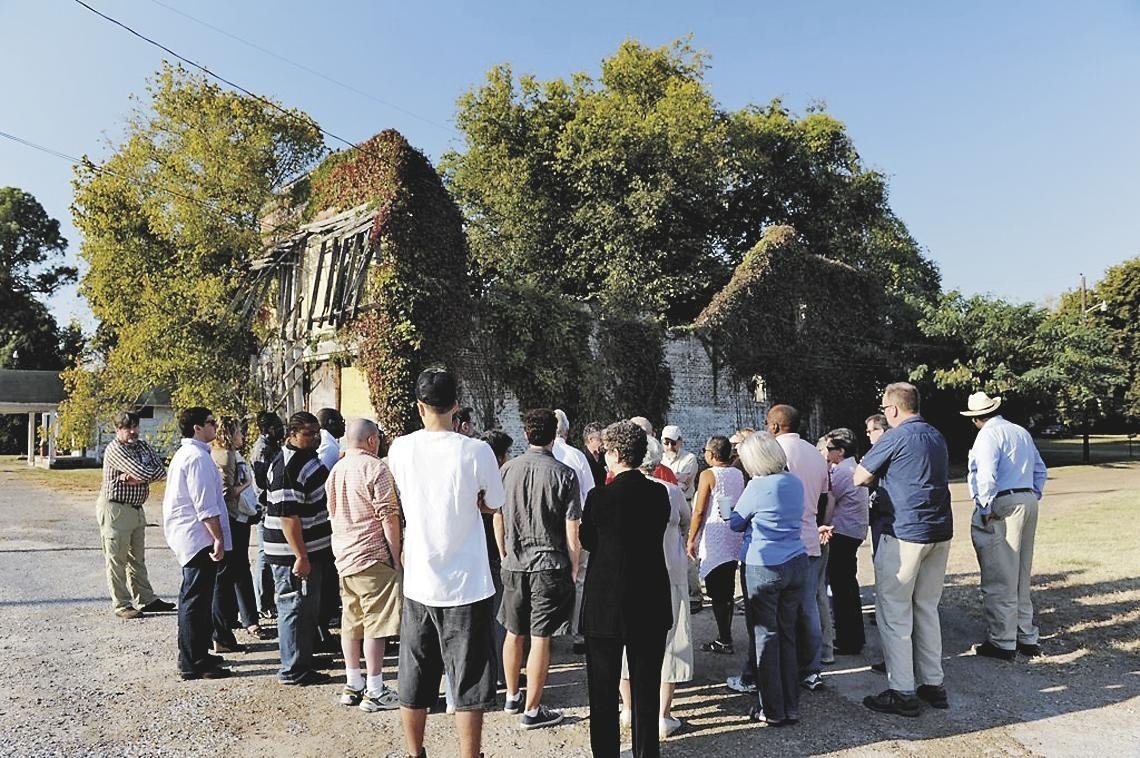
Fifteen years earlier, in 1955, Money was the site of the lynching of Emmett Till, an event that catalyzed the modern civil-rights struggle. The 14-year-old from Chicago was visiting relatives when he had a fateful encounter with a white woman at Bryant’s Grocery and Meat Market.
The store has long sat vacant. The roof is gone. Virginia creeper and poison ivy vine up and down what is left of the exterior walls.
“Obviously there’s been no effort to preserve it,” Luther Brown, director of the Delta Center for Culture & Learning, tells the group.
Right now nothing at the site states the significance of what happened there, but Mr. Brown says that will change next summer when a historic marker is set to go up. Two people who were on the center’s trip last year are paying for the sign.
Blues and Tamales
Figuring out the right balance of history, advocacy, and fun is one of the trickiest parts of planning the trip itinerary.
The Mississippi Center for Justice sued the South Delta Regional Housing Authority in federal court to help public-housing tenants fight rent increases that more than doubled the amount they pay each month, despite the authority’s failure to maintain the properties adequately.
Last year’s bus trip included a visit to one of the housing developments, something the group decided against this year.
“It felt a little bit voyeuristic,” says Ms. Bergmark. “It didn’t quite work unless we were going to take the time to spend half a day there and visit with people.”
The Delta’s rich musical heritage offers a window into local culture and gives the center a chance to inject some lighter activities into the lineup.
A stop at Po’ Monkey’s Lounge, one of the last authentic juke joints in the state, gives road-trip participants a chance to socialize, sample tamales, and listen to live music. Located in the middle of a cotton field outside Merigold, the ramshackle building, more than a century old, serves as both an entertainment venue and home to the farmworker who manages it.
The visitors marvel at the exuberant decor. Christmas lights, photographs, scrap metal cut in interesting patterns, stuffed animals, Mardi Gras beads, and more hang from the ceiling and layer almost every inch of wall space.
Ms. Bergmark is adamant about the importance of showing guests a good time.
“Mississippi’s a wonderful place to live, with wonderful people, interesting food, and a rich history,” she says. “That’s what you want people to get as well, not just, ‘Oh goodness, things are so hard here. Feel sorry for us.’”
Prison Memories
The weekend’s emotional climax is a visit to the Mississippi State Penitentiary, at Parchman.
At 19, Hank Thomas was one of the original freedom riders, a group of 13 activists who in 1961 left Washington in two buses bound for New Orleans with the goal of integrating Southern bus stations along the way.
Now, 49 years later, he is returning as a guest of the Mississippi Center for Justice to the once-notorious prison where he and the other riders were held after they were arrested in Jackson.
A tall man with a sonorous voice, Mr. Thomas wells up as the bus gets closer to the prison.
“I was put into solitary confinement three times while I was there,” Mr. Thomas says. “In solitary confinement, it’s a windowless, dark cell with a hole in the floor with a flush valve on it. They would give you two slices of bread and a cup of water for a day. That was all that was required, to simply keep you alive.”
But on this bright, sunny morning, Mr. Thomas gets a very different reception. Some of the prisoners have made a banner welcoming him back, and Emmitt L. Sparkman, the deputy commissioner of the Mississippi Department of Corrections, asks if he can have his picture taken with Mr. Thomas.
Mr. Sparkman talks about the prison’s GED and vocational-training programs and how important they are in reducing the number of people who end up back in prison after their release. He points out vegetable gardens and a chicken house where inmates tend some of the food they later eat. And he touts Parchman’s efforts to reduce crowding.
“We realize we lock up too many people in Mississippi,” says Mr. Sparkman.
At the end of the visit, Mr. Thomas shakes the official’s hand. “What a difference 50 years makes,” he says. (But government statistics suggest there’s still a long way for the state’s criminal-justice system to go: Mississippi’s crime rate is about 12 percent lower than the national average, yet its incarceration rate is 38 percent higher, according to the U.S. Department of Justice.)
Making a Pitch
The trip is winding down by the time Ms. Bergmark talks about the Mississippi Center for Justice’s plan to open an office in the Delta.
She talks about the great need in the region and the many groups that have come and gone, trying to make a difference but leaving when the going got tough. Ms. Bergmark says her hope is that the center could be a lasting presence to fight injustice but also to help make the Delta a place where residents want to live and where they can thrive.
It is anything but a high-pressure fund-raising pitch.
“We certainly don’t want to make that investment ourselves unless we can stay,” she tells the group. “We don’t want to be one of the groups that dabbles in the Delta.”
The center’s approach is low-key by design, Ms. Bergmark explains after the trip. Giving supporters a chance to experience Mississippi’s turbulent history will help them understand why the problems the state faces are so severe and why they should stand by the Mississippi Center for Justice, she says.
Says Ms. Bergmark, “We’re digging out of a deep, old hole.”
Tips for Planning a Donor Trip
- Conduct a focus group to determine the trip’s feasibility.
- Ask supporters, “Would you come?” not “Would it work?”
- Think about what the organization wants the trip to accomplish.
- Balance serious issues with fun activities.
- Don’t overload supporters with information.
- Make sure the fee donors pay covers the trip’s costs.
- Consider pairing the trip with the charity’s annual fund-raising dinner.





