Holograms to Answer Future Generations’ Questions About the Holocaust

By NICOLE WALLACE
Features Editor
September 8, 2013 | Read Time: 4 minutes
For decades, Holocaust survivors have visited schools to share their stories and give students a chance to ask questions about a very dark period in history. But with many survivors in their 80s and 90s, those days are quickly coming to an end.
To try to give coming generations of students the same opportunity to ask questions of eyewitnesses, the USC Shoah Foundation is turning to what still seems like futuristic technology: holograms.
The foundation is working with scientists at the USC Institute for Creative Technologies to record interviews with survivors using techniques that in time will allow the testimonies to be projected in 3-D. Natural-language technology—not unlike the Siri feature on the iPhone—will then let people interact with the testimony by asking questions that trigger relevant responses.
The goal is to create an immersive experience that sparks students’ interest and encourages them to learn more about the Holocaust, says Stephen Smith, executive director of the USC Shoah Foundation.
“Students will be able to ask the things that trouble them, that are on their minds, and have a direct answer to their question,” he says.
The approach, once perfected, could be used widely by museums and educational institutions, says Mr. Smith.
“We’re establishing a new form of dialogue with historical characters,” he says. “The technology is agnostic to the subject matter.”
3-D Technology
The technology to project recordings in 3-D is still developing, but Shoah and its partners have created a prototype that lets viewers ask 20 questions of the recording of Holocaust survivor Pinchas Gutter on a video screen. (The Institute for Creative Technologies has posted a short simulation online that shows how the technology will work.)
The foundation is now raising $6-million to record full interviews with 10 Holocaust survivors.
“While true holographic display may sound sci-fi to us, it will not sound sci-fi in 20 years’ time,” says Mr. Smith.
Guided Questions
The idea has attracted a lot of excitement, but the project has also raised questions about the appropriate use of technology when dealing with sensitive issues.
Mr. Smith says that colleagues in the field of Holocaust studies have expressed “a degree of uncertainty,” asking whether the project risks taking the Holocaust out of context and if survivors will feel comfortable participating. But he says their fears are unfounded.
“Every single Holocaust survivor I’ve spoken to about this wants to be involved,“ says Mr. Smith. “They’re interested in finding whatever way they can of ensuring that their legacy is preserved in perpetuity.”
To guard against the technology upstaging the survivors’ stories, the foundation will phase in the project. Early on, for example, the video interviews would be projected on a screen until 3-D projection technology is more mature and less likely to distract from the material.
Mr. Smith envisions a docent-led program at the end of a Holocaust museum’s permanent exhibition as a possible first installation.
“The students pose their question, ‘Do you believe in God?’ ” he asks. “And the docent says, ‘Great question’ and then says to the computer, ‘How did your faith change during the Holocaust?’ knowing that’s going to be a more stimulating conversation.”
A Believable Look
The cutting-edge project is expensive. The foundation expects the first interview to cost $1.7-million and the rest to cost roughly $500,000 each.
Mr. Gutter, the first interview subject, and foundation officials will spend three months meeting with students to find out what questions they would like to ask about the Holocaust. To make the final product as educational and conversational as possible, interviewers will have to ask survivors hundreds of questions and follow-up questions.
Asked during the test interview whether he still believed in God after his time in the labor camps, Mr. Gutter said that he did but that he also learned that it’s OK to question God.
“Then the obvious question is, ‘So, what questions do you have for God?’ ” says Mr. Smith. “We find the next obvious link so the content flows from each other.”
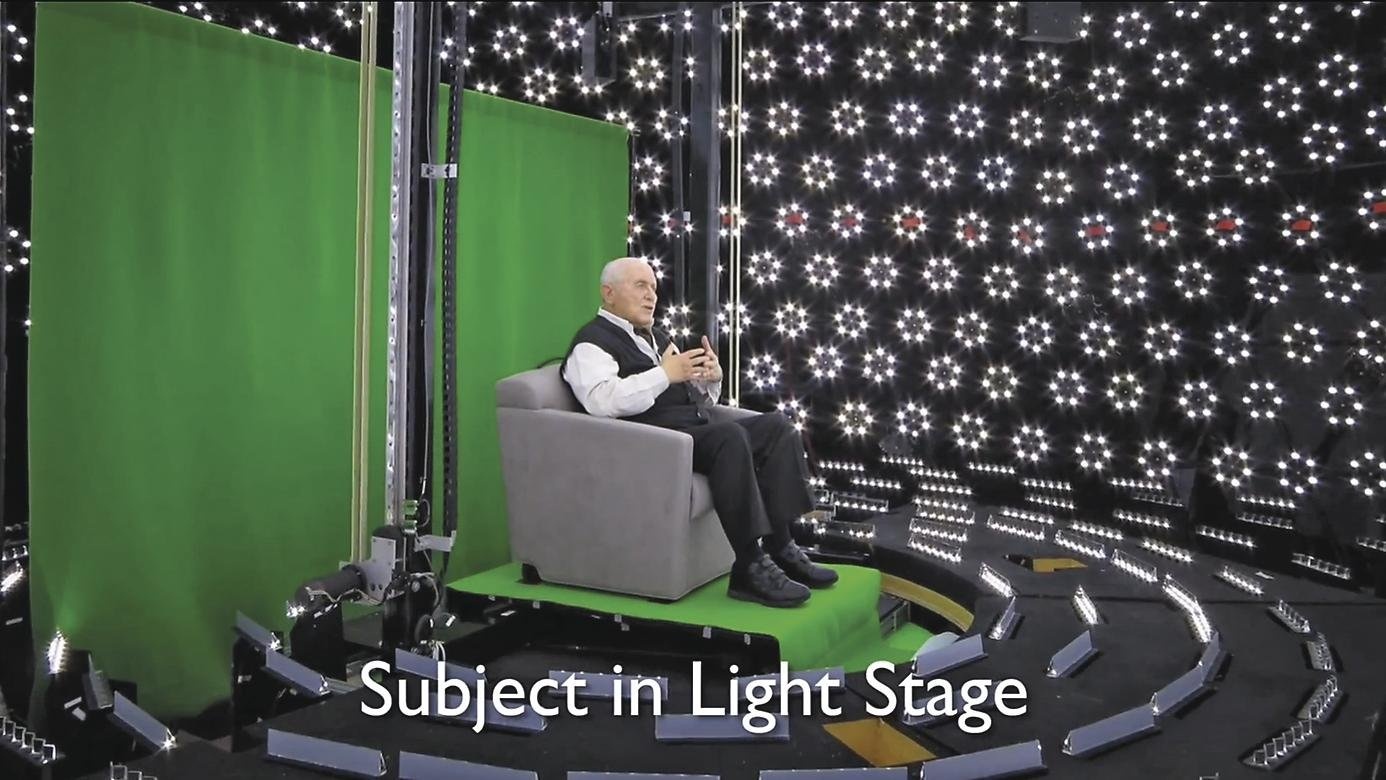
Filming takes place on a high-tech light stage. “It’s like a large 20-foot beach ball with 6,000 LED lights on the inside of it,” says Mr. Smith. “You stand inside the beach ball with these lights illuminating you from all directions.”
Technicians used seven cameras to record the interview for the prototype. For the full interviews, the plan is to use 50 cameras.
Filming from so many angles will eventually make it possible to project “a believable, almost physical-feeling presence” that will make it feel like the survivor is in the room, says Paul Debevec, associate director of graphics research at the USC Institute for Creative Technologies.
Projecting the interviews in 3-D is still in the future. But Mr. Smith says he’s moved by how powerful the interaction is even when the projection is just a video image on a screen.
“You are the creator of the story,” he says. “You ask that question, and the video witness is now looking straight out of the camera, straight into your own eyes, and giving you the answer to your question.”