
How New Robin Hood CEO Plans to Fight NYC Poverty
January 13, 2022 | Read Time: 4 minutes
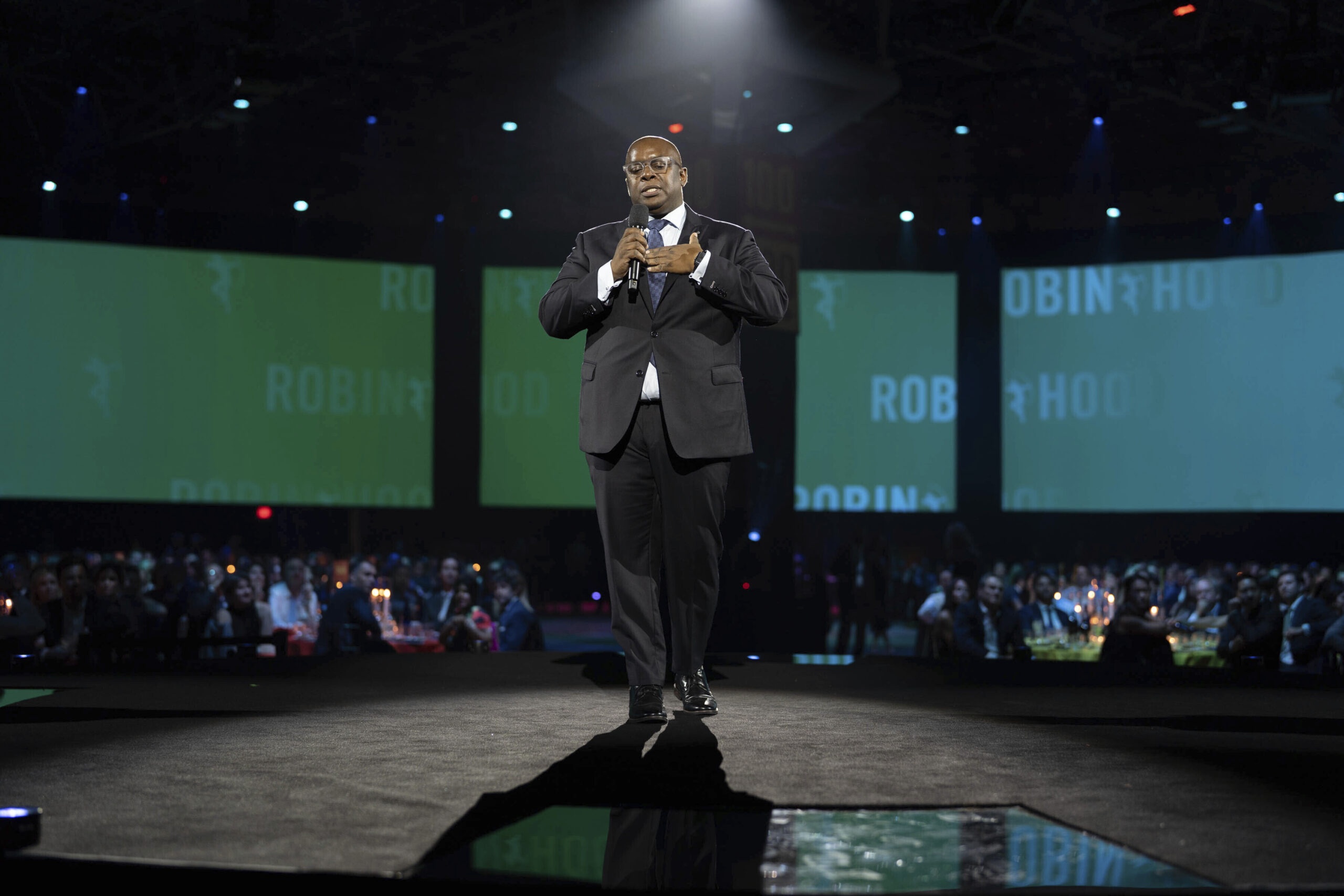
Richard R. Buery Jr. is starting his first full year as CEO of Robin Hood. But he’s no stranger to New York City’s largest poverty-fighting organization.
He first encountered the foundation 20 years ago, when Groundwork, the group he co-founded to support children in public housing developments in Brooklyn, received its first Robin Hood grant. Now he is eager to bring his experience to lead the group that helps more than 500,000 New Yorkers each year.
Buery, 50, replaced the popular Wes Moore — a combat veteran, Rhodes Scholar, and now a candidate for Maryland governor — as Robin Hood’s CEO in September.
“I hope to do the same as he did but in my own way,” said Buery, who has co-founded several nonprofits, including iMentor, Children’s Aid College Prep Charter School, and the Mission Hill Summer Program. He also served as a deputy mayor of New York City, a period when he established the city’s Pre-K for All program and founded the city’s Department of Veterans’ Services.
“My goal,” he said, “is to say, ‘How do we come together to make our city better and stronger and one that works for everyone, particularly during this difficult time?’”
First, though, Buery must lead Robin Hood through the Covid-19 crisis in New York. He recently spoke with the Associated Press about his plans and his approach. The interview was edited for clarity and length.
What is New York’s current level of need?
The need is broad. We know the need in education is marked by the loss of learning opportunities that many young people experienced over the last year, but there are also social and emotional challenges for young people who have often been in isolation without some of the basic anchors schooling provides. Add to that the severe economic harm that is particularly concentrated in the community that we care most about — families who’ve lost jobs and women who are basically forced to leave the work force for lack of access to child care.
How much of that is due to Covid-19?
As an organization that exists to fight poverty, we see how every dimension has to do with the pandemic. It really reiterates the ways that those living in poverty are most at risk in crises like this one. People in poverty are more likely to have frontline jobs with the highest risk of exposure without the same opportunity to take time off or work from home. They’re much more likely to lack internet access so they are often unable to maintain a normal school environment for their children. In every dimension, Robin Hood steps up in the midst of crises. Whether it’s food, eviction prevention, we are there to meet those urgent needs.
One idea you developed is the community school initiative — making schools a central place where people can go for help.
It’s a recognition that in order for school to be a place where every child can learn, it’s not enough to focus on instructional quality. You also have to address the challenges students bring up at school. If you are hungry, depressed, if your family is in crisis, your school, to really be successful, has to have a strategy to meet all those needs. We have to invest in every school to make sure they have a staff person whose job it is to understand what partners are available and to create a plan to connect. We have over 200 meaningful partnerships — everything from comprehensive tutoring programs developed with [City University of New York] to support for teachers in creating curricula to our mental and physical health providers. One interesting example is our work with Warby Parker to make sure that every kid in a New York City school has access to a free eye exam and access to a pair of glasses. We’re really thinking about what the barriers to learning are in each school.
Universal pre-K in New York has become such a big deal that it is now included in President Biden’s Build Back Better proposal. How did it feel for you to get that implemented?
It’s by far the greatest professional accomplishment of my life. It involved partners from government, community partners, business, philanthropy, and higher education. It felt impossible. I wasn’t sure we could pull it off. It was incredibly rewarding to be a part of bringing all those people, those institutions together to accomplish something that’s so important, that feels like a lasting contribution to your city. It was just showing that New York City can do anything. We can do it.
Editor’s note: This article is part of a partnership the Chronicle has forged with the Associated Press and the Conversation to expand coverage of philanthropy and nonprofits. The three organizations receive support for this work from the Lilly Endowment. The AP is solely responsible for the content in this article.




