How One Foundation Built a Board That’s Standing Up to Trump
Young, racially diverse trustees who include several grantees are helping the Robert Wood Johnson Foundation hold the line on equity despite threats from the administration.

By Drew Lindsay
Senior Editor, Special Projects
January 28, 2026 | Read Time: 11 minutes
Keep up with everything happening in The Commons by signing up for our weekly newsletter.
When Secretary of Health and Human Services Robert Kennedy announced in early January an overhaul of the recommended vaccine schedule for children, the Robert Wood Johnson Foundation issued a pointed, even sarcastic response. “Secretary Kennedy has said that people should not take medical advice from him,” declared CEO Richard Besser, a pediatrician. “This announcement shows exactly why.”
This is not the first time that RWJF — one of the country’s largest grant makers, with more than $13 billion in assets — has called out the Trump administration. Ever since the president returned to the White House last year, the health-focused foundation has stood as one of philanthropy’s earliest and most consistent critics of his agenda. Notably, even as some funders beat a quiet retreat from diversity, equity, and inclusion programs amid threats of federal investigations, RWJF remained firmly committed to confronting structural racism as a barrier to quality health for Americans.
Such a public and defiant stance, the foundation says, stems in part from a wholesale change in its board and its trustee recruitment. For decades, the foundation had searched for trustees largely in the personal networks of board members, even keeping a binder of names. But beginning after Besser’s arrival in 2017, it introduced a more formal trustee recruitment process that prioritized diversity across race, gender, sexual orientation, age, and more — a case study of how one mega-foundation aims to make its leadership look more like America.
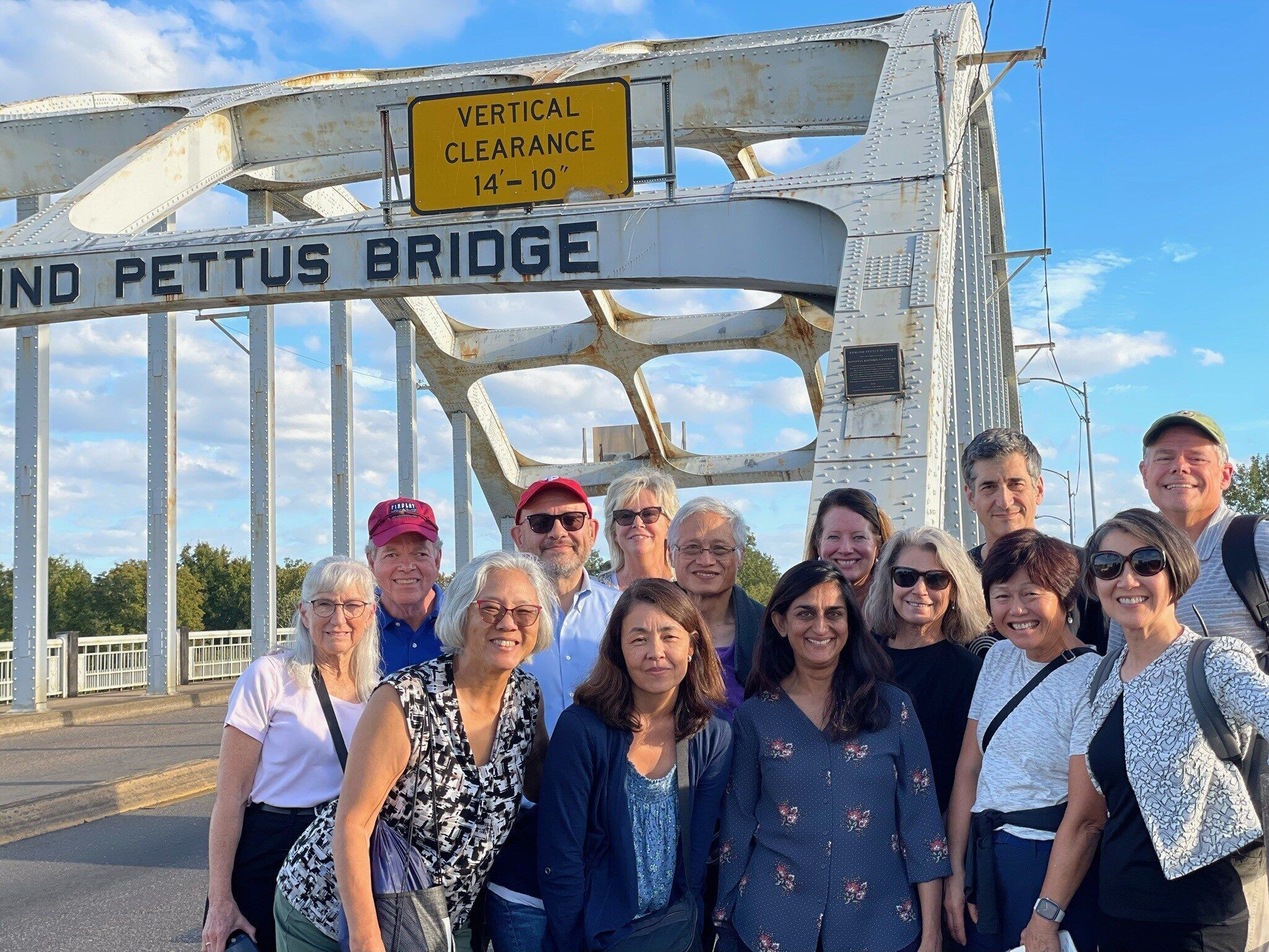
Over time, the original trustees all rotated off, each having completed the maximum 10 years of service. The foundation now seats a board that is significantly younger and more racially diverse than both its predecessors and its peers. Eleven of its 15 trustees are people of color; another is an Iranian-born immigrant.
The Rev. Dr. Starsky Wilson is the first Black person to lead the board. Only three trustees hold Ivy League degrees, and several are in their 40s — a significant contrast to boards often filled with retirees and graduates of prestigious colleges.
The RWJF board also includes several leaders of the foundation’s grantees — another departure from philanthropy norms.
This overhaul, RWJF leaders say, has fundamentally altered how the grant maker assesses risk, power, and responsibility in what is now a hostile political climate for its mission.
“We’ve got board members who are raising families, and they’re impacted by the [Trump administration efforts to] shut down the Department of Education,” says Wilson, CEO of the Children’s Defense Fund. “We’ve got two board members who are working in health care, and they are impacted by the decimation of the public health care infrastructure in America, personally and professionally.”
Wilson is one of three board members who run organizations that receive RWJF grants. When Trump’s policies and funding cuts imperiled groups working on racial health disparities, the board refused to back down, Besser says.
Those grantees, Besser says, help the foundation prioritize threats to the field rather than the dangers to its own well-being.“What I hear in the boardroom is: ‘How can you be bolder?’”
Elite and White
Large foundations typically draw trustees from an elite and often racially homogenous slice of America. A 2017 Chronicle analysis found that white individuals held 72 percent of board seats at the 20 largest foundations. Nearly four in five had attended private colleges or universities, and 40 percent held Ivy League credentials.
Diversity on many boards has increased modestly over the years, particularly following the 2020 police murder of George Floyd and the national focus on racial discrimination. People of color now make up more than half of the Kresge, MacArthur, and Mellon foundation boards, which were previously predominantly white.
After the #MeToo, Black Live Matters, and related movements, “it felt to many organizations like ‘This is a moment, and we have to meet this moment,’” says Melissa Berman, former CEO of Rockefeller Philanthropy Advisors.
Besser, a former senior official at the Centers for Disease Control, was a newcomer to philanthropy and board work when he arrived at RWJF.
At the time, the foundation’s 15-member board was predominantly white and included several prestigious figures moving toward the twilight of their careers — a common trait of trustees at big foundations. The roster featured, among others, former U.S. Senator Bill Frist, ex-World Wildlife Fund CEO Kathryn Fuller, and retired Goldman Sachs executive Robert Litterman.
“The average age was in the 70s,” Besser says. Half had attended Ivy League colleges.
To change who sat at its board table, the foundation upended its recruitment and selection process. When Besser arrived, RWJF board searches aimed chiefly to replace the departing trustee’s qualifications or expertise as a policy expert, for instance. The first stop in the search was “the book” — a binder with names of potential candidates recommended largely via trustee personal networks.
Under Besser, the foundation hired a search firm to identify board candidates. Without such help, Besser says, “a board will tend to replicate itself, because you only know who you know.”
Today, RWJF instructs the firm to search for candidates who would help make up a board that’s diverse in age, race, sexual orientation, geography, and more. The firm supplies a list of candidates to the board’s nominating committee. Besser and other board members follow up with conversations that help gauge a candidate’s commitment to tackling racism as a determinant of health disparities. Ultimately, the top criteria for board selection is alignment with RWJF’s mission, Besser says.
Helping New Board Members
Before Besser arrived, RWJF did not allow nonprofit leaders who directly control programs that received the foundation’s support to sit on the board — a common prohibition in foundations to avoid conflicts of interest. The foundation dropped that prohibition, however, to incorporate more on-the-ground perspective in its decision making.

“You can bring someone in to talk to the board, but having people on the board who are living the reality of what so many people are experiencing across the country is very, very valuable,” Besser says.
Three members of the Robert Wood Johnson board lead organizations that are foundation grantees: Edgar Villanueva, whose Decolonizing Wealth Project has been awarded $4.5 million by the foundation since 2020; the Rev. Dr. Starsky Wilson, a prominent Black faith leader whose Children’s Defense Fund has received $7 million in that time; and Ryan Haygood, whose New Jersey Institute for Social Justice has been given $9.2 million.
The foundation took steps to prevent conflicts of interest. If RWJF provides general operating support to a board member’s organization, for instance, that funding cannot top 30 percent of the group’s revenue. Also, a foundation grant cannot go toward the compensation or benefits of an organization leader who also is an RWJF board member.
“It was done really, really carefully and scrupulously,” says Fuller, who rotated off the board in early 2025.
Wilson says the board rarely makes decisions about individual grants, but he recently recused himself for a vote on a portfolio from which his organization had previously been funded.
It’s unusual to bring on leaders of grassroots organizations because they often want trustees with previous board experience or specific skills in, say, board governance or finance, says Vincent Robinson, founder of the 360 Group, an executive-search firm. “The question then becomes: If they don’t have that experience, how do we ensure that they get it?”
Villanueva, a veteran of boards at several smaller organizations, gives the foundation high marks for a robust onboarding and supportive mentorship, particularly when he’s confronted unfamiliar governance, finance, and investment issues. “Those are really hard skill sets even for me, a person who has three college degrees and a lot of experience in this sector,” he says.
Wilson says the foundation has brought in consultants and facilitators to help the group create collaborative processes and a framework for conversation and a sense of community.
When Villanueva joined the board in 2022, it still featured several older prominent figures such as former U.S. Senator Bill Frist. Villanueva, who’s an Indigenous American, says he hesitated to speak up; in the culture of his Lumbee tribe, the oldest members are considered elders whom the youngest must listen to.
Fuller, then the board chair, noticed his reticence. The two talked, and she encouraged him to speak up and asked for his perspective in meetings. When he spoke, her eyes said to him, “Go, Edgar,” he remembers.
“That invitation and that cultural sensitivity made me a lot more comfortable to just to speak up,” he says. “Now they’re probably tired of hearing me talk.”
‘Getting There Faster’
The three grantees on the board are all nationally known social justice advocates. Villanueva, who’s queer, leads the annual #PhilanthropySoWhite campaigns. Wilson was one of the leaders of the Black community in St. Louis following the 2014 police killing of Michael Brown. At the New Jersey Institute for Social Justice, Haygood, a civil-rights lawyer, helped organize a coalition to advocate for state reparations for descendants of enslaved Black Americans
Each of the three joined the board in 2022 or later. Another new board member, Azita Emami, dean of Yale’s nursing school and the architect of the first center for anti-racism in nursing is also on the board.
“There’s been more of an intention to bring on folks who are absolutely and clearly committed to the path that the foundation is on,” Villanueva says. “And we seem to be getting there faster as a result of that.”
RWJF has always examined the role of race in health disparities, Besser says, but that work deepened with the racial reckoning following George Floyd’s murder in 2020. The pandemic, he adds, also laid bare disparities in health care for communities of color as well as low-income and rural parts of the country.
In 2020, while the board still included many of the trustees from Besser’s first year, the foundation announced $90 million in grants to organizations building “community power,” including community racial-justice advocacy groups. Notably, RWJF is also pursuing one of philanthropy’s boldest and most expansive efforts to win reparations for descendants of enslaved Black Americans.
“We are making significant changes to our work to center dismantling one of the biggest barriers to health in America: structural racism,” Besser said in the group’s 2024 annual report.
‘In the Club’
RWJF sees this board as a victory in bringing diversity to the upper echelons of philanthropy.
“I think we have trustees who are really steeped in the issues that the foundation is trying to address,” says Fuller, who spent more than a decade on the board. “And that’s more than was the case 10 years ago.”
But critics question the outcomes of diversity efforts that prioritize race, gender, and sexual orientation in the way RWJF has remade its board. The result is a collection of individuals who make decisions from the same liberal worldview. “Grant making is going to reflect insularity, a narrowing — you have to be ‘in the club,’” says Michael Hartmann, a senior fellow at the Capital Research Center, a conservative advocacy group.
Besser says RWJF’s does not ask board candidates about their ideology or politics. But he says the board includes a “pretty wide spectrum” of political beliefs, while acknowledging that its focus represents what many see as “a fairly progressive vision for our nation.”
“You would not be a good candidate for our board if you didn’t understand the role that racial inequity plays in health,” he says.
Previously, some trustees were fairly conservative, Fuller says, but “that is much less the case now. The spectrum is from left to farther left.”
Still, even as the foundation focused more on structural racism, Fuller says conversations remained wide-ranging. People continued to speak their minds. “I don’t think it became an echo chamber.”
Berman, the former Rockefeller Philanthropy Advisors CEO, says there are foundations in which “everybody on the board would fit comfortably into one particular political party. And for a few foundations, both on the right and the left, that’s kind of essential to their mission, and that’s what they want.”
But for others, Trump’s 2016 election “made them recognize that nobody in the room understood anything at all about Youngstown, Ohio, or the other industrialized cities and farm communities in the country.”
The Trump anti-DEI campaign will lead some foundations and nonprofits to de-emphasize race, ethnicity, and gender in their diversity analyses, says Tory Clarke, co-founder of Bridge Partners, an executive search firm. “Those will still be measured, but they aren’t going to drive things in the same way that they have in the past.”
RWJF, however, is showing no signs of retreat, pointing to its trustee diversity as something others should emulate. “We’ve had a pretty big transformation of our board,” Besser says. “And that positions us well to meet the moment that we’re in.”
The Commons is financed in part with philanthropic support from the Arthur M. Blank Family Foundation, Einhorn Collaborative, and the Walton Family Foundation. None of our supporters have any control over or input into story selection, reporting, or editing, and they do not review articles before publication. See more about the Chronicle, the grants, how our foundation-supported journalism works, and our gift-acceptance policy.