August 8, 2010 | Read Time: 8 minutes
Two years ago, Jerry Gulley worried about whether the state of Illinois would cut the budget of his charity, Shore Community Services, which helps about 400 people with developmental disabilities in the northern suburbs of Chicago. Now budget cuts are a secondary concern. His chief worry: whether and when the state will pay him for services that Shore has already delivered.
Illinois has $6-billion in unpaid bills, including $490-million to nonprofit social-service organizations.
Shore just got paid in July for bills it submitted in December, but is still owed $1.1-million by the state. The double whammy of budget cuts and delayed payments has pushed many charities that do things like help the disabled, the mentally ill, and the elderly—groups that collectively provide about 75 percent of the human services in the state—to the brink of missing payroll or shutting their doors. Shore, for example, has a balance of $900,000 on a line of credit at its bank, and has additional borrowing capacity of just $300,000—enough to pay about one month’s bills. The charity’s precarious position may worsen this year. Illinois has warned that payments may be delayed by an additional 30 to 45 days over the next 12 months.
“For some agencies, that will probably put them out of business,” says Mr. Gulley, Shore’s executive director.
National Attention
Many other states have run into budget crises that are affecting charities—including Arizona, Florida, and Nevada—but in recent months Illinois has been at the center of national attention. CMA, a company that rates the likelihood that governments will default on their loans, puts Illinois at No. 8 in the world, just below Iraq and above the long-running poster child for American fiscal woes, California.
The crisis has forced the state controller’s office to assess how much money it has each day, and to pay the charities that are closest to missing payroll, while leaving bills from other charities for another day.
The General Assembly’s strategy has been to focus on services that are required by court order, or are eligible to receive a generous federal match (like services covered by Medicaid), and cut deeply into others.
“That means the budget cuts are falling disproportionately in just a few areas—to services for the aging, domestic violence, developmental disabilities and mental health services,” says Terry Mazany, president of the Chicago Community Trust, which has established a $4-million fund to help human-service organizations weather the crisis and streamline their operations.
Foundations and other grant makers are providing money to ensure that the most-essential providers survive to see better days, but they are quick to point out that they can’t make up for what Illinois is cutting. The charities affected by the cuts say they’re doing well if they can simply maintain support from foundations and individuals—much less make up the hole left by the state.
“There’s no way that philanthropy can replace or even come close to filling the gaps that will result from loss of public support for those programs,” says Jack Kaplan, director of public policy and advocacy at the United Way of Illinois.
A Decade of Travail
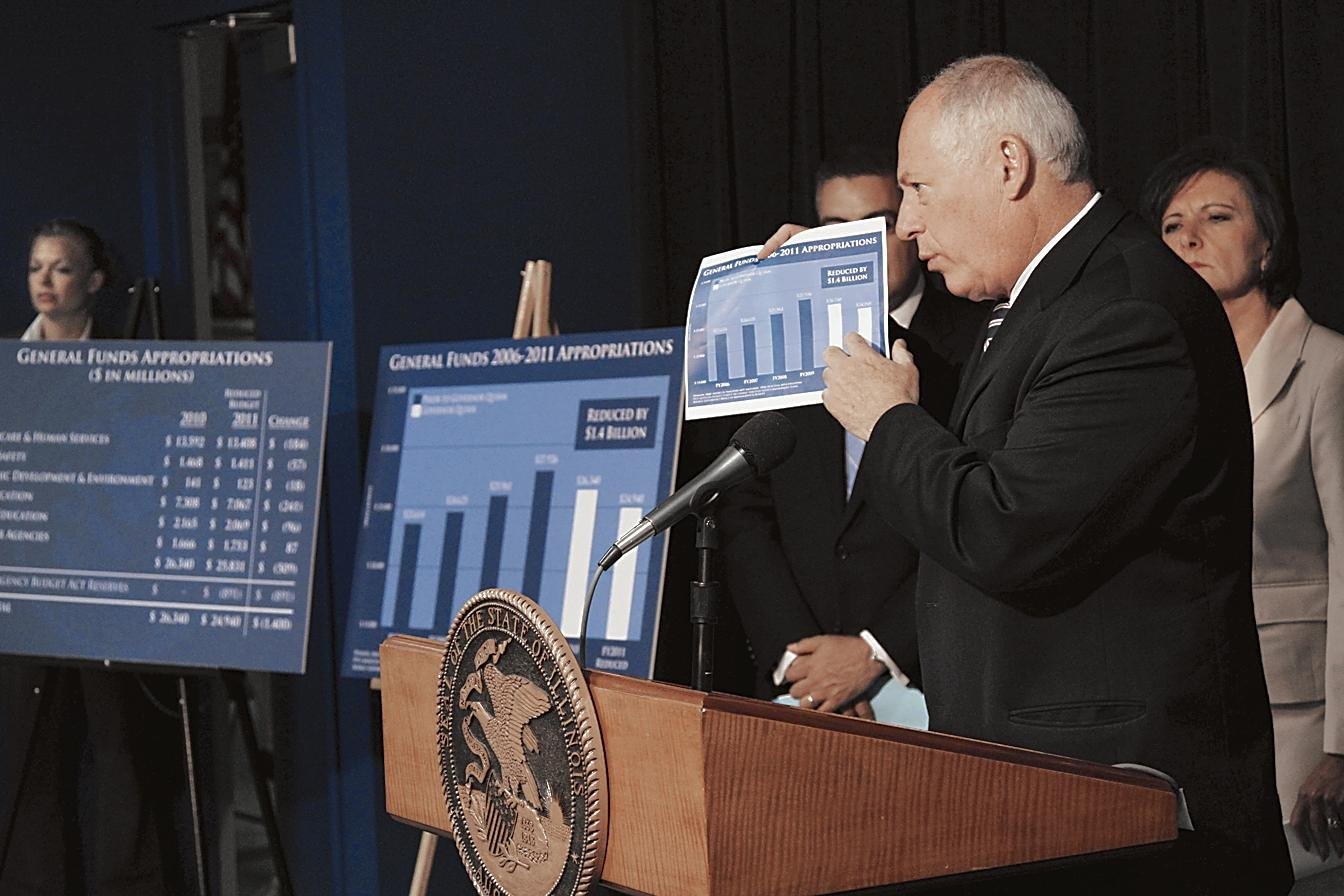
Human-services providers in Illinois have long been hurting, thanks to more than a decade of little or no adjustments in payment rates from the state, and sharp budget cuts in the past two years as the General Assembly has tried to rein in a $12-billion deficit.
According to a new report by Center for Tax and Budget Accountability, a nonprofit research organization, if the state had simply maintained support at 2002 levels, adjusted for inflation and population growth, it would have spent an additional $4.4-billion from 2003 to 2010.
Shore Community Services has cut its work force by about 10 percent, to 100 employees, and indefinitely deferred any capital improvements that aren’t related to health or safety, Mr. Gulley says. Its employees who work with the most severely disabled people have increased their workload, now handling six clients at a time, up from five a year ago.
Mr. Gulley admits that some of the ratios of staff members to clients do not meet state requirements, but for now, he has not received any complaints from the same state that is unable to pay Shore’s bills.
“It’s something that people are reluctant to talk about,” Mr. Gulley says, “but it is reality.”
Piling Up Costs
Charity leaders say the state’s spending decisions will end up costing the state even more in long run.
John J. Troy, chief administrative officer at Community Counseling Centers of Chicago, which provides mental-health and substance-abuse services, says the state has cut its support for the charity by about $2-million over the past three years.
Illinois also owes the group, which has an annual budget of $16-million, more than $1.4-million for services already provided.
The state eliminated a grant that provided about $100,000 per year to the charity to help subsidize patients trying to move out of hospital treatment programs. The grant covered items like furniture, clothes, and the first month’s rent on an apartment.
“It’s going to make it tough for people to come out,” Mr. Troy says. “It will cost the state five times what they would pay us, by having these people stay in the institutions.”
Some charities are closing programs, in part because of inadequate support from the state.
In June, Jewish Vocational Service of Chicago shut down a $1.5-million program that provided mental-health services to about 100 people. The organization itself had not done an adequate job of investing in the program, acknowledges Gail Luxenberg Gruen, the charity’s executive director, but she also worried about rumors that the state might eliminate a grant that covered about 30 percent of the program’s budget.
Jewish Vocational Service needed to make a big investment in technology to modernize the program. Employees had been tracking the progress of participants with handwritten notes.
“When you’re living in uncertain times, you don’t want to make big investments,” Ms. Gruen says.
In the Bottom 20 Percent
Some data suggest that Illinois has not fallen into its current mess by spending too much. The Center for Tax and Budget Accountability says Illinois ranks in the bottom 20 percent of the states in per capita spending on public services.
“It’s not a spending problem—it’s a revenue problem,” says Ralph M. Martire, the center’s executive director. “It’s an embarrassment that the state isn’t willing to raise the revenues to balance the budget.”
A year ago, the state Senate approved legislation that would raise the state income tax from 3 to 5 percent and expand the state sales tax to cover more consumer services. But the legislation was never considered by the House of Representatives.
Lutheran Social Services, which provides a range of programs throughout the state, including Head Start, substance-abuse counseling, and in-home care for the elderly, has advocated a tax increase for more than a decade in mailings to its members, says Daniel Schwick, assistant to the president. The charity also helped start the Responsible Budget Coalition, a group that advocates for the legislation the Senate passed last year.
Lutheran Social Services receives payments from Illinois that cover only 75 to 80 percent of the cost of providing the services. The charity raises about $5-million per year in private support, which it often directs to its programs that have the greatest need, but those donations don’t make up for the gap in state support, Mr. Schwick says. “It’s touch and go whether we’ll have the cash flow to meet payroll every two weeks,” he says.
Human-service charities also argue that the state could save money and provide better services if it operated more efficiently.
The improvement efforts are being led by Illinois Partners for Human Service, a two-year-old organization with 550 member groups that is pushing for streamlined reporting requirements, prompt payments, and better state support that is tied to the performance of specific providers. Tom Green, a spokesman for the Illinois Department of Human Services, did not return phone calls.
The efforts by Illinois Partners prompted Gov. Pat Quinn last year to create the Illinois Human Services Commission, which is made up of legislative leaders, state agency administrators, and charity executives.
“Even in an era of scarce resources, there are basic things that the state can do to make the requirements on the already-beleaguered nonprofits less onerous,” says Laurel O’Sullivan, senior director of public policy at the Donors Forum, a state association of grant makers and charities.
Several grant makers, including the United Way, the Polk Bros. Foundation, and the Chicago Community Trust, support Illinois Partners for Human Service.
Foundations are encouraging charities to narrow their focus—and their spending—to the areas in which they excel. Aurie Pennick, executive director of the Field Foundation of Illinois, in Chicago, which grants about $2.7-million per year, says some charities have come to her seeking help patching holes created by state budget cuts.
“We really challenge them to figure out what their core programs are,” Ms. Pennick says.
In some cases, the hole is too great—even if the charity is deserving of support—and the foundation declines to make a grant. “A $25,000 grant is not going to keep the doors open if a group is losing 40 percent of its budget,” Ms. Pennick says.
Foundation officials acknowledge that human-service providers have little fat left to cut, but they say the crisis in Illinois requires creative thinking about doing more with less.
With its new $4-million fund, the Chicago Community Trust will look to support charities that are exploring mergers, closures, and ways to provide service at significantly lower cost.
“I have been a little befuddled by the apparent lack of activity for mergers or restructurings,” says Mr. Mazany, the trust’s president. “The stimulus funding created an artificial cushion.”
The United Way of Illinois is also offering to assist charities, and possibly provide grant funds, to help them explore mergers. “It’s a delicate discussion, but we’re seeing more and more interest,” Mr. Kaplan says. “We’re not looking at a blip that’s going away in the next 12 months.”