
In Sandy’s Wake, Charities That Serve Region’s Poor Face Harder Task

By SUZANNE PERRY
Contributor
December 2, 2012 | Read Time: 6 minutes
New York City’s nonprofits are planning to gather in January to discuss ways that government and philanthropy can bolster nonprofits so they can do more to help move city residents out of poverty. Thanks to Superstorm Sandy, that conversation has taken on new urgency.
The storm paralyzed the city, drove many low-income families from their homes, and added new demands on already stretched human-service nonprofits.
“Nonprofits have stepped up” to help the storm victims, says Allison Sesso, deputy executive director of the Human Services Council of New York City, a nonprofit association.
But many are worried about the potential hit to their finances: “I’ve talked to executives who are saying, ‘When I lift my head up and pay attention to my budget, my board’s going to bite my head off.’”
The Human Services Council is co-sponsoring the January conference, which was originally planned for November but was disrupted by Superstorm Sandy. The organizers quickly added a new panel discussion—on how to ensure nonprofits are well prepared to respond to disasters.
Years to Recover
The nonprofit association is one of many philanthropic groups that are facing twin challenges in the wake of the violent storm that wracked the East Coast, especially New York and New Jersey, in late October. While giving priority to relief efforts, they are also trying to ensure that nonprofits have the resources to help vulnerable people, who tend to get hit especially hard by disasters, in the medium and long term.
“Unfortunately, sometimes we have short attention spans,” says Alan van Capelle, chief executive of Bend the Arc: a Jewish Partnership for Justice, which is raising money to help storm victims in Newark, N.J. “We’re committed to not have short attention spans when people suffer after such disasters.”
Bend the Arc, a social-justice organization, is among nonprofits and foundations that are dusting off one of the key lessons learned from the response to Hurricanes Katrina and Rita, which devastated the Gulf Coast in 2005: that it takes years for poor communities to recover fully from disasters.
The charity raised nearly $50,000 in immediate relief for Newark, a poor city that it feared would be neglected because the damage there wasn’t as dramatic as in some New York neighborhoods, like Staten Island and Far Rockaway, in Queens.
But it also revived the Isaiah Fund, an interfaith loan project that was set up to help New Orleans recover from the Gulf Coast storms. It hopes to raise at least $1-million for Newark, partly to help rebuild businesses that were hurt by the storm, Mr. van Capelle says.
Temporary Aid Groups
The American Red Cross got the most publicity and the most money for its immediate response to Hurricane Sandy. (It has raised $168-million for the effort so far.)
But the storm turned dozens of other nonprofits into temporary relief organizations—often under trying circumstances. In a survey conducted by the Human Services Council of 382 nonprofits in New York City, 74 percent said Sandy disrupted their services, and 66 percent said they were forced to close down temporarily because of power outages or other problems.
Catholic Charities Brooklyn and Queens is a case in point. Three of its sites suffered serious damage—a senior center in Far Rockaway, a day-care center in Coney Island, and a center for developmentally disabled people in Sheepshead Bay, in Brooklyn.
Robert Siebel, the charity’s leader, says some staff members worked two or three straight shifts in the early days to provide the group’s usual services, like Meals on Wheels, while also helping to evacuate clients.
Meanwhile, he estimates his group lost $250,000 because it had to suspend mental-health services that get reimbursed by programs like Medicaid and managed-care health plans.
He hasn’t had much time to think about what that will mean for his group’s bottom line. “You kind of go into something like this just doing what you have to do and hoping the money comes,” he says. “And it usually does.”
Caaav: Organizing Asian Communities, a nonprofit that advocates for low-income Asian immigrants and refugees, also sprang into action after the storm, offering food, water, and information to hard-hit neighborhoods—armed with hundreds of volunteers. But it’s not by nature a disaster organization, and its executive director, Helena Wong, says its top goal is to ensure that any rebuilding projects take into account the needs of low-income people, who already have problems finding affordable housing.
It will draw on its experience advocating on their behalf when the city was drawing up plans to redevelop lower Manhattan after the September 11 terrorist attacks.
Nonprofit Veterans
Nonprofits that felt Sandy’s wrath are fortunate in one respect: They are located in an area with strong philanthropic institutions, some of which are offering both immediate and longer-term help.
In New Jersey, the Robert Wood Johnson Foundation awarded $500,000 to help the state’s nonprofits provide food, shelter, and other relief services. It pledged $4.5-million more to help the state rebuild and provide social services, including mental-health programs.
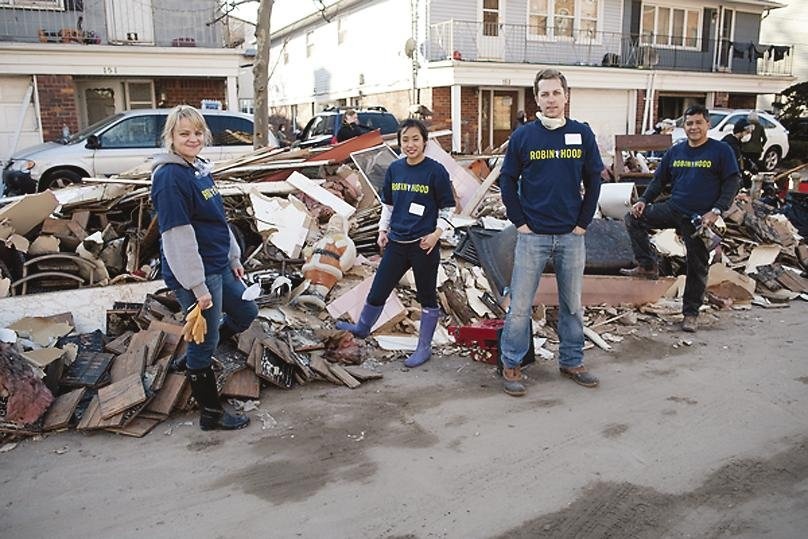
The Robin Hood Foundation, an organization started by a hedge-fund manager and others to provide poverty-fighting grants in New York City, reactivated a relief fund it set up in the wake of the September 11 terrorist attacks.
It has raised $15.5-million to provide both emergency grants to nonprofits that are responding to the storm ($8.2-million so far to more than 90 groups like Food Bank for New York City and Henry Street Settlement) and future aid to the city’s most vulnerable residents.
The original September 11 fund raised more than $65-million—and more than 11 years later, it is still paying for mental-health and other services for September 11 victims and their families.
“After 9/11, we were running like a sprint,” says Emary Aronson, the relief fund’s managing director. “We didn’t know it was going to be a marathon.”
Long-Term Relief
The Nonprofit Finance Fund, a financial institution with a New York office, has set up a low-interest loan fund to help storm-damaged social-service nonprofits repair their facilities, replace property or equipment, or cover revenue losses.
But philanthropic help is also coming from other parts of the country. The Foundation Center, which is keeping a tally, says foundations and corporations across the nation have awarded more than $240-million in cash and product donations to help Sandy’s victims.
Some nonprofit leaders say once the dust settles, philanthropic and government leaders must work together to improve life for low-income people so they are better prepared for disasters, especially since many scientists expect climate change to intensify the impact of future storms.
Sheena Wright, president of United Way of New York City—which is leading United Way’s fundraising efforts for the entire storm-affected region—says that even before Sandy, almost a third of New York state residents who qualified for food stamps were not getting them. Such help can be critical when disasters throw people out of work, she says.
The Center for Disaster Philanthropy, a new organization that aims to improve disaster-response coordination, will work to keep the pressure on, says Regine Webster, its vice president. “The message we’re very much sending is private philanthropy needs to pay attention to this disaster beyond the six-month relief stage.”




