

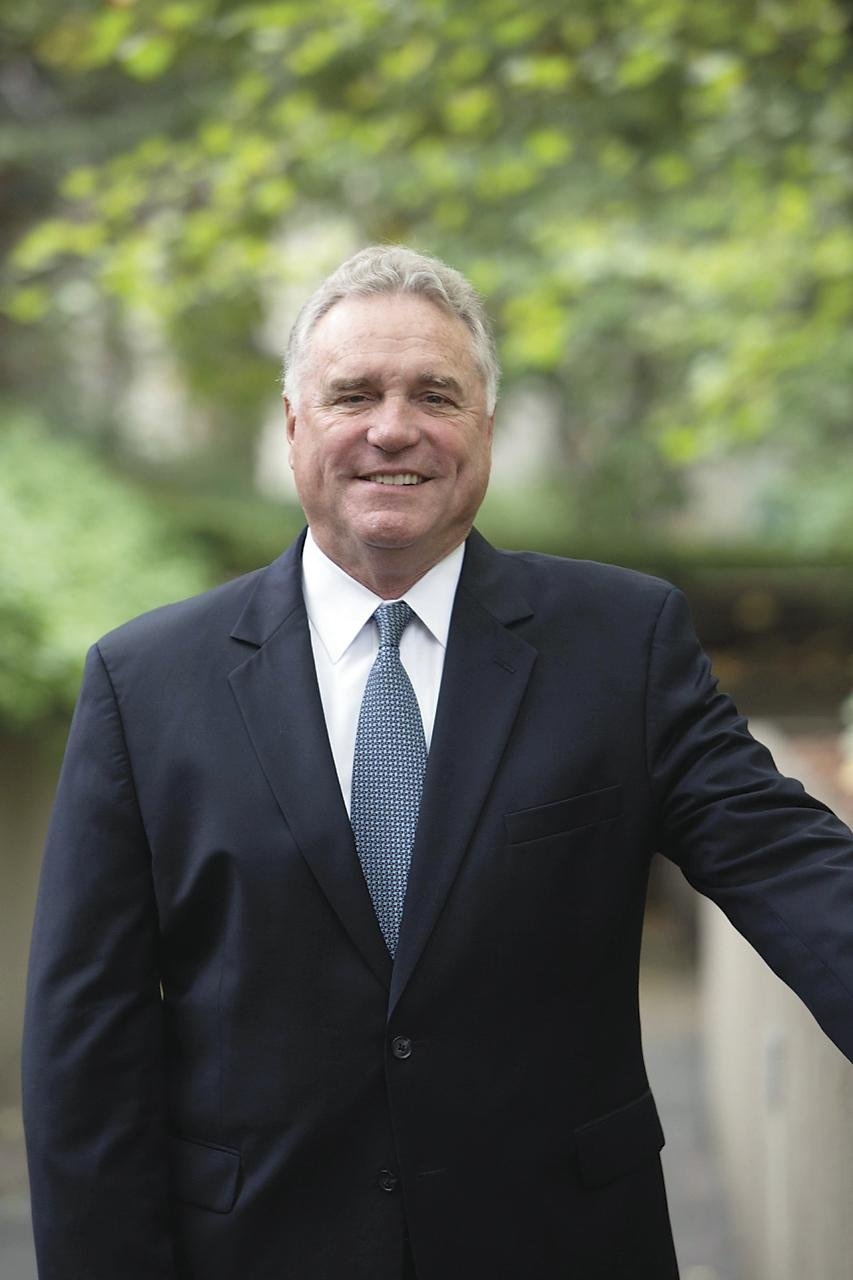
October 20, 2013 | Read Time: 6 minutes
Over the years, William McGinly has gotten other job offers—plenty of them, he says.
But instead of leaving his job as president of the Association for Healthcare Philanthropy, he has remained at the organization for 30 years, long enough to see the business of raising money for hospitals confront a seemingly endless string of challenges.
Now, however, he’s ready to step aside.
“It’s just time. I’m old,” says Mr. McGinly, who is 67. “Everybody gets tired.”
Each time he’s been approached by prospective new employers, he’s been presented with the lure of higher pay. But he’s turned them down, he says, because he’s dedicated to helping hospitals serve their communities.
That sense of mission, rather than a focus on dollar amounts, he says, is essential for successful fundraisers.
“If you lead with numbers, you’re going to lose,” he says.
Bigger Roles
Still, the numbers are important—and have gotten more so during his tenure.
Mr. McGinly says that when he was new on the job, hospital chief financial officers didn’t worry so much about fundraising results. Philanthropy, he notes, accounted for about 2 to 3 percent of hospital revenue in the 1980s.
An off year in fundraising wasn’t too huge a deal as long as hospitals enjoyed big increases. But now that most hospitals are feeling more of a squeeze, their leaders are more concerned about increasing donations.
As he looks back on his accomplishments, what stands out is his group’s contribution to helping hospital fundraisers take a bigger role at the executive table.
For a long time, he says, many of the association’s more than 5,000 members wanted to concentrate on raising money rather than getting involved with higher-level decision making at hospitals and health-care systems.
“We’ve changed attitudes,” he says, explaining that fundraisers need to be an integral part of planning at hospitals to thrive.
But even if they find a place in the executive suite, hospital fundraisers face challenges. After notching a 7-percent increase in 2011, fundraising didn’t budge in 2012, when hospitals raised $8.9 billion.
A sluggish economic recovery and uncertainty surrounding the 2010 health-care overhaul have made it tougher to raise money.
To try to help members increase donations, Mr. McGinly has introduced online training courses to help them prepare for the Certified Fund Raising Executive exam. The Internet offerings are designed to replace face-to-face regional training seminars.
Attendance at those events, he says, has steadily declined because members have not had the money to attend.
The online learning program was introduced last summer after two years of planning that cost about $300,000—a significant expenditure for an association with 14 employees and $4.2 million in annual revenue.
Leading a national organization for three decades has left battle scars.
“I haven’t been a happy, sing-song guy every time I go to work,” Mr. McGinly says.
One of his most difficult battles was trying to devise a system for all hospitals to follow when they reported their fundraising results.
In the 1980s, he tried to lead such an effort, but the discussion fizzled out because the issue was too contentious. Many hospital fundraisers balked, he says, because they thought the approach might make it look like their costs to raise a dollar were too high. “It was bloody,” he recalls.
The debate was waged over a variety of financial definitions, including how to count planned gifts and bequests that wouldn’t end up in hospital coffers for years to come; the definition of cash versus pledges; how to tabulate fundraising salary expenses; and whether to use gross or net funds raised in determining fundraising expenses.
But members of the association say that despite the acrimony, Mr. McGinly remained vigilant as he tried to bring people together on the reporting requirements.
“He’d get frustrated,” says Mark Larkin, chief development officer at CentraCare Health Foundation in St. Cloud, Minn., and a member of the association’s board. “He’d get irritated. But he never gave up.”
Mr. Larkin and other members of the group say that McGinly was successful in advancing the requirements because even as he pressed for more stringent accounting, he listened to the concerns of his members and helped assuage their fears by assuring them the association would help them navigate the changes.
“Bill’s not the kind of guy who gets red-faced and starts pounding the desk,” says Ken Coffey, vice president and chief development officer of the Frederick Memorial Healthcare System. “He’s very thoughtful and engaging.”
After a second try, the association agreed in 2003 to a set of standards. But they aren’t mandatory and only about 100 hospitals follow them.
Mr. McGinly would like to see passage of a federal law making the requirements binding. He says stringent, uniform requirements would lift giving because donors would have more confidence that their contributions were being used wisely.
“We wouldn’t have any of these false, fake numbers and chicanery,” he says.
‘Strategic Imperative’
Mr. McGinly says he hasn’t made plans for what he’ll do next, but he says he’d like to remain involved in hospital fundraising.
Originally, he planned to stay on the job only for a few years, he says. What kept him there, however, was watching the progress the group’s members made.
“A lot of our members are underappreciated and underacknowledged,” he says. “But I believe they’ve made a difference.”
And many of the group’s members say he’s made a difference, too, as hospital fundraising has changed from something that was simply a nice way to add to an institution’s revenue to what David Flood calls a “strategic imperative.”
Mr. Flood, chief development officer at Intermountain Healthcare, in Salt Lake City, and a member of the search committee seeking a replacement for Mr. McGinly, says the increased demands were tough for many of his peers.
“All of us were scrambling for solid ground to stand on,” he says. “A lot of us owe our careers to him.”
About William McGinly, chief executive, Association for Healthcare Philanthropy
Education: B.A., English and biology, Mount St. Mary’s University; M.A., administration, Villanova University; Ph.D., organizational development and administration, American University.
Salary: $410,898 in 2012.
First thing he’ll do when he retires: “I don’t know, but I know I won’t be on an airplane on my first day off. I do a lot of traveling on the job.”
Personal philanthropy: To honor the memory of his son, Mark, who was killed in the September 11, 2001, attacks on the World Trade Center, Mr. McGinly and his wife, Patty, raised more than $600,000 to provide scholarships for 95 students. They invested a portion of those funds, about $250,000, to create a scholarship endowment at Bucknell University, Mark’s alma mater.







