Memories of Grander Times Motivate a Charity’s Efforts to Reclaim Buffalo’s Central Terminal
Editor’s note: Michael Miller, president of the Central Terminal Restoration Corporation, in Buffalo, died August 27 of an apparent heart attack.

By BRENNEN JENSEN
Contributor
September 17, 2009 | Read Time: 6 minutes
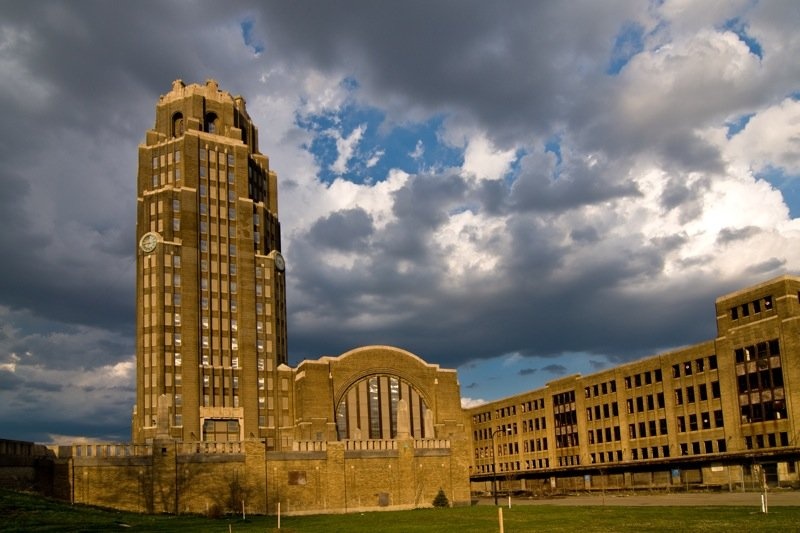
The New York Central Railroad was on a roll back in 1929, when it completed its Buffalo Central Terminal, filling the massive Art Deco station with marble walls, terrazzo floors, and stylish bronze fixtures and topping it all off with a 15-story office tower. The price tag: $14-million.
Sixty-eight years later, with train traffic long gone and the complex a grimy white elephant, the building was sold to a local charity. The price tag: $1.
For that buck, the Central Terminal Restoration Corporation acquired a 532,000-square-foot architectural marvel listed on the National Register of Historic Places. The charity also got thousands of broken windows, a waterlogged concourse — some visitors likened it to Niagara Falls — and a 17-acre site long used as an illegal dumping ground.
“There were times we’d come into the building and see all the debris on the floor, the water, and just wonder what we’d gone ourselves into,” says Mark Lewandowski, vice president of the corporation. “But this station holds so many memories. It was the human side of the building that kept us going.”
Pillaged and Vandalized
Built to handle more than 200 trains a day back in rail travel’s glory days, the Central Terminal saw only two a day by 1979, when Amtrak, the last carrier to use the station, abandoned it. (Passenger trains now stop at a small, suburban station.)
A series of developers acquired the structure with hopes of turning it into a shopping mall or office complex. Some got in over their heads and behind on their taxes; others, charity leaders say, “raped” the building — pillaging the Art Deco detailing while leaving the building unsecured, open to vandals and scavengers. Bits of the Buffalo station are now all over the world; some of its light fixtures illuminate a Hong Kong bar.
In 1997, Scott Field, a leader of the Preservation Coalition of Erie County, confronted Bernard Tuchman, one of the station’s owners at the time, in the hallway of a city courthouse where he had been summoned for building-code violations. Mr. Tuchman’s response: “If you think you can do a better job with the building, I’ll sell it to you for a dollar.” Mr. Field pulled out his wallet. From that impromptu deal, the restoration charity was born.
“It’s really hard to run this building if you’re not a nonprofit,” says Michael Miller, president of the corporation, whose parents met in the station back in the 1940s, when they worked there as billing clerks. “For one thing, the property taxes are just enormous.”
The charity had little more than elbow grease to throw at the building in the early going, organizing volunteer cleanups that removed tons of debris from in and around the property.
A timely million-dollar grant from Erie County in 1999 allowed the group to board up most of the windows and repair the roof, which had been damaged when scavengers tore off the copper flashing.
Given the size of the project, though, the charity’s leaders knew they had to broaden interest in the station beyond their cadre of preservationists and railroad enthusiasts. In 2003 they started giving tours, which proved popular with Buffalonians curious about the shuttered edifice. Thousands of people have since trooped through the building — and more than a few have signed up to help with renovations.
Marty Slawiak took a tour last year, drawn by the knowledge that his late father had worked in the station. Now the union metal finisher spends a couple of days a month working to recreate some of the missing light fixtures.
“It just make me feel good to be doing something here,” Mr. Slawiak says. “I feel my father in the station.”
The old place has also become part of Buffalo’s social scene, rented out for beer and wine festivals, art exhibits, model-train shows, and a rollicking annual Polish celebration called Dyngus Day (which drew some 4,000 partyers this year). It’s not unusual for the station to host a wedding one day and an organized ghost hunt the next.
The vast, empty building has even caught the eye of horror-movie makers. While Prison of the Psychotic Damned and Red Scream Vampyres are unlikely to win any Academy Awards, the charity has earned as much as $1,000 a day leasing the building to film crews.
All told, the charity earns about a $100,000 a year in rentals, money that gets plowed back into the ever-needy building.
“It’s always nice to look back and see how far we’ve come,” says Mr. Lewandowski. “You once took your life in your hands even walking into the building. We’ve now had over 120,000 people come to events here over the last five years.”
Phased Development?
Progress on Buffalo’s station stands in contrast to the fate of the Michigan Central Terminal, a vacant, 18-story train station looming over downtown Detroit. Although that 96-year-old, classically designed station is owned by a billionaire trucking mogul, it has been so neglected and vandalized over the years that the Detroit City Council has voted to raze it.
Still, the work in Buffalo is far from over. Much of the complex, including a five-story baggage building adjacent to the concourse, remains in disrepair. Parts of the office tower are nearly knee-deep in refuse and yellowing railroad paperwork, which a former owner dumped on the floors after selling off the filing cabinets.
The latest hope for the station comes from Washington, where the Obama administration recently called for investing billions of dollars to develop a nationwide high-speed passenger rail network.
Charity leaders argue that the terminal is well situated to be Buffalo’s stop on such a system, a proposal that has received interest from both city and state lawmakers.
“It would be thrilling to have rail passengers back in the building,” says Mr. Miller, of the restoration charity. “Once you have rail stopping here, it then becomes a business incentive to start redevelopment.”
The corporation recently formed a grants committee to seek out foundation money for certain projects, such as creating a museum of station and railroad artifacts. But Mr. Miller doesn’t expect grant makers to provide all of the $100-million or more required to fully restore the terminal.
The charity has long sought private development at the Buffalo Central Terminal. The baggage building could house light industry; the tower could be converted into apartments. The group’s main stipulation is that the cavernous concourse be open to the general public.
“It’s kind of unrealistic to think there’s a silver-bullet solution here — that any one developer is going to come in and save the building,” Mr. Miller says. “But this is large enough of a complex that you can do it in phases.”
As Mr. Lewandowski puts it, “It all comes down to a matter of one room at a time, one floor at a time.”