
Mergers Are Just One Way Charities Find to Team Up and Battle a Tough Economy

By Jennifer C. Berkshire
Contributor
October 2, 2011 | Read Time: 7 minutes
When the Kentucky Opera and the Louisville Orchestra began to discuss a possible merger three years ago, leaders of both institutions soon realized how difficult joining forces would be.
David Roth, the general director of the Kentucky Opera, notes that thegroups were able to identify just one example of a merger between an opera and an orchestra, in Utah. “And it wasn’t a merger that had gone smoothly,” he says.
A visit to Utah helped Mr. Roth and his counterpart at the Louisville Orchestra settle the question once and for all. The two performing-arts charities resolved not to pursue a full-on merger but instead to combine many of the groups’ administrative responsibilities.
“We started with small steps,” says Mr. Roth.
They relocated the back-office operations of both groups to a single shared space, one whose subsidized rent allowed for reduced overhead, then merged the functions that were easiest to combine: phone systems, the box office, reception, marketing, and finance.
The joint venture has already reaped dividends, notes Mr. Roth. Two other arts groups now rely on the shared finance department. Even more significant: The Kentucky Opera has just celebrated its second consecutive fiscal year with a budget surplus, something that seemed all but impossible before the partnership.
“There was a real need by both of our organizations to find a new path,” says Mr. Roth.
As the economy continues to cause problems for nonprofits, charity experts say that collaborative ventures are gaining in popularity. In addition to mergers, some groups are taking several steps short of that, such as sharing office space and back-office duties, applying for grants together, and jointly managing projects.
Dan McCormick, author of Nonprofit Mergers: The Power of Successful Partnerships, argues that nonprofits have long tried to set themselves apart to appeal to grant makers. “Nonprofits get the attention of grant makers by saying, ‘Hey, this is what makes me different from that other group,’” says Mr. McCormick, who runs a consulting firm in Fripp Island, S.C., that helps charities merge. But not every group can afford to go it alone, he adds. “We need a new model given the financial reality we’re in today.”
Still, he and other charity experts caution that collaboration brings with it plenty of challenges—and won’t necessarily deliver savings in the short term. Following are some tips from experts and charity leaders on how nonprofit organizations can pursue partnerships that work.
Seek out expertise. When the Allston Brighton Community Development Corporation, in Allston, Mass., and Urban Edge, in Boston’s Roxbury neighborhood, embark on an ambitious experiment this fall to transform the way they manage some 1,700 low-cost housing properties across the Boston area, they’ll have a team of experts at their disposal. Last year the two community-development groups were awarded a grant from the Catalyst Fund for Nonprofits, which provides financial support and expertise to charities in the Boston area that want to pursue collaborative ventures.
“For collaborations to work, you really have to build them properly,” says Peter Kramer, who manages Catalyst, which is overseen by New York’s Nonprofit Finance Fund
With the help of Mr. Kramer and other Catalyst experts, Urban Edge and Allston Brighton have created a third entity that will manage their combined stock of housing, freeing them to focus on the needs of their respective neighborhoods. Catalyst has also helped the charities create a joint committee of board members from both organizations.
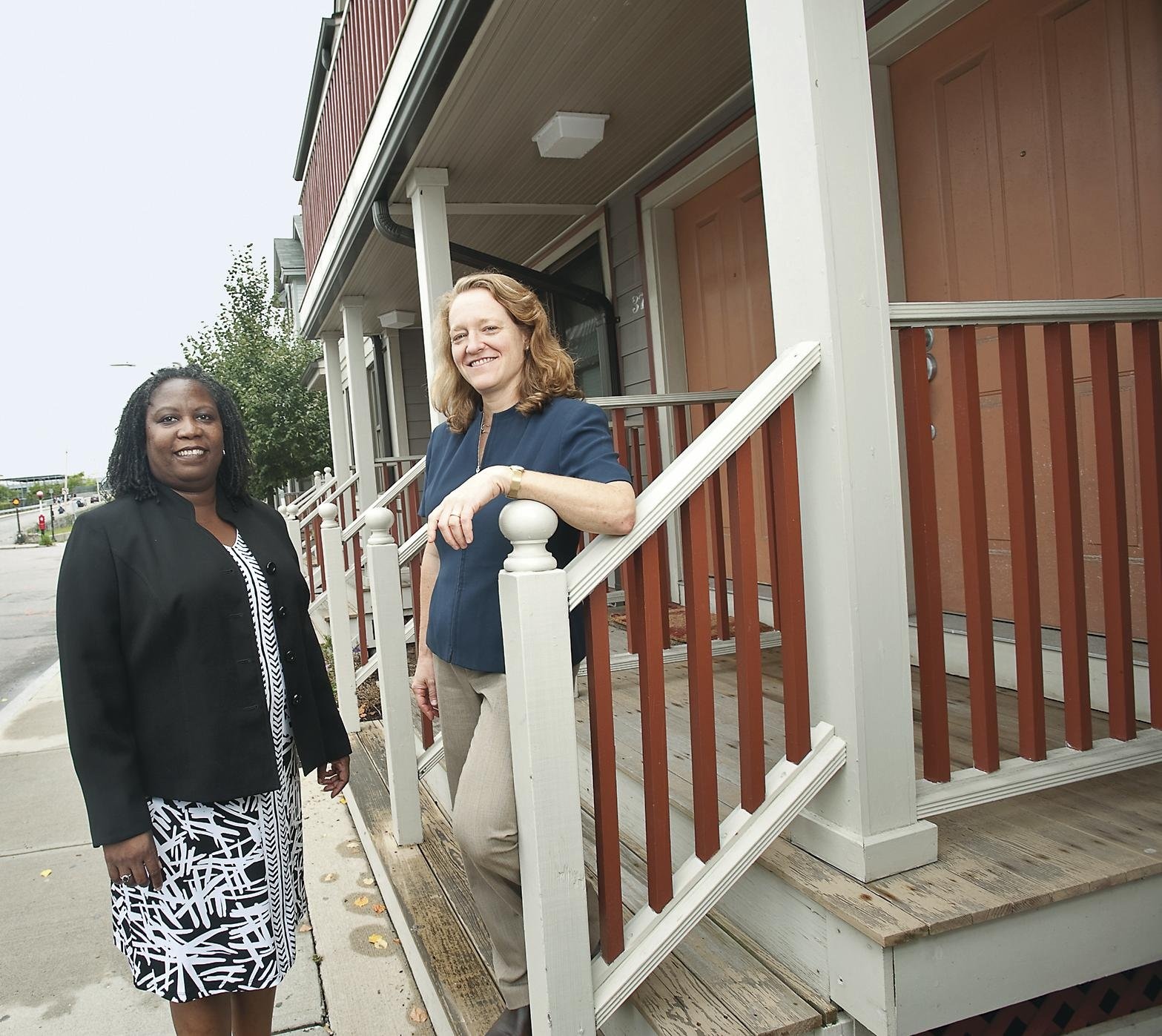
Mary-Helen Nsangou, executive director of Allston Brighton, says she hopes all of the work at the front end will pay off in the form of a new collaborative model for asset management.
“Nonprofit real-estate development corporations have created substantial portfolios of affordable homes, but we struggle at times to be the best owners of those properties,” says Ms. Nsangou.
Choose partners strategically. LifeCare Alliance, a nonprofit home-care provider in Columbus, Ohio, that serves 15,000 older people, has merged with four organizations during the past decade. In each case, the charity’s decision to merge was prompted by a single question, says Charles Gehring, the chief executive officer: “We asked ourselves, ‘What do our clients need in order to live independently in their homes?’ On our own, we weren’t able to provide all of those services.”
LifeCare Alliance’s new partners include a local Meals on Wheels affiliate; Project Open Hand, which delivers meals to people with AIDS; and the Columbus Cancer Clinic, which provides free medical care. Most recently, LifeCare sought out a partner that could help it respond to a growing problem faced by seniors: domestic violence. This summer Impact Safety, a Columbus charity that offers training in violence prevention, became the latest group to join forces with LifeCare Alliance.
Meanwhile, Mr. Gehring continues to seek out other organizations that could add to his charity’s portfolio of services. “We don’t have to have the exact same mission,” says Mr. Gehring. “If you offer a service that seniors need, we’re interested in talking to you.”
Quell workers’ fears. Mr. Gehring emphasizes that the majority of the employees of LifeCare’s new partners continue to work for those organizations, while the parent group provides centralized fund raising and back-office services. Such continuity is key to successful collaboration, say charity experts, because employee fear—particularly among senior staff members—is a major reason such efforts fail.
“Whether you’re talking about a complete merger or sharing services, it’s essential to address that fear early on,” says Mr. McCormick, the author. “Make deals if you have to.”
When the Central Virginia Food Bank, in Richmond, Va., began to explore a merger with the local Meals on Wheels six years ago, the leaders of the charities made their employees a promise upfront. “We guaranteed that no one would lose their jobs,” recalls Fay Lohr, president of Feedmore, the merged entity that was created three years ago.
To lessen the charity workers’ anxieties, Ms. Lohr and her counterpart at Meals on Wheels stressed open communication, making sure that every employee was getting the same information—not an easy task given that the groups occupied separate facilities. “We even held our staff meetings on the same day at the exact same time,” says Ms. Lohr.
The charities also gave employees the option of changing jobs in the merged organization. That choice helped to recast the merger as an opportunity for the groups’ workers rather than a threat, says Ms. Lohr. “We were able to take fear out of the equation.”
Join forces for savings. Even charities that don’t wish to pursue a formal merger or collaboration can still benefit from collaborating with other organizations to make purchases.
Six years ago, the Georgia Center for Nonprofits, in Atlanta, created an online Nonprofit Marketplace so its member charities could receive discounts on office supplies, insurance, printing, overnight delivery, even natural gas.
“When you can aggregate a large number of groups, it creates efficiencies for the purchaser and the provider,” says Karen Beavor, president of the Georgia Center for Nonprofits, which has more than 700 member charities. She likens the entire nonprofit world to a megacorporation that can negotiate huge discounts.
Even small groups of nonprofits can realize savings by banding together to buy, says Ms. Beavor. “If you bring together five homeless shelters to purchase supplies, you end up with far more leverage than if everyone is working on their own,” she says.
Take the long view. Although collaboration interests charities that want to save money, nonprofits shouldn’t expect to reap an immediate financial windfall, experts say.
“If you go into this thinking that a collaboration is going to save you money, you may be disappointed,” says William Pinakiewicz, director of the Nonprofit Finance Fund’s New England office. “You may get some economic benefit, but the real payoff is in preservation, improvement, and the expansion of your group’s impact.”
Such benefits may ultimately prove more important to a charity’s health than even cash savings, says Mr. Pinakiewicz.
“The recession shone a bright light on the need to update the nonprofit funding model,” he says. “We need to do things differently, and collaboration is one way to go about that.”




