
Middletons Focus on Homelessness
Nun Coaxes Publicity-Shy Billionaires to Share Information About Their Giving

By Debra E. Blum
Contributor
June 16, 2014 | Read Time: 9 minutes
A few years ago, a wealthy donor asked the leaders of Project HOME, a Philadelphia charity that helps the homeless, the kind of big-picture question that every nonprofit official dreams of: “What will it take to end chronic homelessness in this city?”
“Until then, we were working on one project at a time, raising money one project at a time,” says Sister Mary Scullion, a Catholic nun who co-founded Project HOME in 1989. “Now we had these incredible people sitting in front of us basically saying, Let’s take this to the next level.”
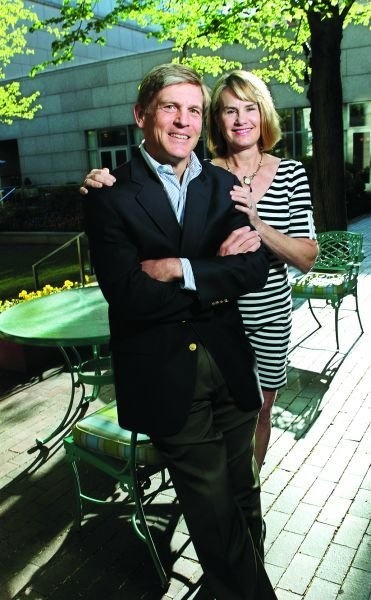
The donor, John Middleton and his wife, Leigh, were, by their account, taking their own philanthropy to the next level at the time.
Mr. Middleton had expanded his family’s tobacco and cigar business and then sold it for $2.9-billion in 2007, and he was eager to use his business acumen in the nonprofit world.
Instead of awarding small donations to many nonprofits, the Middletons decided to focus on helping the city’s most-vulnerable residents. The couple looked for groups that could do the most with the donors’ big-thinking, big-dollar gifts.
“We wanted to identify organizations that could most effectively leverage our investments to really go after solutions to problems,” Mr. Middleton says. “I went to that Project HOME meeting knowing I was going to ask that question; knowing that we had been nibbling at the issue of homelessness, but were ready to do more.”
Sister Scullion and the group’s co-founder, Joan Dawson McConnon, spent months after that meeting in 2011 talking with staff members, consultants, community leaders, public officials, and developers, as well as some of the homeless people the organization serves. They came up with the Middleton Partnership, a five- to eight-year plan to raise $300-million in private and government money and use it to expand the group’s housing stock, support services, and programs for young people at risk of becoming homeless after growing too old for foster-care benefits.
The Middletons, who had previously pledged $5-million, mostly for a single construction project, increased their gift to $30-million and agreed to work personally to attract other private donors and win government grants.
“It was important to get 10 percent seeded so we could go to other donors, other partner organizations, the mayor’s office, and be able to say, look at this plan, look at our investment,” Mr. Middleton says.
Out of the Limelight
Project HOME has so far raised more than $150-million toward its goal, including $51-million from private sources.
The organization has broken ground on a $15-million health-care facility in a North Philadelphia neighborhood that has lacked places for residents to get treatment.
It also cut the ribbon on JBJ Soul Homes, a new $16-million mixed-use development with 55 subsidized apartment units. The facility is named for the foundation started by the rock star Jon Bon Jovi, which gave the project its first big gift of $1.5-million.
Mr. Bon Jovi is a longtime supporter of Project HOME, someone Mr. Middleton praises for his “passion and commitment” and for “his willingness to draw media attention to the organization and the issue of homelessness.”
That Mr. Bon Jovi is the famous face of Project HOME—along with Sister Scullion, who is known nationally both for her advocacy work and her feisty spirit—is a situation that pleases the publicity-shy Middletons.
Although the couple attract some attention, mostly as part owners of Major League Baseball’s Philadelphia Phillies, they strive to maintain, they say, a low-key profile. Until not long ago, they were particularly closed-lipped about their philanthropy.
In recent months, however, the couple have had what Mrs. Middleton calls their “coming out.” After years of giving quietly, and in many cases anonymously, the Middletons have begun to share some information about their giving.
Mrs. Middleton says that Sister Scullion coaxed the couple to be more public about their gifts, in part because Project HOME wanted to honor them at its 25th anniversary gala in April. Although the Middletons had been working to raise money for the Middleton Partnership, their $30-million gift had never been formally announced.
The Middletons had also been chosen to receive a local honor for citizenship, the Philadelphia Award, and they were persuaded to come forward with more details about their giving before the award ceremony last month.
“Being honored is the furthest thing from our minds, but we realized how helpful it would be for Project HOME, and some of the other places we support, if they had this spotlight,” Mrs. Middleton says. “We became convinced that by being more forthcoming, we could help them or maybe inspire others to give.”
More Disclosure
The low profile has marked much of their other giving.
The ESF Dream Camp Foundation has received $250,000 a year from the Middletons since 2008 to support its free after-school and summer programs for low-income kids in Philadelphia. Michael Rouse, Dream Camp’s co-founder, says the Middletons were especially attracted to the group’s proven track record in its first program in Connecticut, which helped at-risk kids graduate from high school and go to college.
Mr. Rouse says that while the Middletons stay in close contact, getting quarterly and annual reports from the group, they asked at the start to have their gifts remain anonymous.
“I’m sure they don’t want the fanfare now either, but they also must know that they can be incredible role models for people,” Mr. Rouse says.
Among the Middletons’ other donations that have come to light is a gift of more than $16.3-million to establish the Neuroscience of Behavior Institute at the University of Pennsylvania’s medical school. The gift was announced in 2011 as an anonymous donation.
Jim Yong Kim, president of the World Bank, who spoke about the Middletons at the Project HOME anniversary event, said of the recent revelations: “You’re only seeing a small proportion of what they actually do. You look around the world and you see these generous anonymous gifts, chances are John and Leigh are behind at least a good number of them.”
Being more public about their donations is part of what Mr. Middleton describes as “the evolution” of the couple’s philanthropy.
Most of their giving in the past was to the private schools and colleges they and their children attended, to their church, and to several cultural institutions and local charities. But when Mr. Middleton sold his company, his wife convinced him to work full-time on philanthropy, and together they decided to focus much of their money and time on helping Philadelphia’s least fortunate.
Keen to Deliver Results
It was Mr. Kim, whom the Middletons met when he was president of Dartmouth College and their daughter was a student there, who encouraged Mr. Middleton to bring his business skills and interests to the business of giving money away.
A colleague had introduced the couple to Project HOME in 2006. Impressed with the organization’s facilities, its handling of finances, and its use of impact measurements, they soon made their first gift of $100,000. Mrs. Middleton joined the board, and she continues serving almost weekly as a volunteer tutor at a Project HOME center that provides academic, literacy, and technology instruction to children and adults.
About five years later, inspired by Mr. Kim’s advice to think big and focus results, Mr. Middleton turned to Project HOME with his hefty challenge.
“I knew I had found the right people—Sister Mary and Joan; that Leigh and I were ready; and that Project HOME was ready to talk about something truly transformational,” he says.
The Middletons say they are continuing to focus on Project HOME, even as they pursue other nonprofit activities, such as Mr. Middleton’s leadership of a board committee on buildings and grounds at his alma mater, Amherst College, which is about to embark on a roughly $300-million campus project.
As Project HOME’s Middleton Partnership winds down in the next few years, though, the Middletons say they will probably increase their attention to another pet issue in Philadelphia. In 2012, the couple made a four-year, $16.2-million gift to pay for programs in Philadelphia’s public schools to train youngsters for jobs.
The gift was inspired by Mayor Michael Nutter, who told the Middletons during a private dinner that improving and expanding opportunities for career and technical education for the city’s students was a priority for him, and one that would not easily find enough money.
The mayor, Mr. Middleton says, was answering the question that Mr. Middleton and his wife had posed: “What is one of the single biggest problems you’d like to solve in the city?”
How the Middletons Came to Focus Their Giving on the Needy
Family fortune
Mr. Middleton’s family opened a tobacco shop in Philadelphia in 1856. The business, which grew over the generations to include cigar manufacturing, was sold in 2007 to the Altria Group, parent company of Philip Morris USA, for $2.9-billion.
Largest gift
$30-million to Project HOME, a nonprofit that works to help end homelessness in Philadelphia
How the gift came about
The Middletons had been donors to Project HOME for a few years when they decided it was time to make a greater commitment to addressing the roots of a major social problem. The organization, Mr. Middleton says, had passionate, dynamic, trustworthy leaders; an effective and streamlined administration; a track record of obtaining private donations to attract government money; and the infrastructure and vision to not just build homes but also provide support to the people moving in.
“We try to identify great practitioners,” Mr. Middleton says. “We feed organizations money and try to get to know them better, and when we got to know Project HOME, we knew they could figure out and execute a way to accomplish the right results in the field.”
How Project HOME made it happen
Sister Mary Scullion, the organization’s co-founder, says Project HOME was ambitious from its start 25 years ago. The proof, she says, is in the group’s name, which uses an acronym for housing, opportunities for employment, medical care, and education.
“It has always been about addressing the needs and the causes, the whole person, the whole issue; we were always thinking about and working to tackle the underlying problems of homelessness,” Sister Scullion says.
When the Middletons asked what it would take to end homelessness in the city, Sister Scullion says she and her co-founder, Joan McConnon Dawson, didn’t have a detailed plan drawn up, but they had been sketching out ideas for years. So when the Middletons broached the question with the intent of making a big gift, Ms. Dawson says, she and Sister Scullion were ready with answers.
“We were incredibly grateful and we were shocked, in a way,” Ms. Dawson says, “but we got right to work because we knew we could do it, we could handle it, and I think that was an important thing for the Middletons, too, having confidence that Project HOME could handle it.”




