December 8, 2005 | Read Time: 13 minutes
Determined New Jersey homemaker has spent 3 decades building one of the nation’s biggest food banks
A few minutes before 9 a.m., Kathleen F. DiChiara parks her Volvo station wagon outside the Community FoodBank of New Jersey, a building near Newark’s airport that is the size of seven football fields. She grabs a case of Diet Coke from the car and heads inside to round up one or two employees to help unload several boxes of donated groceries in her trunk.
Ms. DiChiara, the founder and executive director of the food bank, has been helping the hungry for 30 years. Her friends and neighbors in Summit, N.J., regularly leave items such as pasta and peanut butter beside her garage door. The donations may seem small, she says, but they contribute to the nearly 24 million pounds of groceries the food bank and its southern branch, in Egg Harbor Township, provide to nearly 1,000 charities in the state each year.
On the way to her office, she checks the progress of a large kitchen being built next to the charity’s spacious community room. Officials from a local kitchen and bath company offered to pay for the project after attending a food-bank event last year. Once the room is complete, Ms. DiChiara plans to use it to cater lunches for volunteers, teach basic food-handling and safety skills, and invite local chefs to hold cooking demonstrations as a fund-raising tool.
Before removing her coat, she gives some old photos of the food bank’s volunteers and donors to Kate Leonard, the charity’s director of development. The pictures will be displayed at a black-tie gala the charity is holding to celebrate Ms. DiChiara’s accomplishments in the fight against hunger.
While Ms. DiChiara says she is uncomfortable in the limelight, she looks forward to using the $1-million she hopes to raise at the event to start Food Forever, an effort to develop a comprehensive plan among charities, schools, hospitals, and other groups throughout the state to expand programs to feed needy children.
16,000 Volunteers
In 1975 Ms. DiChiara began piling up donated food in her home to give to needy people in her hometown, and seven years later she formed the current organization to distribute groceries to nonprofit groups that serve the hungry throughout the state.
Now the charity, which has a $7.3-million budget and enlists 16,000 volunteers a year, has grown into the 19th largest food bank in the country, according to America’s Second Harvest, in Chicago, a network of 200 food banks around the nation.
In 1982, Ms. DiChiara says, “we distributed 50,000 pounds of food. Now we do that in a morning.”
Despite her efforts, though, plenty of poor families still need her help; 6.3 percent of families in New Jersey live below poverty level and have trouble paying for sufficient food, according to figures from the 2000 U.S. Census.
The extent of the hunger plight keeps Ms. DiChiara motivated to find more ways to help people, even after three decades of work on the issue. “I want us to make a quantifiable difference in the number of hungry children,” she says.
Humble Beginnings
Ms. DiChiara’s efforts to help the hungry started small.
In 1975 she was a suburban homemaker with two young children when the priest at her church talked about a famine in Africa during Mass. He asked parishioners to refrain from eating meat twice a week to show solidarity with the hungry.
As she left church that day, Ms. DiChiara asked the priest if she could urge people to use the money they saved by not buying meat to instead purchase canned goods to help needy people locally. The priest wanted to know who would receive the food. Ms. DiChiara, who had been volunteering for some international hunger groups, said she didn’t know, but would find out.
She contacted hospitals and houses of worship to locate people in her affluent community who might be going hungry, but many people did not want to admit their needs. She spent time winning the trust of potential recipients, many of them elderly, by visiting them in their homes, swapping recipes, and even having her children dig up a garden for a woman who loved to plant vegetables. The woman would give Ms. DiChiara her extra produce for other needy people, trading the vegetables for other groceries.
“Giving and receiving is a circle,” Ms. DiChiara says. “You give and receive your own vulnerability.”
Three years later, after starting a network of emergency food pantries in her county, food donations — along with her ambitions to feed the hungry — began to overrun her garage and kitchen. She offered to start an emergency food program as a volunteer for the Archdiocese of Newark, which comprised four counties.
“This is not what my husband thought his wife would be doing,” she says. But her spouse, Anthony, a successful self-employed businessman, was supportive of her efforts.
Ms. DiChiara soon learned of a way to help even more needy people. Second Harvest, then located in Phoenix, was developing a system to solicit and store large donations of food from supermarkets and manufacturers, and then distribute the goods to other charities that ran soup kitchens, day care centers, and homeless shelters. The charity grew into America’s Second Harvest, which helps regional food banks around the country.
In 1982, Ms. DiChiara decided to emulate the Phoenix program in New Jersey and amicably split from the archdiocese to start the food bank.
Along the way, Ms. DiChiara, who earned a degree in elementary education from the State University of New York College at Oneonta, learned how to operate a forklift, raise millions of dollars, and expand the group’s mission to include job-skills training for low-income adults, as well as providing free hot meals, clothing, and school supplies for needy children.
She also loaded and unloaded so many boxes of food that “there was a time I thought I could arm wrestle anyone on my block,” she says. Last year Ms. DiChiara received an award for lifetime achievement from America’s Second Harvest.
“She has got this real incredible ability to recognize what is needed and to be able to figure out how to do it,” says Catherine McFarland, executive officer of the Victoria Foundation, in Glen Ridge, N.J., and a member of the food bank’s board. “She is a roll-up-your-sleeves-and-do-what-needs-to-be-done kind of person. She doesn’t sit behind a desk and manage; she is out on the floor when it’s needed.”
Since the food bank began, the foundation has given it more than $2-million. In 1988, Ms. McFarland and the rest of the board insisted Ms. DiChiara start drawing a salary, so the group would have a line item in its budget to hire a replacement, in case Ms. DiChiara left. She now earns $90,000 a year and often works six days a week.
Second Chances
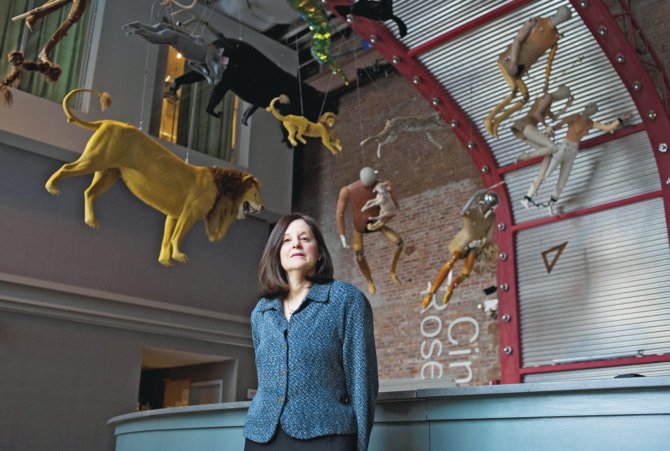
A five-foot-tall artificial stuffed deer greets Ms. DiChiara when she opens the door to her office.
“I call it my ‘yes, dear’ because it will nod its head up and down,” she says, demonstrating by flicking a switch. “I try to get my management staff to role model the deer, but it doesn’t work.”
She was invited to take the deer, and any other decorations she wanted, by a local mall that was upgrading its displays. “I don’t say no to anything,” says Ms. DiChiara, who hopes to earn money from the decorations by renting them to a nearby media production company. The rental plan is among many ideas Ms. DiChiara has to bring in extra revenue. In August, food-bank volunteers worked at concession stands during a Professional Golf Association tournament in New Jersey and raised $100,000.
After asking a colleague to turn down the thermostat to save money, Ms. DiChiara checks her e-mail.
The charity has been in its current location, a former Kraft Foods warehouse, for more than a decade. Ms. DiChiara’s office is comfortably cluttered with spindly plants, overstuffed bookshelves, and a wall of awards and photos.
On the conference table sits a statue of Eleanor Roosevelt given to her two years ago by her board. “The future belongs to those who believe in the beauty of their dreams,” reads Mrs. Roosevelt’s quote on the plaque.
“I’m a pragmatic dreamer,” says Ms. DiChiara. “I dream big dreams but I want to put legs on those dreams that reach all the way to the ground.”
A staff member brings her three checks to sign, including two pay advances for employees. About two-thirds of the food bank’s 83 employees are ex-convicts or recovering addicts, people who might not have large cash reserves if unintended expenses arise. Ms. DiChiara, who signs every check to keep an eye on costs, is willing to help out in a crunch, usually for amounts less than $200.
“We have food that is getting a second chance and these are people that needed a second chance,” she says of her decision to recruit such workers. “The word ‘community’ in our name has the same value out there as ‘food bank.’ We have to live internally the same values we purport to the outside world.”
However, the charity maintains a strict drug-testing policy. “I am very kind,” says Ms. DiChiara, “but I’m not stupid.”
Fund-Raising Challenges
After she answers a few phone calls, Ms. DiChiara, Ms. Leonard, and Richard Uniacke, who runs the charity’s children’s programs, meet at about 10:30 a.m. to plan for the gala in her honor. They watch an old music video about hunger that features the food bank as its background.
Against the wishes of the event planners the charity has hired, Ms. DiChiara wants the clip played during the gala.
“I don’t care if it’s dated,” she says. “It’s so direct to what we are talking about: Make it better for the children.”
She then frets about remembering to thank everyone at the event, including former neighbors who have helped raise hundreds of thousands of dollars for the food bank over the years and will be traveling from their home in Ireland to attend the event.
Gifts from individuals, corporations, and foundations make up nearly 60 percent of the group’s budget. Most of the remainder comes from fees the food bank charges charities that receive its donated goods, as well as fees charities pay to participate in a bulk food-buying program.
The food bank might be able to increase contributions by other means. But Ms. DiChiara does not like phone appeals or sending letter after letter asking for support.
“I had one group I used to contribute to — but by the time my thank-you note had arrived, oftentimes I got the second appeal days after that,” she says. “I thought, ‘Hey, this is a little too much.’”
The food bank relies on one or two annual appeal letters and a quarterly newsletter to reach donors; Ms. DiChiara writes the appeals herself as well as a column in the newsletter.
Back in her office, she prints out the menu for lunch, a meal which is prepared for the food bank’s workers three days a week by participants in the charity’s food-service training academy, which is open to ex-convicts and other people whose circumstances have made it hard for them to find jobs that pay decent wages.
“Like everything we do here, it provides multiple purposes,” she says. “It gives job trainers real cafeteria experience and we employ the working poor — it’s another way for them to stretch their dollar” by getting a free lunch at work.
Two professional chefs teach their adult students culinary, kitchen-safety, and sanitation skills to prepare them for entry-level jobs that pay at least $9 an hour and have benefits. The program, which has placed 119 people so far in jobs with restaurants, hotels, and hospitals also provides help with résumés, job interviews, and money management.
The students also prepare meals for the charity’s eight “Kids Cafe’s,” where children from low-income families receive free meals at their after-school programs.
Mid-morning, Ms. DiChiara makes her first foray onto the food bank’s sprawling roof. She plants a few muscari bulbs in a planter, digging through the dirt with her hands. In another of the dozen or so planters, pink flowers bloom.
Ms. DiChiara walks the roof a few times every day to clear her head, get a breath of fresh air, check on the drains, and pick up golf balls that have gone astray from a nearby course. The balls, which fill a few buckets by the year’s end, are cleaned up and sold through a raffle at one of the charity’s parties.
Ms. DiChiara returns to her office to wait for her lunch guest, Angela Wiggins, the new manager of community contributions at Kraft Foods, in Tarrytown, N.Y. Kraft donated $40,000, as well as more than half a million pounds of food, to the charity last year. When Ms. Wiggins arrives, Ms. DiChiara leads a tour of the facility.
One room she shows off is packed with donated school supplies, where teachers at 151 schools that serve poor children can come twice a year to get free items, and another holds racks of children’s clothes and jackets, donated by retailers and manufacturers. Charities that aid needy families can request five new childrens’ outfits twice a year, and food-bank volunteers sort through the clothes to pack them.
While walking through the warehouse Ms. DiChiara tells Ms. Wiggins about several new programs, including one that will send a backpack filled with food home with elementary-school students over the weekend. She also wants to develop a product, such as bread pudding, that the food bank will produce and market for profit. “I have a thousand ideas,” says Ms. DiChiara.
After a quick hello to the chefs in the training kitchen, Ms. DiChiara hands Ms. Wiggins a plastic tray and they choose among corned-beef sandwiches, minestrone soup, and honey balsamic chicken, as well as other options, to cart upstairs for lunch.
Usually Ms. DiChiara eats with Ms. Leonard and others on the administrative staff, but today her colleagues are finished by the time she arrives. Over lunch in Ms. DiChiara’s office, Ms. Wiggins asks what challenges lie ahead.
Ms. DiChiara mentions her desire to recruit officials from a more diverse range of companies to her board — many of the trustees come from the food industry — and start the Food Forever program.
She is also worried about donations this year, with rising heat prices and the spate of natural disasters, including Hurricane Katrina, that captured donors’ attention. Gifts to the group’s Check-Out Hunger program, an annual fall event where donors can add to their bill at local supermarkets and banks to support the food bank, dropped 30 percent so far this year. Donations from foundations and a mail appeal also slipped.
“Should we be worried? Yes,” says Ms. Leonard. “Some things we have tried year after year that have been our bread-and-butter are not reaching their goals.”
“Even people who are willing to give have given what they can this year,” says Ms. DiChiara. “If this is what is happening with us corporately, then I’m worried about the working poor, I’m worried about seniors.”
After Ms. Wiggins leaves, Ms. DiChiara picks up her mail and opens a letter with a $20,000 check from the F.M. Kirby Foundation, in Morristown, N.J. She’s excited until she learns the charity had requested double that amount. “Well,” she says with a smile, “we’re always nervy.”