March 26, 2009 | Read Time: 8 minutes
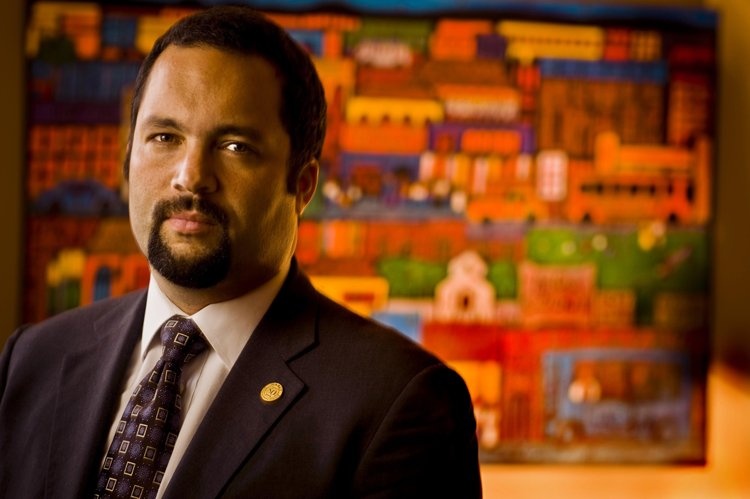
The National Association for the Advancement of Colored People celebrates its centennial this year. As it heads into its second century, the person the storied civil-rights organization has chosen to lead it is the charity’s youngest president ever: Benjamin Jealous, who is 36.
While a fresh face at the group’s helm, Mr. Jealous is no stranger to the organization or its mission. As a fifth-generation member of the NAACP, which maintains its headquarters in Baltimore, he participated in one of its voter-registration drives at age 14 in his native Monterey, Calif. As an NAACP intern during college, he served as a community organizer in Harlem and helped stop the closure of a local hospital. Both his parents were dedicated civil-rights activists in the 1950s and 60s; his father was even jailed for protesting at a segregated lunch counter.
“What comes with that kind of family history is the expectation that wherever you see a wrong to right, or where you see an opportunity to advance justice, you will invest yourself,” says Mr. Jealous, who started his job in September.
To his mind, the election of Barack Obama as the nation’s first black president is the culmination of decades of work by the NAACP and others to create equal opportunities for minorities. And while he says it is cause for celebration, Mr. Jealous is adamant that it doesn’t mean the work is done.
Indeed, when he surveys America in the 21st century, he sees blacks facing increasing disparities in housing, health care, and education, as well as what he calls “mass incarceration” — ills that collectively create a new form of segregation threatening hard-won advancements in racial equality.
“There’s a sense that we are experiencing an interrupted ascendancy,” Mr. Jealous says.
The new president also faces challenges within the NAACP itself, which was forced to lay off half of its staff early last year, following years of operating at a financial deficit. Longstanding plans to move the headquarters to Washington were put on hold because of costs. Even before assuming his post, Mr. Jealous spent months raising money to eliminate the deficit of more than $2-million.
Mr. Jealous’s predecessor, Bruce Gordon, a former telecommunications executive, resigned after serving less than two years, citing difficulties working with the charity’s 64-member board as one reason. And Mr. Jealous assumes the role with less than a mandate: A vocal minority of that board sought a more “traditional” leader for the group when they voted in May. Some critics said they felt a prominent minister would be a better choice.
The young president does bring with him a diverse background of social-justice work, including significant experience in the nonprofit world. A Columbia University-educated Rhodes scholar, Mr. Jealous has directed domestic programs for Amnesty International, in New York. Once a journalist, he led the National Newspaper Publishers Association, a trade group for black journalists.
Most recently, Mr. Jealous served as president of the Rosenberg Foundation, a grant maker in San Francisco that works to provide opportunities to needy people.
“Despite his youth, Ben Jealous possessed the necessary experience in social-justice work,” says Julian Bond, NAACP board chairman. “He was familiar with the nonprofit world and the foundation world. He had been an effective fund raiser for organizations similar to ours. And he was in tune with our mission and our history — this was an excellent match.”
Mr. Jealous would not disclose his annual salary. (Dennis Courtland Hayes, who served as interim president after Mr. Gordon left, earned $240,000 annually in 2007, according to the latest available IRS filings.) Mr. Jealous is in the process of moving his family from California to Baltimore, where he spent summers as a child visiting his mother’s family. In an interview, he spoke about his new duties.
Q: Why did you decide to take this position?
What kept coming up for me was that I have a 3-year-old girl. I had moved back home to California for her birth and began to look around. The schools were worse, the prisons were more overcrowded, the community colleges were in worse repair, and even the elite public universities were having problems. There was just a sense of unease and insecurity about whether she would be safe hanging out as a teenager. Ultimately, that sense of urgency and need to change the world before my daughter is completely out there on her own drove me back into frontline work and to seize this opportunity.
Q: How does your age factor into your leadership?
Well, as somebody in their mid-30s raising a child, I’m firmly invested in the crisis of now and very much focused on making change quickly.
I’m also part of a generation that had been told not to fight. My grandmother would say to me how her grandfather had helped end slavery and how she and my grandfather and my mom and dad had helped end Jim Crow. I had opportunities that nobody had in hundreds of years — go study hard and get rich.
That made a lot of sense in the 1970s and into the 80s, but then I saw increasing violence and friends joining gangs. By the time I was 20 years old it was clear that my peers and I were coming of age just in time to find ourselves the most murdered generation in this country and the most incarcerated on the planet. If I listen to my grandmother talk about black history, it sort of always gets better. But if you ask one of my peers, you often get a different story.
Q: What have you done to win over those board members opposed to your selection?
I had the unanimous support of the executive committee, which is 17 people in the board and a powerful footing. Suffice it to say I’m not the first NAACP president to not have complete support among 64 people when they were selected.
We are a highly democratic organization and both encourage and reward people really making their case strongly. When somebody comes at you yelling about anything, you really have to accept it as an invitation from one person who cares very deeply to have a constructive conversation. That’s what I spent my summer doing. And we are at a very different, stronger place than when we started — as evidenced by the fact that we ended last year well into the black financially, and frankly, in the black for the first time in the last four years.
Q: How did you confront the charity’s financial challenges?
We had become somewhat estranged in recent years from traditional philanthropy. You look at the number of grants we were receiving from foundations in the 1970s and 80s versus in the 90s and 2000, and it was headed in the wrong direction. So one of the very quick things I did was let former colleagues in the foundation world know there was a new sheriff in town and invite them to help me change that culture. We were able to raise about $4-million just over the summer.
Q: How might the recession shape the NAACP’s work over the next few years?
As far as our work in the field, we’ve been calling for a moratorium on foreclosures for three years now. This work has kicked up a notch and expanded. We are suing 17 banks right now — not for damages, just to change their behavior of taking blacks with good credit and assets and pushing them into higher-interest and even subprime loans.
Q: You’ve already met with President Obama in the White House. Do you foresee good access to his administration?
Yes, that’s been free and forthcoming, and to [Vice President] Biden as well. Biden pulled me aside for 10 minutes to talk about the way local NAACP members in Wilmington [Del.] had helped create the foundation for his entire career. That’s just a type of access that frankly no other organization can claim.
Q: Is relocating the organization’s headquarters to Washington still a possibility?
It’s definitely still talked about. I have to be careful about what you make the priorities and how you spend money in this economy. Washington is still a much more expensive town than Baltimore. I guess like every other prospective homebuyer in the country, we’re sort of in a wait-and-see mode right now.
ABOUT BENJAMIN JEALOUS, PRESIDENT, NATIONAL ASSOCIATION FOR THE ADVANCEMENT OF COLORED PEOPLE
Previous employment: Mr. Jealous was president of the Rosenberg Foundation, in San Francisco, from 2005 until May of last year. From 2002 to 2005, he was director of domestic programming at Amnesty International, in New York. He spent several years in journalism, as a reporter and managing editor at The Jackson Advocate, a weekly newspaper in Mississippi, and as head of the National Newspaper Publishers Association, a federation of more than 200 black community newspapers. He has also worked as a program director for the National Coalition to Abolish the Death Penalty and a student organizer for the AFL-CIO.
Education: Earned a bachelors degree in political science from Columbia University in 1996 and a masters degree in comparative social research from Oxford University in 1998.
Hobbies: Skiing, hiking, biking, and reading.