
National Service, Once a Hot Campaign Topic, Now Gets Little Attention

By SUZANNE PERRY
Contributor
September 16, 2012 | Read Time: 5 minutes
The 2008 presidential campaign was full of talk about public service and volunteering.
Democrat Barack Obama proposed a detailed plan to more than triple the size of the national-service program AmeriCorps, double the size of the Peace Corps, recruit older volunteers, expand student community-service programs, and create a Green Job Corps for troubled young people and a Global Energy Corps to help other countries reduce greenhouse-gas emissions.
Republican John McCain vowed to create a White House Service to America office to streamline national-service efforts, hold “volunteerism summits” where people could share information about effective programs in their areas, and get more students participating in the Federal Work-Study program to do community service.
This year?
The candidates have virtually ignored the issue.
Reticence on Both Sides
During the first 100 days of his presidency, President Obama signed the Edward M. Kennedy Serve America Act, which called for a big expansion of AmeriCorps and introduced several new programs to help nonprofits.
But since Republicans assumed control of the House of Representatives in 2010, he has had to spend much of his energy fighting off their efforts to kill AmeriCorps and the federal agency that manages it, the Corporation for National and Community Service.
The Democratic Party platform hailed the Serve America Act. But Mr. Obama’s campaign Web site does not mention the law or national service, and he has not said much about them on the campaign trail.
His Republican challenger, Mitt Romney, has been supportive of national service, but that might surprise many voters since he rarely talks about it.
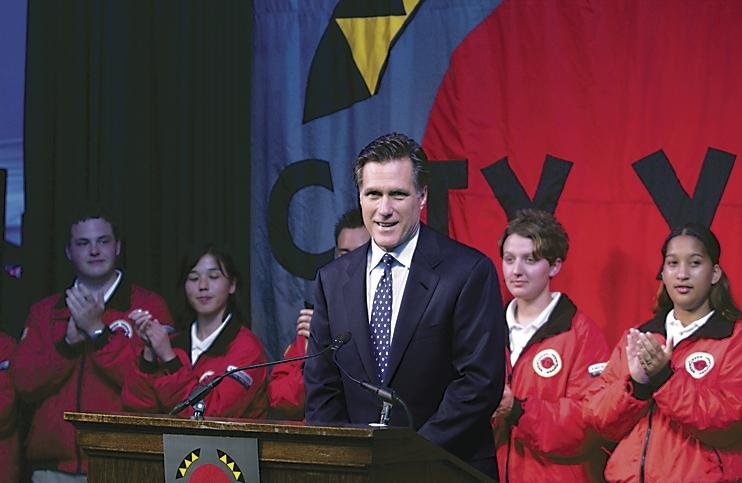
From 1995 to 1999, he served on the board of City Year, a Boston group that recruits young people to tutor, mentor, and provide other help to public schools.
That group was a model for President Clinton when he created AmeriCorps, a federal program that gives young people a small stipend and education grant to work up to a year at a nonprofit or public agency.
Michael Brown, a co-founder of City Year, recalls that Mr. Romney pitched the idea of a federal program to Mr. Clinton during the 1992 presidential race. He was then chief executive of Bain & Company, a management-consulting company that was a big City Year donor. (A spokeswoman for Mr. Romney, Andrea Saul, did not respond to a question asking her to confirm that information.)
When AmeriCorps faced a fiscal crisis in 2003, Alan Khazei, City Year’s other co-founder, says he turned to Mr. Romney, who was then governor of Massachusetts, for help.
“I was talking to him almost daily,” he recalls.
Mr. Romney and Edward Rendell, then the Democratic governor of Pennsylvania, led an effort to get governors to sign a letter asking Washington for emergency aid for the program. The letter, signed by 43 state leaders, said a proposed cut in AmeriCorps members “could seriously affect communities and individuals” who rely on the program for help.
Mr. Romney, who Mr. Brown says has also personally donated to City Year for 20 years, does not include any information in his current official biography about his ties to the group, nor has he signaled what policy he would adopt toward AmeriCorps as president.
When asked about the federal program at a campaign event last December that was captured on video, he did not volunteer information about his support as governor.
He said that City Year was financed “exclusively through charitable contributions” when he was on the board (the program actually was receiving AmeriCorps money at that time) and that he believed “we should keep this as a privately funded, charitably funded effort.”
He added that as governor, he advocated the philosophy that “people should do these things on their own rather than having us tax them to give to the charities of our choice.”
A Move to the Right
Mr. Romney and his wife, Ann, both have other charity ties. He served on the board of the Points of Light Foundation, which incorporated the National Volunteer Center—an organization headed for many years by his father, George—from 1995 to 2001.
Ann Romney has served on numerous charity boards, including the Greater New England Chapter of the National Multiple Sclerosis Society and the Massachusetts Children’s Trust Fund.
The candidate’s reticence to discuss national service and other spending that benefits nonprofits could be a sign of the political times.
The Republican Party has moved to the right since the last election, especially on budget issues—and many conservative Republicans have opposed AmeriCorps from the start. Mr. Romney’s running mate, Wisconsin congressman Paul Ryan, has proposed killing the program as House Budget Committee chairman.
When asked about Mr. Romney’s plans for national service, Ms. Saul sent links to several articles, including one from American Thinker praising the candidate for personal acts of kindness that were recounted at the Republican National Convention, his charitable giving, and his City Year service.
Adam Fetcher, a spokesman for Mr. Obama, sent an 11-page document outlining the president’s national-service accomplishments, including providing money for AmeriCorps in the economic-stimulus law and creating a White House Council for Community Solutions to recommend ways to mobilize citizens, nonprofits, and the government to resolve social problems.
But John Bridgeland, a Republican who was director of USA Freedom Corps, a volunteer program, under President George W. Bush, is disappointed that national and community service—traditionally a bipartisan issue— has not gotten more attention in the campaign.
“The candidates do need to ask something of the American people,” says Mr. Bridgeland, now chief executive of Civic Enterprises, a public-policy firm, “particularly in tough fiscal times where the pressures on the budget are going to be so enormous that the nonprofit and citizen response has to be ramped up.”
Suzanne Sataline contributed to this article.




