
New Salvation Army Leader Confronts Stretched Resources and Thin Ranks

By Alex Daniels
Contributor
September 22, 2013 | Read Time: 6 minutes
Some people first learn about the Salvation Army at a time of need, when they receive a bundle of clothing from the charity. Others are reminded about the group’s mission at Christmastime when they hear volunteers ringing bells at shopping centers during the group’s “red kettle” fundraising drives.
David Jeffrey, the charity’s next national commander, was introduced to the Salvation Army through a pool-hall hustle.
The son of a coal miner, Mr. Jeffrey grew up “out in the sticks” in Mount Morris, Pa., a small town near the West Virginia border. One day, the 15-year-old was playing pool in nearby Morgantown when the local Salvation Army corps officer made him a bet: If the teenager lost, he would have to come preach at the officer’s church.
“Once I shot and missed, he cleared the table,” Mr. Jeffrey recalls.
His encounter with the pool shark introduced him to both the charity’s mission of spreading the Christian gospel and the group’s work feeding the poor and helping people overcome addiction. Five years later, Mr. Jeffrey began working full time for the Army, which provides social services in 126 countries.
Beginning in November, Mr. Jeffrey, 62, will lead the group’s efforts in the United States, overseeing 3,300 officers and 64,000 employees who work in the Army’s 7,500 treatment centers, stores, and camps.
Among his challenges: attracting a new generation of officers, a task that has proved more difficult than the game of pool that led Mr. Jeffrey to join the organization.
Lean Resources
During the recession and the slow recovery that followed, the Salvation Army saw its resources stretched to the limit, just as needs spiked. In 2011, for instance, four in five of the programs it runs for young people faced increased demand. But because of lean budgets, 42 percent of those programs made cuts in services.
The tight resources stem from the Salvation Army’s rocky fundraising during and after the recession: It has suffered declines in donations for three of the past five years. In 2012, the group reported $1.7-billion in donations, down 6.1 percent from the previous year.
The charity has also seen a thinning of its ranks. Over the past decade, it’s been harder to attract staff members. In 2012, the group reported it had 3,555 people who ran and managed local offices, a steep drop from the 5,443 it had in 2002.
One obstacle to recruitment: The Salvation Army and other faith-based charities serve a public that considers itself less religious than Americans in previous eras. About 20 percent of all adults surveyed in 2012 by the Pew Research Center said they were not affiliated with a religious institution; among adults under 30, nearly one in three said the same. In 1972, roughly the time Mr. Jeffrey’s career began, only 7 percent of Americans told Pew researchers they had no faith affiliation.
Another reason for the drop in new officers, says William Roberts, Mr. Jeffrey’s predecessor on the job, is that the Salvation Army’s “autocratic” structure doesn’t appeal to everyone.
“Young people are inclined to service,” Mr. Roberts says. “They see the need, but they don’t want to tie themselves to an organization for life. The Salvation Army is very structured, very hierarchical. That doesn’t appeal to today’s generation.”
Mr. Jeffrey will be able to inspire and motivate new recruits because of his dedication to the charity’s overarching Christian principles, predicts Dale Jones, vice chairman of the executive-search firm Heidrick & Struggles and a member of the Salvation Army’s National Advisory Board. His commitment to religious principles could also help the organization attract donors, Mr. Jones says.
“When people give, they want to know the leader of the organization is a steward of the group’s historical mission,” he says.
Easing Into Service
For his part, Mr. Jeffrey says, his dedication to the Salvation Army and its spiritual message is best summed up in U.S. Army General Douglas MacArthur’s 1962 talk to West Point cadets. He told them: “When I cross the river, my last conscious thoughts will be of the corps and the corps and the corps.”
But Mr. Jeffrey allows that not all potential Salvation Army officers will feel that inspired right off the bat. To encourage people to give the charity a try, he said the organization will focus on “sprint” events—getting together to plant an orchard, for instance—rather than promoting lifelong service.
And for those thinking about becoming an officer, they don’t have to make a commitment right away, says the new national commander.
Mr. Jeffrey says the group’s “730 days” campaign—named for the number days a new staff member trains before becoming what the group calls an officer—gives potential leaders in the organization a smaller, more manageable commitment to focus on than a lifetime calling.
The organization created a “730-days” Facebook page to promote its training programs, along with YouTube videos featuring cadets who tell viewers about the experience they’ve had with the group.
Providing counseling for officers to help them deal with the rigors of service can help retain staff. Officers who work directly with disaster victims, the poor, and the hungry often suffer burnout, says Ben Brown, co-author of Leadership Secrets of the Salvation Army.
“They experience failure every day,” he says. “It’s a very stressful way to live.”
To help alleviate stress, Mr. Jeffrey said he will emphasize the counseling resources available to officers and clearly indicate to the charity’s employees that quality-of-life issues need to be addressed.
Given the Salvation Army’s military-like structure, Mr. Jeffrey says, he expects results.
“Make your expectations clear,” he says. “If I as a leader talk about applesauce, that’s just what I’ll get.”
Raymund Flandez contributed to this article.
David Jeffrey, national commander, Salvation Army
Education: Associate’s degree, general studies, Hagerstown Community College, Md.; bachelor’s and master’s degrees, religion, Liberty University Career highlights: A 42-year career at the Salvation Army, including roles as national chief secretary and chief operating officer for national headquarters. Since 2011, he’s served as the territorial commander for the Southern territory.
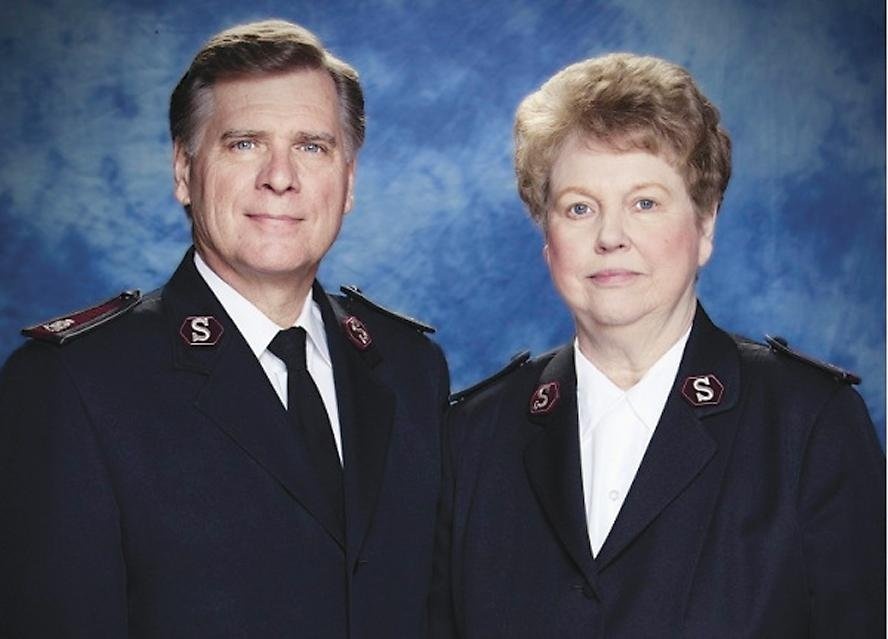
Salary: Mr. Jeffrey and his wife, Barbara (pictured), who will serve as the charity’s national president of women’s ministries, receive a yearly “allowance” of $112,000, which amounts to their combined salaries as well as the value of what they would pay in rent per year at the home provided for them.
What he’s been reading: Bishop: The Art of Questioning by an Authority in Question, by William H. Willimon; Give Smart: Philanthropy That Gets Results, by Thomas J. Tierney and Joel L. Fleishman; Stonewall Jackson and the American Civil War, by G.F.R. Henderson; It Worked for Me: in Life and Leadership, by Colin Powell.







