
Nonprofit Groups Expect Financial Woes to Continue Even as Need for Services Grows

By SUZANNE PERRY
Contributor
March 21, 2010 | Read Time: 3 minutes
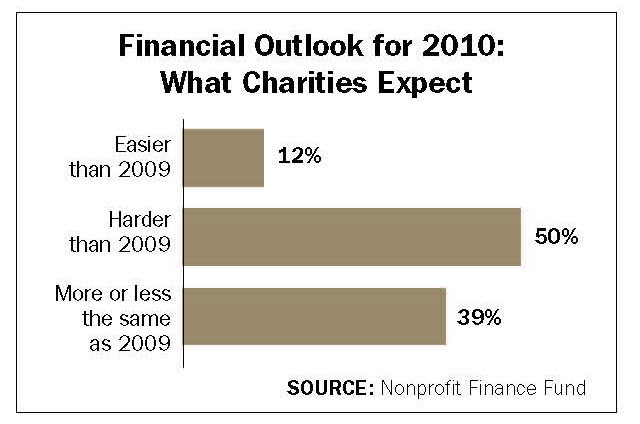
Nonprofit groups are still reeling from the economic downturn—and for many of them 2010 will be even tougher than 2009, a survey to be released this week finds.
Half of the groups surveyed expect their financial outlook to worsen this year, only 18 percent expect to end the year with a surplus (compared with 35 percent in 2009), and less than half believe they will be able to meet a growing need for services.
The survey of more than 1,300 charity leaders, conducted by the Nonprofit Finance Fund, also found that 61 percent have less than three months of cash available and 12 percent have no reserves whatsoever.
“The economic recovery hasn’t yet reached people in need and there are more people in need than in good times,” said Clara Miller, president of the Nonprofit Finance Fund, which offers consulting services and loans to nonprofit groups. “It hasn’t reached the people who serve them. We’ve got to focus on the business needs of those organizations in this environment.”
At the same time, she said, nonprofit groups are making valiant efforts to adapt to the hard times so they can continue helping people in need. “I think it’s time they got some respect for their financial management and ability and resourcefulness,” she said.
Emergency Measures
The survey, which was conducted from January 20 to February 19, found that 52 percent of organizations had collaborated on programs with another organization in the previous 12 months. Forty-eight percent had frozen hiring and salaries, 44 percent had developed a contingency budget, 39 percent had relied on more volunteers, 35 percent had cut jobs or salaries, and 34 percent had used money from their reserves.
Some had also reduced or ended programs (36 percent), but others had added or expanded them (43 percent).
Many organizations are bracing for lower revenue in 2010, especially from the government. Reflecting in part the toll the recession has taken on many state budgets, 59 percent of the organizations that receive government money said they expect to get less this year.
Slightly more than one-fourth of the groups said they had received economic federal-stimulus money, and 46 percent of those said they will not be able to replace it with money from other sources.
Cutbacks in government spending are particularly hard on “lifeline organizations,” those that offer critical services to people in need, Ms. Miller said, since such money often makes up 75 percent to 90 percent, or even more, of their revenue.
Most “lifeline” groups, which made up 40 percent of those surveyed, said they expect 2010 to be more difficult financially for both their clients (68 percent) and their own organizations (56 percent).
More than half (55 percent) of the groups that receive foundation, United Way, or federation grants also expect that money to shrink in 2010, while 44 percent expect declines in their —compared with 44 percent their corporate gifts, and 23 percent in the money they receive in fees, ticket sales, and other so-called earned income. They are more optimistic about individual and board gifts: only 23 percent think those will fall, compared with 49 percent who expected that last year.
More Cutbacks
Meanwhile, a big majority of those surveyed (71 percent) reported increased demand for their services in 2009—and that was on top of the increased demand that 73 percent of those surveyed last year said they experienced in 2008. Eighty percent of those participating in the new survey said they expect demand to increase once again in 2010.
Some groups plan to cut back further in 2010, but at a lower rate than in 2009: 23 percent plan to reduce or end programs, 26 percent to freeze hiring and salaries, and 14 percent to cut jobs or pay.
Ms. Miller said policymakers should consider adopting measures to help nonprofit groups get through the economic hard times, for example by creating a temporary tax break for people who make gifts to charities that work in neighborhoods with large numbers of poor people, improving access to credit for charities, and introducing less cumbersome -expensive government procurement, regulatory, and audit processes so groups can save money on overhead costs..
The survey results are available on the Nonprofit Finance Fund’s Web site.




