Nonprofit Groups Hope Film Will Stir Public Passion for Improving Schools

By Ben Gose
Senior Editor
July 11, 2010 | Read Time: 5 minutes
Seeking to stir public fervor for policies to improve schools, many foundations, corporations, and charities are pouring money into a campaign to call attention to a new documentary on education by the director of An Inconvenient Truth, a film that transformed how many Americans think about climate change.
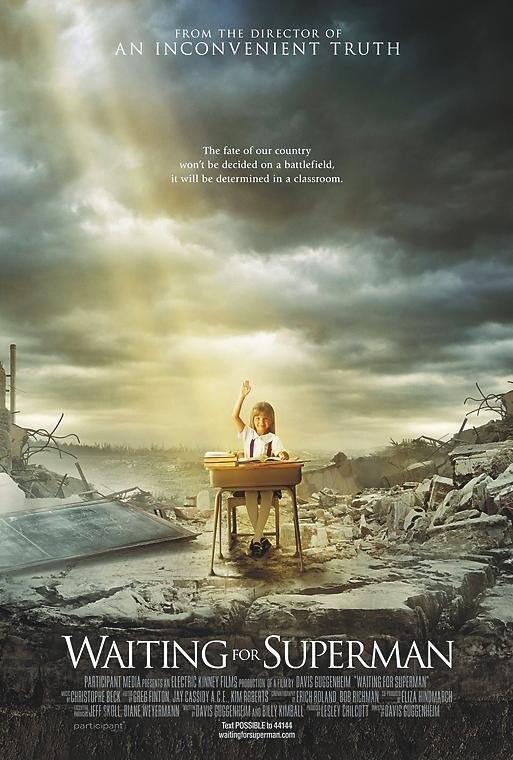
The new movie, Waiting for Superman, by Davis Guggenheim follows five children and their families in California, New York, and Washington as they go through a lottery system to try to get into high-achieving charter schools.
Each of the five lives in an area with public schools with poor track records when it comes to student test scores and other measures.
The movie, like the Academy Award-winning An Inconvenient Truth, was made by Participant Media, a for-profit company started by the philanthropist Jeffrey Skoll (former president of the online auction site eBay).
Walden Media, a film company started by the philanthropist Philip Anschutz, is a partner in the film. Paramount Vantage bought the film, which is currently on the festival circuit, and will place it in theaters in September.
Encouraging Action
Visitors to the film’s Web site are encouraged to sign a pledge to see the movie. First Book, which distributes free books to children in thousands of cities and towns in the United States, will donate 250,000 books when 50,000 people pledge to see the film.
Jim Berk, chief executive officer of Participant Media, believes the experience will prompt many viewers to want to do something, and has designed a campaign that taps those feelings while they are fresh.
As the credits roll, the movie will urge viewers to go to the film’s Web site or to send a text message with their cell phones to get more information.
“We don’t want people to have any barriers to getting involved at the end of the film,” says Wendy Cohen, who is managing the online strategy for the social-action campaign. “You’re emotional and you’re angry. This is a way to get them at their most impassioned moment.”
As an example, the movie’s Web site features a “Help a School” link, giving visitors a way to find volunteer opportunities or make a gift toDonorsChoose, a site that posts classroom projects organized by teachers and in need of financial support.
“Just as your easy first step on climate change was to change your lightbulbs to compact fluorescents, one of the easy steps on education is to support a great classroom project,” says Julie Lacouture, director of program expansion at DonorsChoose.
A second link, “Fix the System,” allows visitors to write a statement of support for the Common Core State Standards Initiative, a set of national standards that many states are considering adopting, or see how their own state did during the first phase of the federal Race to the Top grant competition.
The site will feature a series of blogs about education, with content provided by schools and charities.
Citizen Schools, a provider of after-school programs that relies heavily on adult volunteers, is planning to contribute to the blogs. “Volunteer recruitment is something we’re doing year-round,” says Stacey Gilbert, a spokeswoman for the charity. “We’re hopeful that this can help us.”
‘Incomplete’ View
Waiting for Superman features some well-known figures in the education-overhaul movement, including Geoffrey Canada, president of Harlem Children’s Zone, and Michelle Rhee, chancellor of the District of Columbia Public Schools.
Even Randi Weingarten, president of the American Federation of Teachers, who is cast as the antagonist in the film, is helping to promote it.
She participated in a panel discussion after a screening in Washington last month because she views the film as a “call to action” that could help improve public education.
That doesn’t mean she likes Mr. Guggenheim’s vision.
“The disappointment I have in the movie is that it is incomplete to the point of inaccurate in that it shows not one good public school, and there are thousands and thousands in this country,” she says.
Several foundations that have long supported education-improvement efforts and charter schools—including the Bill & Melinda Gates Foundation, the Doris & Donald Fisher Fund, the Eli and Edythe Broad Foundation, and the Walton Family Foundation—have agreed to support the film’s advocacy campaign, although no grants have yet been made final. Bill Gates is featured in the film, and he praised it at the Sundance Film Festival in January.
“There will be a very emotional response to this film, and that’s aligned with our long-term strategic interests,” says Greg Shaw, advocacy director for the foundation’s U.S. program. “The film tells in a compelling way that we could never do, the importance of an effective teacher and the importance of improving our school system.”
Get Schooled, a project started by the Gates foundation and Viacom, will also support the campaign, according to Mr. Berk. He says foundation giving “will be in the many millions,” with additional support from corporate sponsors like American Express.
“Until we get millions of people to demand a better education system for public-school students, nothing is going to change,” Mr. Berk says. “We want to make sure this becomes at the center of people’s pool of worries.”
Seeking Donors
The biggest beneficiaries may be the five charter schools featured in the film, including the Seed School, of Washington, operated by the Seed Foundation, a D.C. charity. One of the five students in the movie is trying to get into the Seed School, a boarding school that has a 92-percent graduation rate, nearly three times as high as the public high schools in the poor neighborhoods where Seed recruits students, according to Eric Adler, the charity’s co-founder and managing director.
Mr. Adler says he hopes the film encourages more donors, talented teachers, and volunteers to take a closer look at Seed.
Mr. Guggenheim, who declined an interview request, has his own part in the movie, in which he says he was motivated to make the film out of a feeling of injustice he had each day as he drove past a sub-par public school in his neighborhood to take his kids to a private school.
The name of the movie comes from a story told by Mr. Canada, who grew up in a poor and sometimes dangerous neighborhood in South Bronx and thought Superman would save him, until his mother told him no superhero would be coming.
The metaphor, say supporters: There’s no easy cure for the problems in public schools. The task can only be accomplished when Americans muster enough public will.