
Nonprofit Leaders and Fundraisers Call For Greater Diversity

By Timothy Sandoval and Rebecca Koenig
September 14, 2017 | Read Time: 4 minutes
Charity leaders and fundraisers called on nonprofits to build more diverse staffs and do more to engage donors from a wide variety of backgrounds at The Chronicle’s Philanthropy NEXT conference, a gathering that tackled race, gender, and sexual orientation in philanthropy.
Nonprofit leaders must be honest with themselves about how well their organizations have grappled with diversity, some speakers said at the gathering, which was held on Thursday.
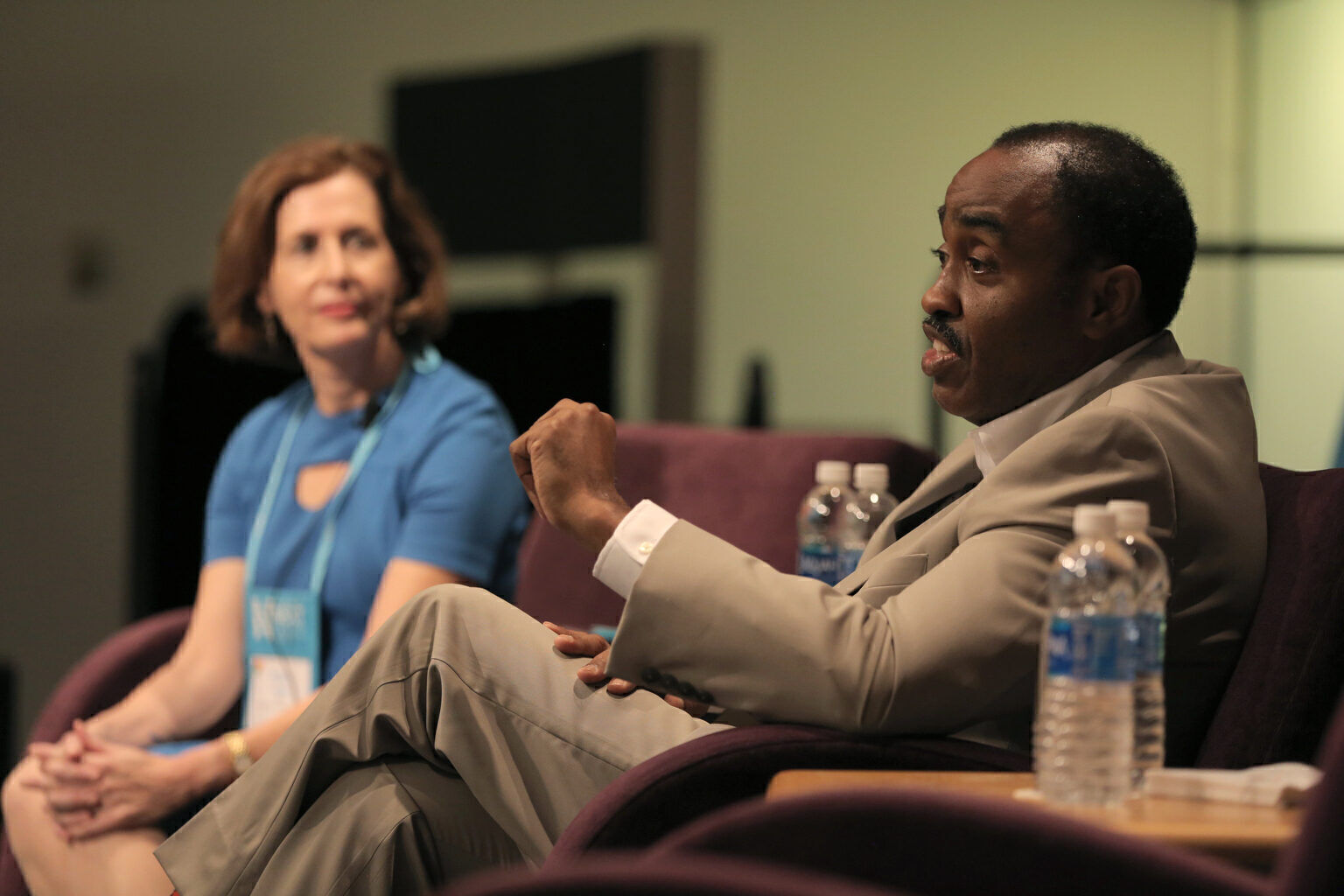
“We suffer from the same ills as the country,” said Emmett Carson, chief executive of the Silicon Valley Community Foundation, in a morning conversation with The Chronicle’s editor, Stacy Palmer.
Asked whether nonprofits had been effective advocates for “diversity and inclusion,” Mr. Carson was blunt: “No.” He argued that the same types of implicit biases that are rampant throughout society often infect nonprofits.

Those biases are evident in fundraising, he said: “We walk into the room with a certain set of assumptions about who gives how much.”
To be more inclusive, organizations need to have an open dialogue about diversity and race, he said. He added that making a nonprofit’s culture more inclusive starts with board members and executive directors.
If a nonprofit’s top leaders aren’t diverse, “the community is going to question that commitment,” he said.
Getting Started
Taking steps to reach out to people from different racial and ethnic backgrounds will be critical as the country’s demographics change and people of color, rather than whites, make up the majority of the population. It’s also important as the country struggles with increasing racial mistrust and resentment, speakers said.
Experts at the conference offered advice on how nonprofits can improve their outreach and fundraising with emerging donors:
Diversify leadership. If a nonprofit has diverse leaders, the group will take inclusion more seriously, some speakers said. A board that is homogeneous lacks much-needed perspective.
Many Lincoln Center trustees “did not believe donors would give $50 million to an endowment for jazz” but “would give to the opera and the ballet,” said Dwayne Ashley, former vice president for development at Jazz at Lincoln Center who now leads Bridge Consulting. He had to work to persuade them, he said. With a more racially diverse board, that might not have been an issue.
Know your donors. Speakers also discussed how best to speak to diverse donors. Some suggested that nonprofits start logging information about their supporters’ backgrounds to better communicate with them. That might include information about their race, ethnicity, religion, or preferred gender pronoun.
“We as higher-education and nonprofit institutions just have to be better about acknowledging that our donors are different,” said Isaac Thweatt, executive director of individual giving at the Columbia Business School in a morning session.
He noted that lately he’s seen more students specify which gender pronouns they prefer.
Consider millennials’ expectations. Fundraisers need to pay special attention to generational differences, said Mr. Carson, of the Silicon Valley Community Foundation, especially in a fundraising landscape that is changing constantly due to technology. His donors, many of whom are engineers and computer programmers who became rich at a young age, expect to see evidence that proves an organization’s success.
“They want to know impact, scale, how many, and how come,” he said. “They’re engaged to an extent that people of my generation find uncomfortable.”
To communicate with and raise money from young donors, hire millennials who understand how to talk to them — especially online, Mr. Carson says: “You gotta make investments in hiring young people who are digital natives. Gotta give them some latitude to make you uncomfortable and also fail.”
Young donors also expect to be able to give seamlessly through mobile devices and websites, said Felicity Meu, who works at the Stanford Effective Philanthropy Lab. The maximum amount of time young donors want to spend making a gift online or by cellphone: 90 seconds.
Get diverse donors engaged. Another way nonprofits can attract young and diverse donors is to get them involved. In 2012, LatinoJustice, a civil-rights and advocacy group in New York, started its “Líderes Board,” a group of young lawyers and other professionals who helped shape the organization’s programs and raise money, said Diana DeJesus-Medina, director of development.
The “junior board,” as she called it, has helped the group attract more individual donors and develop new educational events that help it court new supporters.
Members have also done some limited direct fundraising and have given themselves. In 2016, members of the Líderes Board donated $6,500 and raised $9,500. They’ve also helped foster relationships with laws firms that offer pro bono legal advice, she said.
Still, the biggest value of the board is building relationships with skilled young people, some of whom may join the official board down the line, Ms. Dejesus-Medina said.
“It’s an investment,” she added. “You have to spend a little time and money to get this to work, but the payoff is huge.”




