
Nonprofits Find Delicious Opportunities in the Food-Truck Craze

By NICOLE WALLACE
Features Editor
November 13, 2011 | Read Time: 5 minutes
The first day the Sixth & Rye food truck took to the streets of Washington selling kosher fare—smoked-corned-beef sandwiches, couscous salad, loaves of challah bread, and crisp dill pickles—the line wrapped around the block. Workers eventually had to turn people away.
With the popularity of street food soaring, it’s not an unusual story, except that the food truck is run by the Sixth & I Historic Synagogue, a Washington nonprofit that serves as both as a place of worship and a sponsor of arts and culture programs.
“We are a very open, inviting, and welcoming space, but we know that we can’t reach everyone by having everyone come to us,” says Jackie Leventhal, director of cultural programming and communications at the synagogue.
“This was an effort for us at going beyond the walls of our building and meeting constituents where they are—and, in this case, on their lunch hour.”
Sixth & I is one of a small but growing number of charities that are taking advantage of the popularity of food trucks to help fulfill their missions. Organizations concerned about access to healthy food in poor neighborhoods are creating mobile farmers’ markets. Economic-development groups are eyeing food carts as an entry-level business for first-time entrepreneurs.
Foreign Connections
The American Refugee Committee, an international-development organization based in Minneapolis, is even considering a Somali-food truck. The charity thinks food and culture is one way to help residents of the Twin Cities connect with the faraway nation and to encourage them to donate to relief efforts in the Horn of Africa, says Therese M. Gales, the group’s spokeswoman.
As a first step, the organization, which is located in a city with a large number of Somali immigrants, held a cooking competition this summer at which five chefs battled for recognition for the best sambusa, a savory stuffed pastry popular in Somalia. The event drew a diverse crowd of more than 400 people.
So far, groups that have started food trucks aren’t looking to them as a way to make money.
Sixth & Rye sales have come close to meeting operating expenses, but the synagogue used a $25,000 grant from the Natan Fund, a New York grant maker, to pay for start-up expenses, including the cost of renting a truck for the program’s weekly runs.
“Without them, we could not have done this,” says Ms. Leventhal.
The truck has finished its six-month test run. Over the winter, leaders of the synagogue will discuss the experiment and decide whether to continue it next year.
Food trucks are a great way to draw attention to a cause, says Sam Giese, who coordinates City Greens Produce, a farmers’ market run by Catholic Charities Midtown Center, in St. Louis.
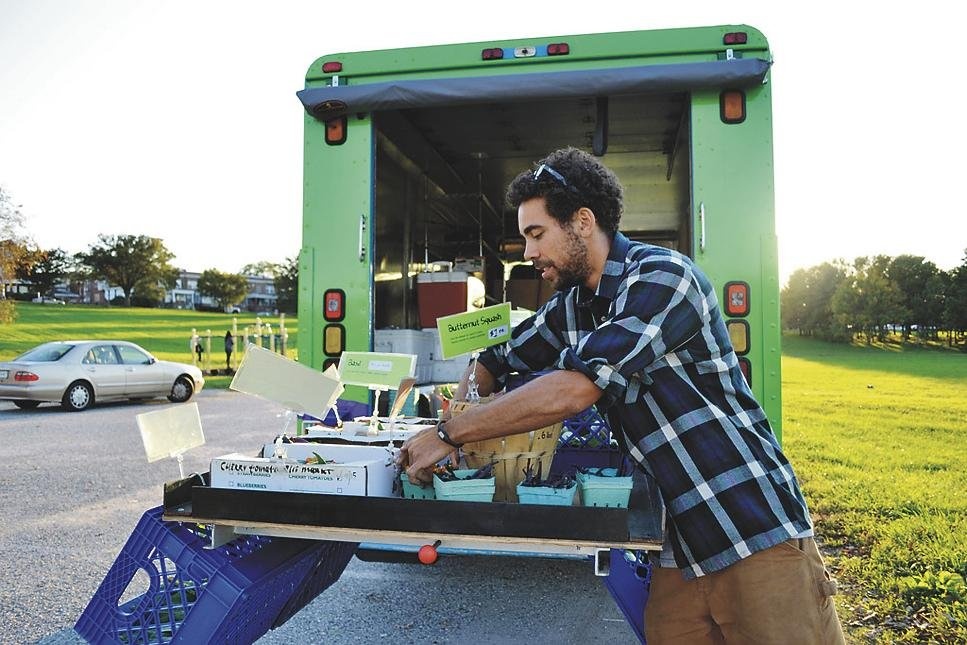
The organization’s vibrant, almost lime-green Supa’ Fresh Veggie Mobile hit the road in June, taking fresh produce, eggs, and meat to midtown neighborhoods.
“People who are walking by or driving by see the market for the first time tend to be like, ‘Whoa, what’s going on here? This looks like fun,’” says Mr. Giese.
With money tight, nonprofit food trucks are often bootstrap affairs.
The mobile market created by the Real Food Farm, an urban-agriculture program run by Civic Works, a nonprofit in Baltimore, started its life as a Washington Post delivery truck. The group found it through an ad on Craigslist. “It still had the faded Washington Post decal on the back of the truck,” says Maya Kosok, a program manager at the charity.
Students at the Maryland Institute College of Art gave the truck a makeover, and because the group has a tight budget, Ms. Kosok’s father helped out with construction.
In July, the truck started making rounds in neighborhoods near the farm. A month later the organization began making home deliveries for orders of at least $10. Employees stress to customers that several people can chip in together to meet the minimum order. As a result, says Ms. Kosok, some customers have become the “spokesperson on their block,” drumming up interest in the farm’s fruits and vegetables.
The organization has also learned that it’s important to go to the right place at the right time, such as parking near an elementary school at dismissal time, when parents are picking up their kids, says Ms. Kosok.
“There’s a flurry of activity around the school during this crucial half-hour, so it makes our time there a lot more effective,” she says.
Building Entrepreneurs
Economic-development charities see the sale of street food as a way for low- and moderate-income entrepreneurs to get a toehold in the food business.
“The point of entry into a food cart is quite inexpensive,” says Inna Kinney, chief executive of the Economic and Community Development Institute, in Columbus, Ohio. “You could get into a used food cart for $5,000 to $6,000, $7,000.”
Food-related businesses account for roughly a quarter of the ventures Ms. Kinney’s group helps start. This spring, the organization opened the Food Fort, an 8,000-square-foot incubator for food businesses, which also serves as a licensed commissary where entrepreneurs can park their food carts and trucks overnight.
With a combination of government grants and other funds, the Economic and Community Development Institute purchased eight carts in a variety of sizes, which it is renting to entrepreneurs. The group is considering whether to start its own food-cart business.
“It would be like a teaching kitchen on wheels,” says Ms. Kinney.
La Cocina, a nonprofit in San Francisco, was founded in 2005 to help low-income immigrants start food businesses. Since the city changed its permitting process to make it easier to run food trucks, the organization has helped several clients start mobile food businesses.
The charity’s clients are in a good position to thrive even after the current street-food craze cools, says Leticia Landa, programs manager at La Cocina. “Maybe if there’s a fifth cupcake truck, that’s not going to be viable,” she says. “But somebody’s who doing regionally-specific Mexican food or really fantastic Nigerian food or Ethiopian food, there’s enough pull in terms of the type of cuisine being something unique that you can’t find anywhere else.”





